Sunday, August 14, 2016

Larval Host Plant for Butterflies: Sea-Shore Ardisia

Butterflies' Larval Host Plants #11
The Sea-Shore Ardisia (Ardisia elliptica)


This 11th instalment of our Butterflies' Larval Host Plants series features Ardisia elliptica, a species in Primulaceae (primrose family). This family of flowering plants has close to 3000 species and include a number of garden plants and wild flowers. The genus Ardisia (coralberry or marlberry) has about 400 odd species which occur in either tree or shrub forms.

A flowering Ardisia elliptica.

A fruiting Ardisia elliptica.

Ardisia elliptica is native to India, Sri Lanka, South East Asia and New Guinea. Over the years, it has been introduced to other tropical regions as ornamental plants. In Singapore, it is readily found as cultivated plants in various parks and gardens. Due to its ability to reproduce prolifically, wild specimens in tidal swamps, nature reserves and wastelands are not uncommon too.

An Ardisia elliptica plant in the Chinese Garden in Jurong.

Plant Biodata:
Family: Primulaceae
Genus: Ardisia
Species: elliptica
Synonyms: A. solanacea, C. humilis
Country/Region of Origin: India, Sri Lanka, South East Asia and New Guinea
English Common Names: Sea-Shore Ardisia, Shoebutton Ardisia
Other Local Names:  Mata Pelanduk, 兰屿树杞 , 东方紫金牛
Larval Host for Butterfly Species: Taxila haquinus haquinus (Harlequin), Abisara saturata kausambioides (Malayan Plum Judy), Nacaduba kurava nemana (Transparent Sixline Blue).

A row of young Ardisia elliptica plants forming a hedge in Changi coastal park in the east.

Ardisia elliptica is a understory shrub which can grow up to 5 meters in height. Young stems and petioles are reddish pink in colour. Branches projecting sideways from a stem have leaves arranged on them alternately. Young leaves are reddish pink in colour as well but the coloration fades to reddish brown as it grows.

A young sapling of Ardisia elliptica.

Change in coloration as the leaf of Ardisia elliptica grows and matures.

Mature leaves are green, leathery, elliptic to elliptic-obovate in shape and have nearly invisible lateral veins. The leaf margin is entire (that is smooth all the way round). Leaves of Ardisia elliptica have been used medicinally to treat heart pain, scabies and intestinal worms.

A small cluster of young leaves of Ardisia elliptica.

Mature leaves of Ardisia elliptica, note the alternative arrangement of leaves on each branch.

Flowers occur in umbellate inflorescences (flower clusters in which stalks of nearly equal length spring from a common centre) which develop in leaf axils. Each of these small, star-shaped flowers has five light pink petals.

Umbellate inforescences of flower buds.

Close up view of a flower of Ardisia elliptica.

The small berry-like fruits are roundish, initially green, turning red as they mature and finally deep purple/black when ripened. They are edible but insipid. The single seed within each fruit is approximately spherical. The dispersement of these seeds are aided by fruiting-eating birds.

Clusters of young fruits of Ardisia elliptica.

Maturing and ripended fruits of Ardisia elliptica.

In Singapore, Ardisia elliptica also serves as the larval host plant for three butterfly species: Harlequin, Malayan Plum Judy and Transparent Sixline Blue. The first two are riodinid butterflies, while the last one is a lycaenid.

A female Harlequin.

A male Harlequin.

A female Malayan Plum Judy.

A male Malayan Plum Judy.

A Transparent Sixline Blue.

Eggs of both Harlequin and Malayan Plum Judy are laid singly on leaf surface, typically on the underside. In contrast, eggs of the Transparent Sixline Blue are laid singly on young shoots and sometimes on the pedicel of a flower.

Two views of an egg of the Malayan Plum Judy.

Two views of an egg of the Harlequin.

An egg of the Transparent Sixline Blue laid on a young shoot of Ardisia elliptica.

Caterpillars of the Harlequin and Malayan Plum Judy feed on both developing and mature leaves of Ardisia ellitica while those of the Transparent Sixline Blue feed mainly on flower buds, often with ants in attendance.

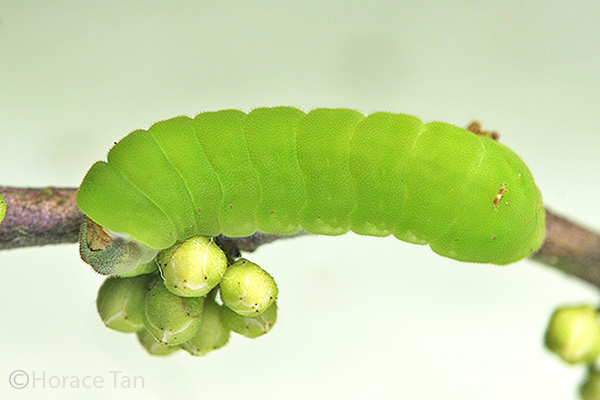
A caterpillar of the Transparent Sixline Blue feeding on a flower bud of Ardisia elliptica in the presence of two ants. An empty egg shell can be seen near the base of the pedicel.

A final instar caterpillar of the Transparent Sixline Blue feeding on a flower bud of Ardisia elliptica.

Two views of a final instar caterpillar of the Malayan Plum Judy.

Two views of a final instar caterpillar of the Harlequin.

Caterpillars of the Harlequin and Malayan Plum Judy both choose to pupate on the underside of a leaf. Their pupae are secured via a silk girdle as well as cremastral attachment to a silk pad on the leaf surface. They have close resemblance but those of the Harlequin have reddish brown markings not found in those of the Malayan Plum Judy.

Two views of a pupa of the Malayan Plum Judy.

Two views of a pupa of the Malayan Plum Judy.

The pupae of the Transparent Sixline Blue have the typical lycaenid shape, pale brownish with black spots. They are also secured via silk girdle and cremastral attachment.

A pupa of the Transparent Sixline Blue.

References:
Text by Horace Tan, Photos by Sunny Chir, Khew SK and Horace Tan.

Saturday, August 6, 2016

Butterfly of the Month - August 2016

Butterfly of the Month - August 2016
The Club Silverline (Spindasis syama terana)


The hot humid weather at the height of the summer months seems to have brought out a relatively good season of butterflies across the region. There has been a good series of butterfly postings on our FaceBook Group from Vietnam to Thailand, Malaysia and Singapore. It would be interesting to trace butterfly activity over the years and ascertain the effect weather patterns have on the abundance and diversity of species across the region.


Reading the headlines on news portals over the past few weeks can be rather depressing as the series of terrorist and other disastrous events caused by psychotic individuals (or groups) continued to hit the news. First it was Orlando. Then Nice. And Bavaria. Munich. Kabul. Fort Myers. Sagamihara. And the coup in Istanbul. One author calls it 'toxic masculinity'. She goes on to say "Toxic masculinity finds expression in fascism, sexism, white supremacy, Islamophobia, xenophobia, jingoism, capitalism, homophobia, rape culture and patriarchy, in the glamourisation of military culture."


And then there was the recent arrest of 6 suspects who were in the process of launching a rocket from nearby Batam island in Indonesia towards Singapore. Whilst some netizens laughed it off as "additional fireworks" for Singapore, as our island nation celebrates our National Day next week, authorities are not amused. The threat is indeed real, and I recall one retired Minister saying "it's not the size of the explosion that is of concern, but the signature of the blast". Food for thought... as far as our hitherto safe Little Red Dot is concerned.


Our Prime Minister's visit to the US made the news in the past week, showcasing the close diplomatic ties and support between the US and Singapore over the years. All the more apt, as the US is on the threshold of a change in the Presidency and no one can predict how the world's biggest economic power will view our part of the world, as far as its future foreign policy is concerned, particularly towards Asia. It's something that will be closely watched as Americans go to vote soon.


Interestingly, an unlikely dinosaur-themed denim pouch stole the news limelight after Ho Ching carried it to the official arrival ceremony at the White House in Washington DC. The S$14.80 pouch, designed by Seetoh Sheng Jie, who has autism, created more buzz on the news portals than one could ever imagine such a humble pouch would! Goes to show that the value and meaningfulness of one's actions and material possessions are more important than their cost and opulence.


Let's turn to our Butterfly of the Month for August 2016, which is Singapore's 51st birthday after independence. This month, we feature a small but attractive butterfly from the Aphnaeinae subfamily of the Lycaenidae family - the Club Silverline (Spindasis syama terana). This is one of two species of the Silverlines that are found in Singapore.


Both the Club Silverline and its closely-related cousin, the Long Banded Silverline (Spindasis lohita senama) are more often found in urban parks and gardens than in the forested nature reserves of Singapore. The Silverlines are characterised by their banded appearance on the undersides of their wings, centred with attractive silvery markings. The hindwing bears a pair of delicate filamentous white-tipped tails.


Club Silverlines feeding on the flowers of Leea rubra and Cordia cylindistrachya

Both species can be considered 'moderately common' and often frequent the same locations. The caterpillars feed on a variety of plants. The Club Silverline is a fast-flyer and is regularly seen feeding on the flowers of the Red Tree Shrub (Leea rubra) and StringBush (Cordia cylindristachya). At times, if disturbed, it flies off quickly and perches on the underside of a leaf to hide itself.


An aberrant Club Silverline with the forewing sub-apical markings distinctly detached

The Club Silverline usually stops and rests with its wings folded upright and sometimes observed stopping on a blade of grass, with its head facing downwards. At certain times of the day, however, it can be observed stopping with its wings opened flat to sunbathe. This behaviour, although not common, is observed in both the male and female of this species.


Male and female Club Silverline sunbathing, showin the uppersides of their wings

The male is deep aquamarine blue on the upperside with broad black apical borders on the forewing. The female is a dull steely-blue above and generally unmarked, although the underside markings can often be perceptible through the wings. The underside is an whitish-cream ground colour with black streaks infilled with silvery streaks.  In some individuals, the black streaks may be replaced with burgundy streaks instead (more like the Long Banded Silverline)


A Club Silverline with the bands in red rather than the usual black

The distinguishing markings between this species and its closely-related cousin, the Long-Banded Silverline, can be found in the basal area on the underside of the forewing. The basal streak is L-shaped in the Long Banded Silverline, but club-shaped in the Club Silverline. The hindwing has two white-tipped tails emerging from a prominent orange tornal patch


On behalf of ButterflyCircle members, we would like to take this opportunity to wish all our Singaporean readers a Happy 51st Birthday on our National Day on 9 Aug 2016!

Majulah Singapura!


Text by Khew SK : Photos by Sunny Chir, Huang CJ, Khew SK, Koh CH, Loke PF, Bobby Mun, Anthony Wong, Mark Wong and Benjamin Yam

Friday, July 29, 2016

Life History of the Chocolate Royal v2.0

Life History of the Chocolate Royal (Remelana jangala travana)


Butterfly Biodata:
Genus: Remelana Moore, 1884
Species: jangala Horsfield, 1829
Subspecies: travana Hewitson, 1865
Wingspan of Adult Butterfly: 31-35mm
Caterpillar Local Host Plants: Ixora 'Super Pink' hybrid/cultivar. of Ixora chinensis (Rubiaceae, common name: Ixora, chinese name: 龙船花), Eurya acuminata (Theaceae, chinese name: 尖叶柃).


A female Chocolate Royal.

Physical Description of Adult Butterfly:
On the upperside, the male is deep lustrous purple with broad brown border on both wings; the female is paler purple and different from the male in having basal areas of spaces 2 and 3 entirely purple. On the underside, both sexes are brown with conspicuous cell-end bars and post-discal series of dark brown striae on both wings. The prominent black tornal spot and the black marginal spot in space 2 are bothcrowned with brilliant metallic green/blue scaling. Between and beyond the two spots, the marginal area of spaces 1a, 1b and 3 is also covered with same metallic scaling. There are two pairs of white-tipped tails at the end of veins 1b and 2.


Field Observations:
This species is moderately rare in Singapore and can be found in forested areas of the nature reserves. There are also infrequent sightings of this species in urban parks and gardens. Adults are fast flyers and make rapid sorties among foliage. Both sexes have been observed to visit flowers of various plants for nectar. The male has also been observed to puddle on wet grounds.


Early Stages:
Two local host plants have been recorded for the Chocolate Royal. They are Eurya acuminata and Ixora 'Super Pink'. Caterpillars of the Chocolate Royal feed on the flowers, flower buds, and young and tender leaves of the host plants. In the wild, the caterpillars are found in the company of attending ants.


5th instar caterpillar and the pre-pupa of Chocolate Royal being attended by ants.

Local host plant #1: Ixora 'Super Pink'.

Local host plant #2: Eurya acuminata.

The eggs are laid singly on the underside of leaves, young shoots, on or in the vicinity of flower buds of the host plants. Each egg is about 0.7-08mm in diameter, white with a strong greenish tinge when freshly laid. It is burger-shaped with a depressed micropylar at the pole and a surface reticulated with rather large polygonal depressions.

Two views of an egg of the Chocolate Royal, laid on leaf underside.

An egg of the Chocolate Royal laid on the flower bud of Ixora 'Super Pink'.

It takes about 3 days for the egg to hatch. The caterpillar nibbles away the polar portion of the egg shell to emerge, and does not eat the egg shell remnant. The newly hatched is pale yellowish with lateral orangy brown bands running lengthwise. Its body has a length of about 1.3mm and has long setae dorso-laterally and laterally. The prothoracic shield are both pale brown. Typically the newly hatched finds its way to adjacent flower buds, feeding on the peduncle or the bud proper where it will bore a hole to reach the flower parts within. After about 3 days of growth in the first instar, and reaching a length of about 2.5-2.7mm, the caterpillar moults to the next instar.

Two views of a 1st caterpillar, newly hatched, length: 1.3mm.

Two views of a 1st instar caterpillar, length: 2mm.

An early 1st instar caterpillar eating away the peduncle (flower stalk) of an Ixora flower.

In the 2nd instar caterpillar, the prothoracic shield and the head are both black, a significant change from the earlier pale brown coloration. The body still features reddish brown lateral bands and bear numerous short fine setae on its surface. On the dorsum of the 7th abdominal segment, the dorsal nectary organ is present but still inconspicuous. The 2nd instar caterpillar reaches a length of about 3.6-3.9mm, and after about 3 days in this stage, it moults again.

Two views of a 2nd instar caterpillar, newly moulted, eating its exuvia, length: 2.5mm.

Two views of a 2nd instar caterpillar, length: 3mm.

A 2nd instar caterpillar of the Chocolate Royal on a young shoot of Ixora 'Super Pink'.

The 3rd instar caterpillar loses the contrasting lateral brown bands in the previous instars. Its body is now uniformly coloured in pale yellowish brown to pale green. The prothoracic shield and the head retains the black coloration. The dorsal nectary organ is now more conspicuous and has a short bar-like appearance. There is no visible sign of any tentacular organs (common in many other lycaenid species) on the 8th abdominal segment. The 3rd instar takes about 3 days to complete with the body length reaching about 6.5-7mm.

Two views of a 3rd instar caterpillar, length: 5.5mm.

Two views of a late 3rd instar caterpillar, length: 7mm.

An early 3rd instar caterpillar of the Chocolate Royal boring a hole on the flower bud of Ixora 'Super Pink'.

The 4th instar caterpillar resembles the 3rd instar closely. Its body is still yellowish green to dull green, covered with numerous tiny setae. The black coloration of the prothoracic shield is retained in some specimens but changed to a brown to pale brown coloration in others. The bar-like dorsal nectary organ is marked with two reddish brown marks around a central white speck, giving it a prominent appearance. The 4th instar takes about 3 days to complete with the body length reaching 12.5-13mm.

Two views of an early 4th instar caterpillar, length: 7.5mm.

Two views of a late 4th instar caterpillar, length: 12.5mm.

A 4th instar caterpillar of the Chocolate Royal feeding on an Ixora flower.

A 4th instar caterpillar of the Chocolate Royal feeding on an flower bud of Eurya acuminata.

The 5th instar caterpillar has similar markings as in the 4th instar. The body colour takes on a brighter shade of yellowish green and the prothoracic shield, together with rest of the prothorax, has faded further to pale yellowish brown. When an ant approaches, the dorsal nectary organ can be observed to protrude and exude droplets of clear nectary fluid.

Two views of a newly moulted 5th instar caterpillar, length: 12mm.

Two views of a 5th instar caterpillar, late in this stage, length: 20.5mm.

Close-up view of the prothorax and the dorsal nectary organ of a 5th instar caterpillar of the Chocolate Royal. Lower left: dorsal nectary organ; lower right: the prothorax.

A 5th instar caterpillar of the Chocolate Royal eating flower buds of Eurya acuminata.

A 5th instar caterpillar of the Chocolate Royal eating flower buds of Ixora 'Super Pink'.

After about 5-6 days of feeding and reaching a length of about 21-23mm, the caterpillar stops food intake and wanders around for a pupation site. During this time, its body gradually shortened. Typically the caterpillar chooses a site on the sheltered surface of a leaf for its pupation site.

An ant triggers the protrusion of the dorsal nectary organ of a Chocolate Royal caterpillar and reaping its reward.

The dark jade-green pre-pupatory caterpillar prepares for pupation by spinning a silk girdle and a silk pad to which it attaches itself via anal claspers. After about 1 day as a pre-pupa, pupation takes place. The pupa is predominantly jade green and has numerous small whitish speckles. Pupal length: 12-13mm. The stout pupa has a typical lycaenid shape with a short abdomen.

Two views of a pre-pupa of the Chocolate Royal.

Two views of a pupa of the Chocolate Royal.

Six to seven days later, the pupa turns black, mostly in the thorax and wing pads. The bluish patch on the forewing upperside of the adult can now be seen in the wing pads. The next day, the pupal stage comes to an end with the emergence of the adult butterfly.

Two views of a mature pupa of a Chocolate Royal.

A newly eclosed Chocolate Royal.

References:
  • [C&P4] The Butterflies of The Malay Peninsula, A.S. Corbet and H.M. Pendlebury, 4th Edition, Malayan Nature Society, 1992.
  • Butterflies of Thailand, Pisuth Ek-Amnuay, 2nd Edition, 2012.
  • A Field Guide to the Butterflies of Singapore, Khew S.K., Ink On Paper Communications, 2nd Edition, 2015.
Text by Horace Tan, Photos by Koh Cher Hern, Goh LC, Nelson Ong, Sunny Chir, Khew S K and Horace Tan