Saturday, November 7, 2015

Life History of the Tree Yellow

Life History of the Tree Yellow (Gandaca harina distanti)


Butterfly Biodata:
Genus: Gandaca Moore, 1906
Species: harina Horsfield, 1819
Subspecies: distanti Fruhstorfer, 1910
Wingspan of Adult Butterfly: 30-45mm
Caterpillar Local Host Plants: Ventilago maingayi (Rhamnaceae), Ventilago malaccensis (Rhamnaceae).


Physical Description of Adult Butterfly:
Tree Yellow has its vein 7 on the hindwing originating from well before the end of the cell. In contrast, Grass Yellow species has their rises at or just before the cell-end. On the upperside, the wings are pale lemon-yellow with a narrow black apical border on the forewing. In the female, this black border has a dentate projection along vein 4. On the underside, the wings are pale lemon-yellow without any markings.


Field Observations of Butterfly Behaviour:
The Tree Yellow is common in Singapore and can be found at multiple locations within the nature reserves. They regularly visit flowers for nectar and puddle on wet grounds for minerals.


Early Stages:
In Singapore, two plants in the nature reserves, Ventilago maingayi and Ventilago malaccensis, have been identified as larval hosts for Tree Yellow. The caterpillars feed on young leaves of the host plants. The caterpillars typically rest on the upperside of a leaf which has its leaf margin curled inwards to form a partial leaf shelter for the caterpillars.

Local host plant #1: Ventilago maingayi.

Local host plant #2: Ventilago malaccensis.

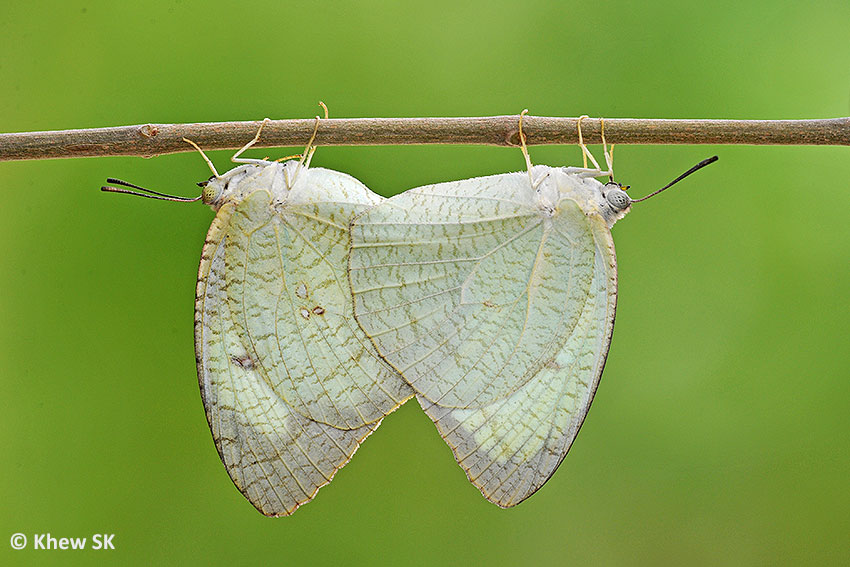
A mating pair of the Tree Yellow.

The eggs of the Tree Yellow are laid singly on a young shoot of of the host plant. The spindle shaped egg is laid standing at one end with a length of about 1.4-1.5mm. It is whitish in color and has indistinct shallow vertical ridges. The micropylar sits at the tip of the standing egg.

A mother Tree Yellow laying an egg on a young leaf of Ventilago maingayi.

An egg of the Tree Yellow on the young shoot of Ventilago maingayi.

An egg of the Tree Yellow.

The eggs take about 3-3.5 days to hatch. Each newly hatched caterpillar has a length of about 2mm and has a pale whitish head capsule. It has a cylindrical and pale whitish body covered with dorso-lateral and lateral rows of tubercles running lengthwise. As is the case for Eurema spp., each tubercle has a seta emerging from the middle of it with the tip of the seta bearing a droplet-like structure. These droplet-bearing setae is a feature seen in all five instars of the larval phase.

Two views of a newly hatched caterpillars of the Tree Yellow, length 2mm.

After hatching, the young caterpillar does not seem to follow the common habit of eating the empty egg shell for its first meal, instead it moves away to feed on the leaf lamina. The body colour turns pale yellowish brown as growth progresses. The body length reaches about 4mm in about 2 days before the moult to the 2nd instar.

Two view of a 1st instar caterpillar, length 2.5mm.

The body of the 2nd instar caterpillar is pale whitish to yellowish with a greenish tinge. Its head capsule is similarly coloured. This instar lasts about 2 days with the body length reaching about 7mm.

Two views of a 2nd instar caterpillar, early in this instar, length 3.5mm.

Two views of a 2nd instar caterpillar, length: 5mm

The 3rd instar caterpillar resembles the 2nd instar caterpillar closely with the body bearing a stronger greenish tinge than in the 2nd instar. This instar takes about 2 days to complete with body length reaching about 9-10mm.

Two views of a 3rd instar caterpillar, length: 8.8mm.

Two views of late 3rd instar caterpillar, dormant prior to its moult, length: 9.5mm.

A 3rd instar caterpillar of the Tree Yellow found in the central catchment reserve.

The body of the 4th instar caterpillar is little changed in appearance from its previous instars, with its body coloration more whitish overall. This penultimate instar takes about 2-3 days to complete with body length reaching about 16-17mm.

Two views of a newly moulted 4th instar caterpillar.

Two views of a 4th instar caterpillar, length: 12mm.

Two views of a late 4th instar caterpillar, dormant prior to its moult, length: 16mm.

A 4th instar caterpillar of the Tree Yellow found in the central catchment reserve.

The 5th and final instar does not bring along any drastic change in appearance in both the body and head capsule. Overall the caterpillar is more yellowish green than in the previous instars. The 5th instar lasts about 3-4 days, and the body length reaches up to 24-25mm.

A newly moulted 5th instar caterpillar of the Tree Yellow.

Two views of a 5th instar caterpillar, early in this stage, length: 19mm.

Two views of a 5th instar caterpillar, late in this instar, length: 24.5mm.

Two views of a late 5th instar caterpillar, ceased feeding and ready to become a pre-pupa.

On the last day of the 5th instar, the body of the caterpillar shortens and the body colour changes to pale yellowish jade green. It ceases feeding and comes to a halt on the underside of a leaf or a stem of the host plant. Here the caterpillar spins a silk pad and a silk girdle. With its posterior end secured to the silk pad via claspers, and the body suspended at the mid-section with the girdle, the caterpillar soon becomes immobile in this pre-pupatory pose.

The sad ending of a final instar caterpillar of the Tree Yellow. Here the parasitoid larvae had emerged from the caterpillar and pupated, leaving the caterpillar to die hours later.

A late 5th instar caterpillar of the Tree Yellow found in the central catchment reserve.

A pre-pupatory larva of the Tree Yellow.

Pupation takes place about 0.5-1 day later. The pupa secures itself with the same silk girdle as in the pre-pupal stage, but with the cremaster replacing claspers in attaching the posterior end to the silk pad, It has a pointed cephalic horn) and a slightly keeled wing pad, and its body is free of any spots/markings. The body colour is pale green throughout with the abdomen in paler green. Length of pupae: 17-19.5mm..

Two views of a pupa of the Tree Yellow.

Two views of a mature pupa of the Tree Yellow.

After about 4 days of development, the pupal skin turns translucent as the development within the pupal case comes to an end. The yellow coloration and back borders on the forewing upperside are now discernible. The following day, the adult butterfly emerges from the pupal case.

A newly eclosed Tree Yellow clinging onto its empty pupal case.

References:
  • [C&P4] The Butterflies of The Malay Peninsula, A.S. Corbet and H.M. Pendlebury, 4th Edition, Malayan Nature Society, 1992.
  • Butterflies of Thailand, Pisuth Ek-Amnuay, 2nd Edition, 2012
  • A Field Guide to the Butterflies of Singapore, Khew S.K., Ink On Paper Communications, 2010.

Text by Horace Tan, Photos by James Chia, Lemon Tea YK, Nelson Ong, Mark Wong, Loke PF, Simon Sng, Frederick Ho, Sunny Chir and Horace Tan

Saturday, October 31, 2015

Two Skippers Added to the Singapore Checklist

Two Skippers Added to the Singapore Checklist
Featuring the Malayan Swift and Bengal Swift


The identification of some Lycaenidae and Hesperiidae from field shots is often challenging due to the very similar physical features of several species. This is made even more difficult due to the wide variation of these features amongst individuals and between different sexes.

In museum and scientific collections, it is much easier to identify and differentiate between species as comparisons amongst a number of specimens can be done systematically. Where available, male specimens can be dissected and their genitalia compared with a database of figures from reference resources. In recent times, the use of DNA sequencing can help advance the identification of specimens with greater accuracy.


However, positive identification of field photographed individuals is often a tricky business, because either the upperside or underside of an individual may not be available. Furthermore, if the butterfly photographed is a worn or tattered individual, its identification may prove almost impossible.

This is where the early stages of a butterfly can add another dimension to the accurate indentification of the species concerned. Over the years, our early stages expert, Horace Tan, has had many opportunities to breed and document the egg, caterpillar and pupa stages of a butterfly, and the adult morphology compared with reference literature.


After much scrutiny and discussion with our Malaysian expert Dr TL Seow, we have narrowed down the identification of two more species of Hesperiidae. The first is a species from the genus Caltoris. These "Swifts" are largely found in heavily-shaded forests in Singapore, and thus far, the Full Stop Swift (Caltoris cormasa), is the only species that has been identified with certainty. A recent find, is another species, Caltoris malaya (Malayan Swift).


Caterpillar and pupa of the Malayan Swift bred on Bambusae sp

The Malayan Swift is described as being dark brown with the usual spotting on the forewing. A key distinguishing factor is the absence of the cell spots on the forewing. On the underside, the male is ferruginuous (or dark rusty) brown, whilst the female is ochreous (or reddish-orange) brown.


Several individuals were bred, and the specimens were examined and compared. The consistent absence of the forewing cell spots narrowed down the idenfication of the species to Caltoris malaya a species that is documented as extant in Singapore by the early authors. We record this re-discovery of the Malayan Swift (Caltoris malaya) as species #323 in the Singapore Checklist.


The next species, also a re-discovery, is the Bengal Swift (Pelopidas agna agna). This species is very similar to the more common extant species found in Singapore, the Small Branded Swift (Pelopidas mathias mathias). Differentiation between the two via field shots can be a hit-and-miss affair. However, Dr TL Seow has added his other observations to help narrow down the identification between these two species.


A female Bengal Swift perches on a blade of grass

Pelopidas mathias mathias
  • Male: FW line through cell spots cut brand variably at lower third.
  • FW spots large especially 2 and 3. Spot 2 irregularly rectangular.
  • Female: Line through cell spots generally pass close spot 1b but variable and unreliable.
  • HW ground colour uneven, marginal areas often paler with dark shading/smudges around the spots.
  • Underside is greyish-ochreous
Pelopidas agna agna
  • Male: Line through cell spots only touches lower end of brand.
  • Forewing spots often very small and spot 2 very narrow.
  • Female : Line through cell spots usually far from spot 1b but unreliable.
  • Underside ground colour is even and without obvious dark shading/smudges around the spots.
  • Underside is ochreous without a grey tinge.
Breeding of several individuals and comparison with the adult males and females strongly suggest the presence of the Bengal Swift (Pelopidas agna agna) in Singapore. However, another related species, Pelopidas lyelli which also bear a strong resemblance to the Bengal Swift, may also create some confusion. This Australian species should be looked for in Singapore where it is not impossible that it reached the shores of Singapore like the Yellow Palm Dart.


Caterpillar of the Bengal Swift

Given the comparisons and specimens from breeding documentation, we record the Bengal Swift (Pelopidas agna agna) as species #324 as a re-discovery for Singapore. Further observations will continue as to whether there are other Pelopidas species exist in Singapore.


It is likely that we will continue to discover other Hesperiidae from the lookalikes via their early stages as and when the opportunities arise. Henceforth from 2015, all bred and collected material will be submitted to the Lee Kong Chian Natural History Museum for DNA sampling and the voucher specimens documented for future comparisons when more material are available.

Text by Khew SK : Photos by Horace Tan and Khew SK

Special thanks to Horace Tan for his patience and effort in documenting the early stages of these Skipper species and to Dr TL Seow for his persistence in scrutinising the voucher specimens and coming out with additional consistent ID features for the species concerned .

References :
  • The Butterflies of The Plain Peninsula, A.S. Corbet and H.M. Pendlebury, 4th Edition, Malaysian Nature Society.
  • Butterflies of West Malaysia and Singapore, WA Fleming, 2nd Edition, Longmans, 1983
  • Butterflies of Thailand, Pisuth Ek-Amnuay, 2nd Edition, 2012
Special Note :
All voucher specimens, host plants and early stages collected within Parks or Nature Reserves under the jurisdiction of the National Parks Board are done with the permission of the National Biodiversity Centre Division of NParks. Specimens will be submitted to the Lee Kong Chian Natural History Museum's Lepidoptera Collection for reference.

Friday, October 23, 2015

Butterfly of the Month - October 2015

Butterfly of the Month - October 2015
The Mottled Emigrant (Catopsilia pyranthe pyranthe)


A male Mottled Emigrant feeding on the flower of Bidens pilosa

The haze that enveloped much of Southeast Asia continued into the month of October 2015 and will probably go down on record as one of the worst man-made air pollution event for a long time. The prevailing south-westerly and south-easterly winds continued to blow the smoke from Indonesia's forest-burning activities towards Singapore, Malaysia, southern Thailand and even as far as the Philippines!


Regional Haze map showing the extend of the haze covering Singapore, Malaysia and Thailand and the prevailing winds

It is quite amazing that Indonesian government continues to sit back whilst their own people suffer PSI conditions reaching almost 3,000! At that number, keeping count of whatever the PSI number is, becomes totally meaningless and irrelevant. It is hoped that ASEAN will continue to put pressure on the Indonesian government to take positive action to stop this environmental carnage. Otherwise it will become a yearly affair for all its neighbours - at least until the government allows the perpetrators to burn down all its forests until there is nothing left to burn.


At the moment, there is nothing else any other neighbouring country can do, but offer assistance, grumble, complain, threaten and so on, without any resolution. The only answer to end this haze will be when the Northeast monsoons puts out the fires in Sumatra and Kalimantan. A weak government cannot do anything more than to chide its neighbours for complaining about the haze.


Over in little Singapore, it is heartening to know that there are more and more voices regarding animal welfare concerns. A fisherman was videoed baiting a hook which snared an otter. In the video clip, the squeals of distress (and probably pain) from the hooked otter made watching the whole thing even more heart-wrenching. But the amount of criticism in social media prompted the government agencies and even the police to eventually locate the fisherman. The case is still pending.


This month, we feature a common butterfly species in Singapore, the Mottled Emigrant (Catopsilia pyranthe pyranthe). The Mottled Emigrant is one of three species of the genus Catopsilia found in Malaysia and Singapore. Their common name "Emigrant" suggests that these butterflies indulge in migratory tendencies. Indeed, over the years of butterfly watching here in Singapore, at least one of the species, the Lemon Emigrant (Catopsilia pomona pomona), has been seen "migrating" in numbers across the island on one occasion.


A male Mottled Emigrant shot in flight with its wings opened, whilst courting a female

The Mottled Emigrant is greenish-white in colour. On the upperside, the forewing has a thin black apical border in the male, which is much broader in the female. There is also a hint of a black marginal border on the hindwing in the female. Both sexes have a prominent black cell end spot on the upperside of the forewing.


A mating pair of Mottled Emigrants.  Left - female, right - male

The underside of the butterfly features a series of brown transverse striations, giving the butterfly a "mottled" appearance. The underside of the closely-related Lemon Emigrant is usually clean and without this mottling. However, in some individuals of the Mottled Emigrant, this mottling is so indistinct as to cause mis-identification of this species, particularly in the field.


A close-up of the mottled markings on the underside of the wings of a Mottled Emigrant

The Mottled Emigrant is a fast-flying butterfly, often on the wing on bright sunny days, flying erratically at high speed. It is skittish, and difficult to photograph, except with it stops to feed at flowering plants, or when it is resting in the shade. It is seldom encountered with its wings opened flat.


The species does not appear to puddle at moist sandy streambanks and forest footpaths (thus far no known record in Singapore). Unlike many Pieridae, which tend to puddle, the Mottled Emigrant is more often encountered feeding on flowers in urban and sub-urban parks and gardens. The caterpillar of the Mottled Emigrant feeds mainly on its preferred host plant, the Seven Golden Candlesticks (Senna alata), which has been cultivated in many parks and natureways as a butterfly-attracting plant.


In photographs, the Mottled Emigrant may look pale greenish white to light lime green, depending on the condition of the butterfly, its surroundings, fill-flash, ambient lighting and contrast settings on the camera. Hence in the field, it may sometimes be confused with the various forms of its cousin, the Lemon Emigrant. The key distinguishing characteristic are the mottled markings on the underside of the wings.

Text by Khew SK : Photos by Khew SK, Koh CH, Loke PF, Bobby Mun, Tai LA, Benedict Tay and Mark Wong.