Friday, July 5, 2019

Butterfly of the Month - July 2019

Butterfly of the Month - July 2019
The Dark Grass Brown (Orsotriaena medus cinerea)


A Dark Grass Brown perched on a blade of dew-covered grass in the early morning hours of the day

We move into the latter half of 2019 and the month of July. Over in the US, Americans celebrated "Independence Day" on the 4th of July. Global politics continue to be centred on the Trade War between the US and China, and it does appear that more countries may be dragged into the fray with possibly more tariffs being slapped on goods imported from these countries into the US.


Closer to home in Asia, the protests over the extradition law in Hong Kong continues to spin out of control. Whilst a lot have been said and done, who really benefits or wins, and who really suffers and loses the most from such public unrest? The world watches as the drama unfolds, as such instability rarely benefits anyone in the country in the long run.


A mating pair of Dark Grass Browns.  The sexes are almost indistinguishable

Our Butterfly of the Month for July 2019 is the Dark Grass Brown (Orsotriaena medus cinerea), a relatively common species that is usually found fluttering skittishly amongst grasses and low shrubbery. Originally christened with the English Common name of Nigger, the species has been renamed, to be politically correct, to avoid any racial sensitivities.


Over in Australia, it is called the Smooth-Eyed Bush Brown, in India it is referred to as the Medus Brown, and in Southeast Asia, it is called the Dark Grass Brown. Whilst easier to refer to, English Common names do not follow any set of scientific rules and can be confusing as all the three names (and probably more) refer to the same species - Orsotriaena medus.


The Dark Grass Brown resembles the many lookalike species of the Mycalesis genus (referred to as "Bush Browns"), and often flies together with these other species in the same habitats. The Dark Grass Brown tends to fly low and can be seen flying in the early hours of the morning and late into the evening.


Another pair of mating Dark Grass Browns

Although a common and usually under-appreciated species that is often overlooked by observers, the Dark Grass Brown is alert and skittish and will require a bit of patience and stealth to approach and take a good photo of. It does not fly far when disturbed, often flitting away in its characteristic hopping flight and then settling on the top of a leaf or a grass blade.


A Dark Grass Brown that is a victim of a Crab Spider.  Note the upperside of the wings

The Dark Grass Brown is dark brown and unmarked on the upperside. It has two large ocelli on the underside of the forewing, and three more on the underside of the hindwing. There is a distinct white discal stripe extending across the underside of both wings. There are two white marginal lines from the apex of the forewing to the tornal area of the hindwing.


A slightly aberrant Dark Grass Brown with an additional ocellus on the forewing.

The caterpillar of the Dark Grass Brown feeds on lalang (Imperata cylindrica), a "weed" that grows very commonly in cleared areas and wastelands. This may explain the widespread distribution of this species across Singapore where its host plant is invasive and often considered as unwanted vegetation that is removed by maintenance workers.

Text by Khew SK : Photos by Jerome Chua, Huang CJ, Khew SK, Loke PF and Jonathan Soong

Friday, June 28, 2019

The Bamboo Feeders (Part 2)

The Bamboo Feeders (Part 2)
Bamboo-feeding Butterfly Caterpillars


In this follow-up Part 2 of the Bamboo Feeding butterfly caterpillars, we take a look at 4 other Hesperiinae (Skippers) species whose caterpillars depend on various species of bamboos as their host plants. As mentioned in Part 1, butterfly caterpillars are very plant-specific, and the monocotyledonous bamboos are host plants to some butterfly species, particularly from the subfamilies Satyrinae and Hesperiinae.


Bamboos growing naturally in Singapore's forests

There are many species of bamboos in southeast-asian forests, and some have been cultivated as feature plants in the landscaping of parks and gardens. Hence bamboos also contribute to the biodiversity of butterflies as these butterfly species' sustainable populations are dependent on the presence of these bamboos.


A bamboo clump at Pulau Ubin Butterfly Hill

We now take a look at another series of examples of butterflies whose caterpillars feed on bamboos as their host plants. These species are from the Hesperiinae (Skippers) subfamily.

5) Linna Palm Dart (Telicota linna)


Amongst the 'Palm Darts' found in Singapore, the Linna Palm Dart is the only species of the six Palm Darts whose caterpillar feeds on bamboo. Bred successfully on Bambusa multiplex (Hedge Bamboo), the Linna Palm Dart can be found in urban parks and gardens, and sometimes at the fringes of the forests in Singapore. It is considered moderately rare, but is widespread in distribution across the island.


The Linna Palm Dart is one of several cryptic species that resembles its close cousins with black and orange markings in the Telicota and Cephrenes genera. The diagnostic features that separate the Linna Palm Dart from the others are that the base in space 3 of the forewing is black, and the veins across the orange post-discal patch on the underside of the hindwing are not dark dusted.


A black-headed morph of the Linna Palm Dart's caterpillar

The caterpillar goes through six instars and the colour of the head is variable, having two "morphs" - a black-headed morph and a brown-headed morph. The body of the caterpillar is largely greenish yellow in the late instars and the anal plate is unicolourous with the rest of the body. The caterpillar creates a leaf shelter by folding the bamboo leaf as it continues feeding on the host plant.

6) Dark Banded Ace (Halpe ormenes vilasina)


The Dark Banded Ace is a forest-dependent species that is considered rare in Singapore. Its occurrence is rather local, where the butterfly is often observed in the vicinity of its caterpillar host plant, Bambusa vulgaris. It is a skittish butterfly but is often seen feeding on bird droppings and other animal excretions.


The Dark Banded Ace is dark brown above, with a series of discal and post-discal yellow spots on the forewing. The basal area of the forewing is speckled with golden yellow. The underside is similarly dark brown, with golden speckles on the forewing margins and bases of both wings. There is a distinct white band on the underside of the hindwing which is outwardly jagged. The antennae are yellow-tipped just below the apiculus.


Unique head pattern of the Dark Banded Ace's caterpillar

The caterpillar is whitish-green with creases along its body during the later instars. The anal plate is similarly coloured as the rest of its body. The caterpillar folds the bamboo leaf and creates a shelter to hide itself from predators. The black-and-white head of the late instar caterpillar gives it an appearance of a head with two large black eyes.

7) Malayan Swift (Caltoris malaya)


The Malayan Swift was a recent addition to the Singapore Checklist after its life history was recorded and validated that the species identification was correct. The species frequents the same habitats as its closely related cousins like the Full Stop Swift and the Philippines Swift. Being a cryptic species with many lookalikes, it is difficult to identify the species in the field.


The Malayan Swift can be separated from its other lookalike cousins in the genus Caltoris in that it has no cell spots on the upperside of the forewing. On the upperside, the wings are dark brown with hyaline spots in spaces 2,3 and 4, subapical spots in spaces 6 and 7 and no cell spots in the forewing. Compared to the other Caltoris sp., the male is almost always missing a spot in space 1b. On the underside, the wings are dark ferruginous in the male, and ochreous in the female.


The 5th instar caterpillar has a pale yellowish green body. Its head capsule is a pale reddish brown in ground colour but dark reddish brown along the periphery and various sulci (groove/furrow). Two dark reddish brown stripes rise from the adfrontal area, giving a very vague impression of the Chinese character 山. The anal plate is unmarked as in the all previous instars. The host plant is the Malay Dwarf Bamboo (Bambusa heterostachya).

8) Philippine Swift (Caltoris philippina philippina)


Another species of the Caltoris genus, the Philippine Swift is rare and frequents shaded forested areas in the nature reserves. Due to the very similar markings with other species in the genus, it is extremely challenging to distinguish one species from the other in the field, without the ability to see the upperside of the butterfly.


The Philippine Swift is dark brown above and lacks any forewing cell spots but features the usual post-discal spots. The male has a pale yellow spot in the lower half of space 1b on the upperside of the forewing. The underside is ferruginous but appears to have a more greenish sheen that the allied species in the group. The forewing is distinctly excavate at vein 2.


The late instar caterpillar looks very similar to the caterpillar of the Malayan Swift, but the head capsule has darker and more distinct markings. It has been successfully bred on two bamboo species - Common Bamboo (Bambusa vulgaris) and Malay Dwarf Bamboo (Bambusa heterostachya).


It is highly likely that there are other species that have yet to be discovered whose caterpillars feed on bamboos. It is a matter of time that one or two surprising cryptic species may turn up if the life histories are discovered and recorded. Already, there is likely to be another species of Caltoris that is new to the Singapore checklist and had eluded discovery until recently when its caterpillar was discovered on bamboo. That will be another post for another time.

Text by Khew SK : Photos by Federick Ho, Khew SK, Koh CH, Jonathan Soong, Horace Tan and Mark Wong

The Bamboo Feeders (Part 1)

Sunday, June 23, 2019

The Bamboo Feeders (Part 1)

The Bamboo Feeders (Part 1)
Bamboo-feeding Butterfly Caterpillars


A Common Duffer (Discophora sondaica despoliata) whose caterpillars feed on Bamboo

It is relatively well known that many butterfly caterpillars are very plant-specific in their diet. Unlike moth caterpillars, which can feed on many different plants, butterfly caterpillars are picky eaters and often feed on only one or two particular plant species. These plants, on which the caterpillars feed, referred to as "host plants", support their respective butterfly species. Without these specific plants, the corresponding butterfly species may cease to exist in a particular habitat.


Plants can generally be classified into monocotyledons and dicotyledons. Whilst it is beyond the scope of this article to discuss plant taxonomy and biology, we take a layman's view of plants on which these caterpillars feed, and their correlation to the butterfly families. In general, monocotyledons feature long, narrow-leafed plants with parallel veined leaves, whilst dicotyledons are generally broad-leafed with net-veined leaves.


This blogpost deals with a specific group of monocotyledons - the bamboos. From online resources, there are over 1,600 species of bamboos, and broadly split into two groups that describe how they grow in nature - clumpers and runners. In southeast asian countries like in Singapore, the clumpers are the more dominant species. The diversity of bamboo species is amazing, and identifying the spectrum of species is best left to the experts. Bamboo, like the coconut tree, has a myriad of uses in construction, cuisine, ornaments, medicine and everyday utensils.


The parallel-veined elongated leaves of the monocotyledon Bambusa spp

Coming back to bamboo and butterfly correlation, it is noteworthy to mention that caterpillars of only two families of butterflies feed on bamboo leaves - Nymphalidae and Hesperiidae. And if we move one level deeper, only a few species from two subfamilies - Satyrinae and Hesperiinae, use bamboo as their caterpillar host plants.


Malay Dwarf Bamboo (Bambusa heterostachya)

Hedge Bamboo (Bambusa multiplex)

Common Bamboo (Bambusa vulgaris)

We take a look at a few examples of the species from these two subfamilies that use bamboo as their caterpillar host plants. As research and data are continuously being updated and new finds are discovered and documented, the information that we have are by no means final. The intent here is to highlight the similarities and differences amongst the species that use bamboo as a host plant.

1) The Bamboo Tree Brown (Lethe europa malaya)


The English common name of the butterfly already suggests that the species is somehow connected to bamboos. This medium-sized species is by no means common, but can often be found in the vicinity of bamboo clumps around Singapore. It is an elusive species, skittish and hard to approach. Its caterpillars feed on bamboo leaves although it is likely to use different species of bamboos as its host plant.


The Bamboo Tree Brown is predominantly brown above, with females having a wider subapical band on the forewing compared to the male. The undersides bear a number of cryptic patterns with thick lilac ocelli on the forewing. There is a short "tail" at vein 4 of the hindwing. The butterfly stays close to bamboo thickets and flies low amongst the shrubbery.


A Bamboo Tree Brown perched on the sign of the Tinwa Bamboo at the Singapore Botanic Garden's Bamboo Garden Collection

A caterpillar of the Bamboo Tree Brown with its "cat ear" feature

The caterpillar is green and resembles the related species amongst the Mycalesis (Bush Browns), Ypthima (Rings), and Elymnias (Palmflies) in that they feature "cat ear" heads and a twin-tailed posterior. The Bamboo Tree Brown is relatively widely distributed across Singapore, and can be found quite regularly on Pulau Ubin and in the bamboo garden of the Singapore Botanic Gardens near the Eco-Lake.

2) The Common Duffer (Discophora sondaica despoliata)


The second Satyrinae species featured in this article, the Common Duffer can hardly be described as 'common' in Singapore these days. However, at times, its caterpillars have been found in numbers, feeding on the leaves of bamboo. The adult butterfly is elusive and stays in heavily-shaded thick vegetation. Its cryptic undersides camouflage it well, and unless it is disturbed and flies off, it is hard to detect.


The male is dark purple brown above with a series of obscure pale blue spots on the forewing. The female is also brown but with a series of yellowish-white discal and post-discal spots on the fore and hindwings. The underside is ochreous brown and heavily striated. There are few post-discal eye-spots on the hindwing. The female has a more angular protrusion at vein 4 of the hindwing.


The hairy caterpillars of the Common Duffer resemble moth caterpillars

The caterpillar of the Common Duffer may be mistaken for a moth caterpillar at first glance. It is hairy and features cryptic stripes and markings on its body. However, unlike similar-looking moth caterpillars, the hairs on its body are not urticaceous and do not result in rashes or any skin irritation if one were to touch them. The caterpillar feeds on a type of broad-leafed bamboo and the butterfly can sometimes be found in the same localities as the Bamboo Tree Brown.

3) The Bamboo Paintbrush Swift (Baoris farri farri)


Like the Bamboo Tree Brown, this species' common name instantly suggests its association with bamboos. The Bamboo Paintbrush Swift (and its close cousin, the Paintbrush Swift (Baoris oceia)) are regularly found in the vicinity of bamboo thickets in Singapore. They are skittish, but are often observed to rest on the uppersides of leaves with their wings folded upright in shaded areas in the undergrowth.


On the upperside, the wings of the Bamboo Paintbrush Swift are dark brown. The forewing has hyaline spots in spaces 2-4, 6-8 and 2 cell spots. The female is usually fully spotted and has an additional non-hyaline spot in space 1b on the forewing. The hindwing does not bear any spot, but the male has a black hair tuft in the cell on top of a scent pouch (hence "Paintbrush" in its common name). On the underside, the wings are pale brown and similarly ``spotted'' as per the upperside.


The caterpillar of the Bamboo Paintbrush Swift with its unique head pattern

The caterpillar has a green body, usually covered with a whitish waxy powder. It folds the bamboo leaf as a shelter in which to conceal itself. In its later instars, the black head transforms into a unique black-and-white patterned 'face' that helps to distinguish the species from other lookalikes. The caterpillars use several species of bamboos as their host plants, of which two - Bambusa multiplex and Bambusa vulgaris have been identified.

4) The Common Redeye (Matapa aria)


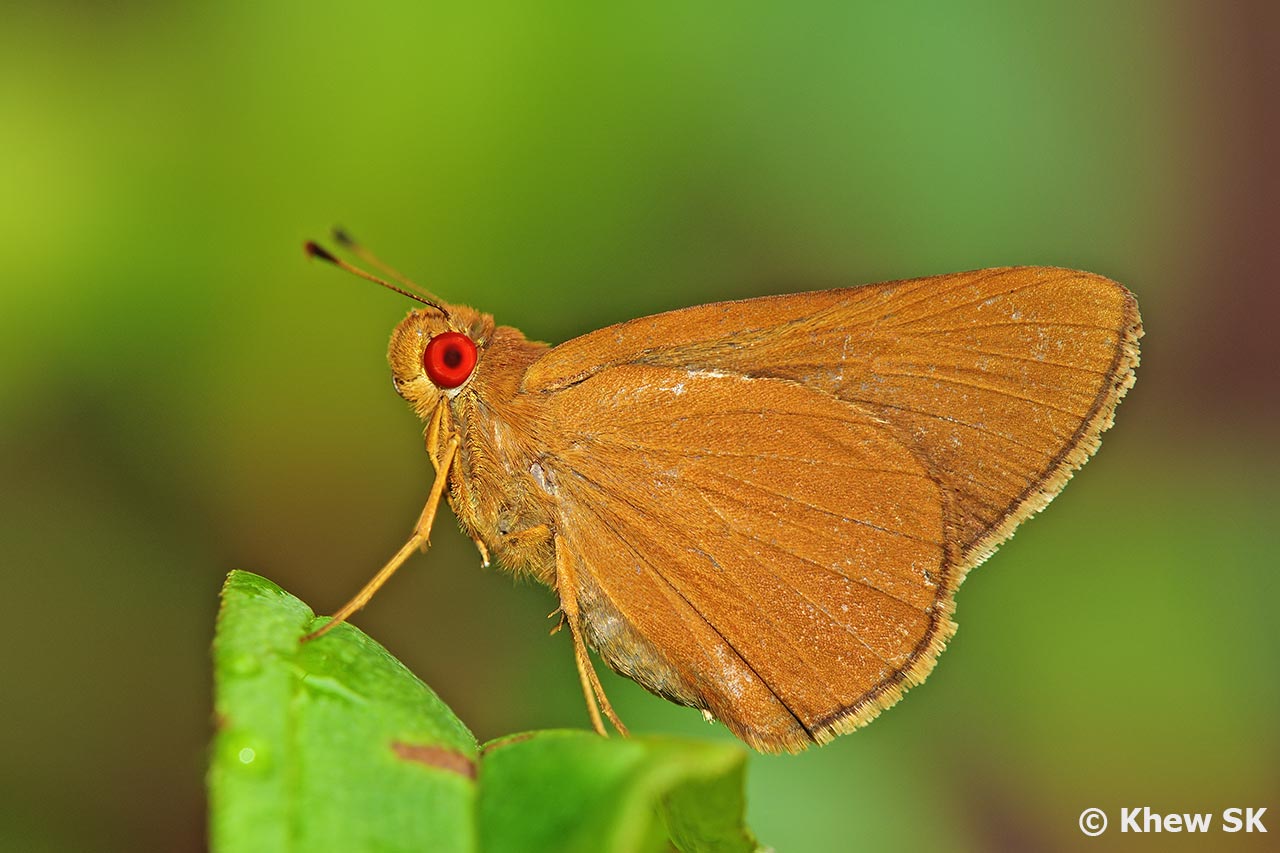
A Common Redeye with its prominent bright red eye perches on a leaf

The Common Redeye is widespread in its distribution across Singapore. Although the adult butterfly is not as common as its name suggests, it makes its appearance regularly in parks and gardens, as well as in the fringes of the nature reserves. Again, bamboo, being its caterpillar host plant, indicates that the species is usually not far from where bamboos grow.


The Common Redeye's wings are a buff-brown above and unmarked. The underside is a more orangey-brown with the hindwing cilia prominently yellowish-white. The eyes of the butterfly are a deep red and stands out prominently. It is a fast-flying species, although more often spotted at rest with its wings folded upright in shaded undergrowth.


The caterpillar of the Common Redeye constructs a leaf shelter to conceal itself

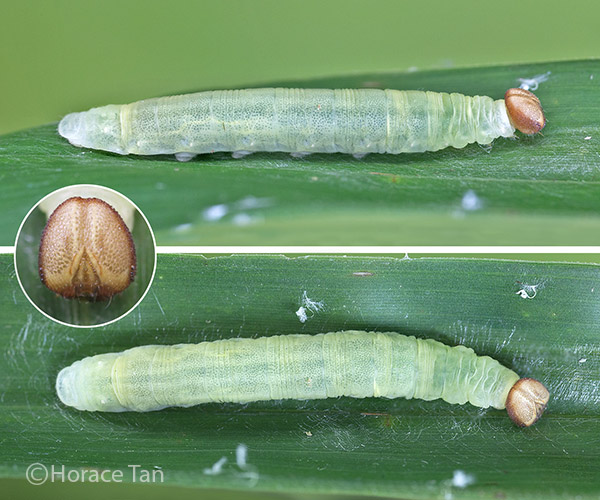
The caterpillar uses several bamboo species as its host plant and is more often spotted, than the adult butterfly. The 5th instar caterpillar has a head which is orange-coloured with no markings, and its body much more whitish in appearance with a slight hint of a yellow tone. The anal plate does not bear any marking.


And so, bamboos, an easily cultivated plant used for horticultural use in landscaping, but which also grows wild in various areas in Singapore, belong to group of plants that butterfly caterpillars use as their host plant. These species depends on bamboos for their continued survival in our environment. In the next part of our bamboo-feeding butterfly caterpillars, we will take a look at four other skippers whose life history depends on bamboos.

Text by Khew SK : Photos by Foo JL, Huang CJ, Khew SK, Loh MY, Jonathan Soong, Horace Tan, Bene Tay and Anthony Wong

References :