Saturday, December 19, 2015

Life History of the Spotted Judy

Life History of the Spotted Judy (Abisara geza niya)


Butterfly Biodata:
Genus: Abisara C. & R. Felder, 1860
Species: geza Fruhstorfer, 1904
Subspecies: niya Fruhstorfer, 1914
Wingspan of Adult Butterfly: 36-46mm
Caterpillar Local Host Plants: Embelia ribes (Myrsinaceae), Embelia canescens (Myrsinaceae).


Physical Description of Adult Butterfly:
Both sexes have their hindwings prominently angled at vein 4. On the upperside, the male is deep crimson brown with a pale, whitish and diffuse subapical band on the forewing and black submarginal spots in spaces 4, 5, and 1b on the hindwing. The female is paler and marked similarly but with its forewing subapical band much broader, and there are two diffuse whitish postdical bands on each wing. On the underside, both sexes are paler and each wing has a pair of diffuse, pale-purplish, postdiscal bands. The outer band on the hindwing has a series of black, white-edged, submarginal spots in spaces 1b, 4, 5 and 6. The female has broader and paler transverse bands. The hindwing discal band is dislocated at vein 4.


Field Observations of Butterfly Behaviour:
The adults are moderately rare and are typically sighted in the forest understorey within nature reserves and in a hill park. The timid and skittish adults are often seen perching on leaves with half open wings, turning and hopping from one perch to the next.


Early Stages:
The local host plants known to date are both Emelia species. One of them, Emelia ribes, is more widespread and can also be found in hill parks and wastelands. The immature stages of the Spotted Judy feed on leaves of the host plant. In the first two instars, the caterpillar feeds by grazing on the leaf surface while in the later instars, it feeds by chomping away at the leaf edges. Between feeds, the caterpillars of all instars rest on the leaf underside.

Local host plant #1: Embelia canescens.

Local host plant #2: Embelia ribes.

A mating pair of the Spotted Judy.

Each egg is laid singly on the underside of a leaf on the host plant, typically close to the leaf edge. Each egg is lime green, somewhat conical in shape with a diameter of about 0.7mm. The egg surface is generally smooth and there is a mid-level belt of fine hairs encircling the egg.

Two views of an egg of the Spotted Judy.

Two views of a mature egg of the Spotted Judy.

It takes about 3.5-4 days for the egg to hatch. The young caterpillar consumes part of the egg shell to emerge. With a length of about 1.6-1.9mm, it has a greyish white body which is greenish on the dorsum of anterior segments. The colour of the head follows that of the body. There are moderately long black dorso-lateral setae and exceptionally long whitish sub-spiracular setae. The body color changes to pale yellow with a green undertone as it feeds and grows.

A newly hatched caterpillar resting next to its egg shell.

Two views of a 1st instar caterpillar, length: 2.8mm.

The first instar lasts about 4-5 days and the body length reaches about 3.5mm. Prior to the moult to 2nd instar, the body shortens and takes on a pumped up appearance. This shortening routine also occurs prior to all subsequent moults.

Two views of a late 1st instar caterpillar, dormant prior to its moult, length: 3.3mm.

The body color of the 2nd instar caterpillar is pale yellow with a greenish undertone. Overall, the appearance is little changed from the 1st instar. This instar lasts for about 4-5 days and the caterpillar grows to a length of about 6-6.3mm before the moult to the 3rd instar.

Two views of a 2nd instar caterpillar, newly moulted.

Two views of a 2nd instar caterpillar, length: 5.8mm.

Two views of a late 2nd instar caterpillar, dormant prior to its moult, length: 5.8mm.

The 3rd instar caterpillar is still yellowish green but with green dominating. Closer scrutiny reveals that the body surface is marked with numerous tiny whitish speacks. The dorso-lateral setae are black in colour while the sub-spiracular setae are still whitish. After 4-5 days in this stage with the body length reaching a maximum of about 10.5-11mm, the caterpillar moults to the 4th and final instar.

Two views of a 3rd instar caterpillar, early in this stage, length: 6.5mm.

Two views of a 3rd instar caterpillar, length: 10.8mm.

Two views of a late 3rd instar caterpillar, dormant prior to its moult, length: 10.5mm.

A late instar caterpillar of the Spotted Judy found in the field.

The 4th instar caterpillar resembles the 3rd instar caterpillar closely but with much greater number of tiny whitish specks on the body surface. The body and the head are both yellowish green in color.

Two views of a 4th instar caterpillar, early in this stage, length: 11.8mm.

Two views of a 4th instar caterpillar, length: 20.5mm.

The 4th instar lasts for about 7-8 days and the body grows up to a length of about 24-28mm. On the last day of this final instar, the caterpillar ceases food intake and its body shrinks in length. It then finds a spot on the leaf underside where it spins a silk pad and a silk girdle to secure itself for the pupation event.

Two views of a pre-pupatory larva of the Spotted Judy

Pupation takes place after 1 day of the pre-pupal period. The greenish pupa has a diamond-shaped outline, being broader at mid-body, less so at the anterior end, and rather pointed at the posterior end. The green body surface is marked with numerous paler and more yellowish specks. Laterally, there are whitish setae running along the fringe of the body. Each pupa is about 16-19mm in length.

Two views of a pupa of the Spotted Judy.

Six to seven days later, the pupa becomes darkened in color signaling the imminent emergence of the adult. The next day the adult butterfly emerges from the mature pupa.

Two views of the mature pupa of  the Spotted Judy.

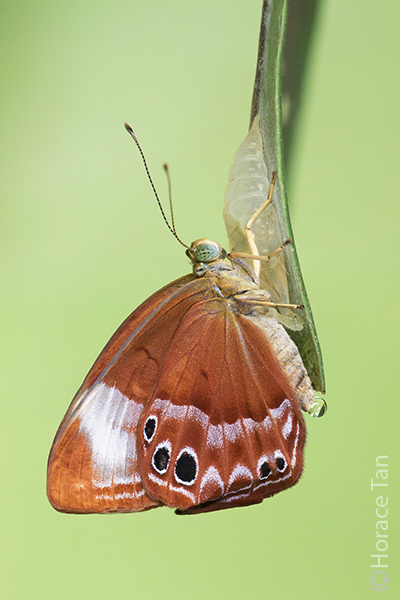
A newly eclosed Spotted Judy expanding its wings near its pupal case.

References:
  • [C&P4] The Butterflies of The Malay Peninsula, A.S. Corbet and H.M. Pendlebury, 4th Edition, Malayan Nature Society.
  • Butterflies of Thailand, Pisuth Ek-Amnuay, 2nd Edition, 2012
  • A Field Guide to the Butterflies of Singapore, Khew S.K., Ink On Paper Communications, 2nd Edition, 2015.
Text by Horace Tan, Photos by C K Chng, Nelson Ong, Frederick Ho, C J Huang, Sunny Chir, Khew SK and Horace Tan

Friday, December 11, 2015

Butterfly of the Month - December 2015

Butterfly of the Month - December 2015
The Lesser Darkwing (Allotinus unicolor unicolor)


It's the final month of the year 2015 as we feature our last Butterfly of the Month in this series that has been going on for the past eight years! We started way back in December 2007 with our first feature butterfly, the Malay Lacewing. So eight years and 97 butterflies later, we now showcase our 98th butterfly of the month for December 2015.


Note the extra long abdomen of the Lesser Darkwing

The monsoon season has begun a few weeks back, clearing our dreaded haze, and making our air safe to breathe again. The haze and the rainy season seems to have taken a severe toll on our butterfly population. There seems to be fewer butterflies out and about, particularly the forest-dependent species. Urban parks and gardens are still quite active with the common species visiting the flowering bushes, but numbers are generally much lower than previous years.


With NParks starting the biodiversity monitoring programme in collaboration with the nature community in Singapore, there will at least be a regular documentation of butterfly population in the coming years. The biodiversity surveys are done with the help of citizen science programmes and in collaboration with the public. This has the added benefit of getting a larger number of Singaporeans and the resident population more involved in nature conservation and community projects.


A pristine individual with a very distinct dentate hindwing

With more active community groups like the Seletar Country Club Butterfly garden group (under Mr Foo JL), the Tampines-Changkat Butterflygarden Interest Group, Bishan-Ang Mo Kio Butterfly Garden group and others, the nature conservation message is being effectively spread in the community and importantly, to the younger generation. This is encouraging, as there are now more butterfly enthusiasts working to conserve our butterfly diversity for future generations to enjoy.


NParks is also getting in the act, with programmes like BioBlitz and the biannual Butterfly Count across urban parks in Singapore. A Species-Recovery project is also being organised to make another attempt to save the Harlequin butterfly's habitat and help to conserve this species in Singapore. JTC is also being roped in to help with the conservation programme and this will take place in 2016.


Coming back to our Butterfly of the Month for December 2015, we feature a small-sized species from the subfamily Miletinae from the Lycaenidae family. The Miletinae is often referred to as the "Harvesters", probably due to their behaviour of predating on Homoptera like aphids, coccids, mealy bugs and even ant larvae! In my earlier article on this blog, entitled Mergers, Partnerships and Betrayals, the behaviour and feeding habits of the Miletinae are discussed.


A Lesser Darkwing rests amongst some grasses

We introduce our Butterfly of the Month, the Lesser Darkwing. The original name given for this butterfly was Lesser Darkie. However, due to racial sensitivities, the name of this butterfly was amended to Lesser Darkwing. This new common name was first suggested by Dr Laurence Kirton in his 2014 book, Butterflies of Peninsular Malaysia, Singapore and Thailand. We concur with the proposed name change, and have adopted it in the 2nd Edition of Butterflies of Singapore.


The Lesser Darkwing is a small butterfly, usually fluttering for long periods of time amongst bushes in the shade. The butterfly is usually looking for Homoptera and ant colonies that are tending to these Homoptera. Hence the distribution of this species is widespread, depending on plant species that are infested with aphids, coccids, membracids and mealy bugs.


A Lesser Darkwing perches on four of its six legs with the forelegs folded against its thorax

The Lesser Darkwing is dark brown on the upperside and unmarked, except for a short light greyish brand at vein 4 of the forewing in the male. The female has a more rounded forewing and is of a warmer reddish brown above. The hindwing margins are dentate, often more prominent in pristine individuals.


The ground colour of the underside is a greyish white and is highly variable, with a series of dark brown spots and light striations on both wings. The eyes of the Lesser Darkwing are yellowish-green. Despite having three fully developed pairs of legs, the butterfly prefers to fold its forelegs against its thorax, and use only two pairs of legs to support itself when at rest.


An ant checks out a Lesser Darkwing but not harming it

The species has a weak restless flight and prefers shaded forested areas where it flutters amongst the shrubbery. At times, it stops to rest with its wings folded upright, and if undisturbed, can stay in that position for long periods of time. It is curious to note that the Lesser Darkwing is quite comfortable in the presence of ants and strangely, the ants do not attack the butterfly.


And so we end the year 2015 with a inconspicuous and modest butterfly. A new year is just round the corner, and we will be doing our usual year-end review at the end of the month whilst looking ahead to a new and hopefully more butterfly-ful year in 2016!

Text by Khew SK : Photos by Sunny Chir, Chng CK, Khew SK, Koh CH and Loke PF.

Friday, December 4, 2015

Larval Host Plant for Butterflies: Turn-in-the-Wind

Butterflies' Larval Host Plants #5
Turn-in-the-Wind (Mallotus paniculatus)


This 5th instalment of our Butterflies' Larval Host Plants series features Turn-in-the-wind (Mallotus paniculatus), a species in Euphorbiaceae (spurge family) which is a large family of flowering plants with about 7,500 species. The members take on a variety of growth forms (trees, shrub, herb) with some having considerable economic significance (for examples, the Rubber Tree, Cassava and Castor Oil Plant). Turn-in-the-wind is a member which assumes the shrub and tree form. The name "paniculatus" refers to the branched state of the inflorescence.


Turn-in-the-wind is native to East Asia, Southeast Asia to North Australia. In Singapore, it is a common plant which can be found in multiple habitats including secondary forest reserve, wastelands. hill parks and gardens. Turn-in-the-wind proves to be a useful plant to human in various parts of the world. For examples, the root and leaves have medicinal uses while the bark and wood have been used in construction, making strings, matches, packing cases and paper pulp.

Plant Biodata :
Family : Euphorbiaceae
Genus : Mallotus
Species : paniculatus
Synonyms : Mallotus conchinchinensis, Croton appendiculatus
Country/Region of Origin : East Asia, Southeast Asia to North Australia
English Common Names : Panicled Mallotus, Turn-in-the-wind
Other Local Namezs : Balek angin, 白楸 , 白匏子
Larval Host for Butterfly Species: Megisba malaya sikkima (Malayan), Semanga superba deliciosa, Rapala pheretima sequeira (Copper Flash), Rapala dieneces dieneces (Scarlet Flash), Allotinus unicolor unicolor (Lesser Darkwing), Logania marmorata damis (Pale Mottle), Mooreana trichoneura trichoneura (Yellow Flat).

Left: A young plant of Turn-in-the-wind, about 1m tall. Right: A small tree form of the Turn-in-the-wind, about 3m tall.

Turn-in-the-wind is an evergreen plant which appears in shrub to small tree form up to 15m tall. The leaves are simple and tripli-veined (where the lowest pair of veinlets are much more conspicuous than others above them) and are arranged in alternate to apically subopposite manner. The petioles are greenish tawny and rather long. The young leaves are initially reddish brown.

The reddish brown young leaves.

Leaves of the Turn-in-the-wind, showing the leaf arrangement and long petioles.

Mature leaves are yellowish green to green on the upperside, whitish on the underside, and up to 15cm long. The common name "Turn-in-the-wind" comes from the fact that the long and slender petioles cause the leaves to twist even in slight breeze, showing the contrasting and whitish underside. Leaf shapes are variable with leaf margin entire to irregularly dentate, sometimes 2-lobed.

Left: leaf upperside; Right: leaf underside. Note the distinct contrast in colour between the two sides.

Leaves of the Turn-in-the-wind, showing variable leaf shapes.

There are two conspicuous nectary glands at leaf base on the upperside. The nectary fluid from these glands is a food source for various insects visiting or resident on the plant.

Ants attracted to the nectary glands at leaf base.

A final instar caterpillar of the Lesser Darkwing (Allotinus unicolor) enjoying the nectary fluid from the leaf glands.

Turn-in-the-wind is usually dioecious (having separate male and female plants), but occasionally monoecious forms do occur. Flowers are placed in panicles (much-branched inflorescence) which occur either terminally or axillary. Staminate (male) inflorescences are up to 45cm long with side branches to 28cm long. Each branch has up to 70 nodes, each of which bearing 3 to 7 flowers. The male flowers are small with pale yellow sepals and yellow anthers. Pistillate (female) inflorescences are up to 30cm long and up to 75 nodes per branch. The female flowers are 3-4mm in diameter and have yellow style and yellow stigma.

A male inflorescence of the Turn-in-the-wind, still at the flower-bud stage.

Left: A male inflorescence with flowers in bloom. Right: Close up view of an individual male flower among flower buds on the same branch.

A female inflorescence of the Turn-in-the-wind, still at the flower-bud stage.

Part of a female inflorescence of the Turn-in-the-wind.

Close-up views of individual flowers. Left: male; Right: female.

The 3-lobed fruits are greenish tawny and about 7mm in diameter. Each bears several hairy spines which are up to 7mm long. When ripened, the fruits split open to reveal small, globose seeds which are smooth and black.

A fruiting tree of the Tunr-in-the-wind at Mount Faber Park. The massive occurrence of the fruiting inflorescences turns the tree brownish in appearance.

A fruiting inflorescence.

Developing fruits.

Fully developed fruits.

Ripened fruits split open to reveal small, black seeds.

In Singapore, Turn-in-the-wind also serves as the larval host plant for seven butterfly species: Megisba malaya sikkima (Malayan), Semanga superba deliciosa, Rapala pheretima sequeira (Copper Flash), Rapala dieneces dieneces (Scarlet Flash), Allotinus unicolor unicolor (Lesser Darkwing), Logania marmorata damis (Pale Mottle), and Mooreana trichoneura trichoneura (Yellow Flat). The first six are lycaenid species, while the last one is a member of Hesperiidae (subfmaily: Pyrginae).

The Malayan.

Semanga superba deliciosa

Yelow Flat.

Eggs of the Malayan are typically laid among flower buds, whereas those for Semanga superba deliciosa, Copper Flash and Scarlet Flash are laid on young shoots. The Lesser Darkwing and the Pale Mottle are carnivorous species which feed on tree hoppers living on young shoots and inflorescences of the Turn-in-the-wind. Their eggs are typically laid at these sites and sometimes even directly onto the body of these scale insects. In contrast, the eggs of the Yellow Flat are laid on the upper surface of mature leaves, often concealed in a tuff of hair.

A female Malayan laying an egg among the female flower buds of the Turn-in-the-wind.

Close-up view of an egg of the Malayan laid between male flower buds of the Turn-in-the-wind.

Eggs of Semanga superba deliciosa laids on the petiole base in a young shoot.

Eggs of the Yellow Flat on the leaf upper surface.

Caterpillars of the Malayan feed on flower buds and flowers on the flower/fruit inflorescences while those of Semanga superba deliciosa and two Rapala spp. feed on young leaves and shoots. The two carnivorous spp. do not consume any plant parts but attack and feed on tree hoppers living on young shoots and inflorescences. The caterpillars of the Yellow Flat feed on leaf blades as well but live in a folded-up leaf shelters on a chosen leaf. All six lycaenid species have nectary glands which attract ants to attend to them.

A Malayan caterpillar feeding on male flower buds.

Another Malayan caterpillar feeding on male flower buds.

Semanga superba deliciosa caterpillar being attended by several ants on the underside of a leaf.

A  Scarlet Flash caterpillar being attended by several ants on the stem of a young shoot.

A  Copper Flash caterpillar imbibing nectory fluid while being attended by a weaver ant.

Leaf shelters of  early star caterpillars of the Yellow Flat.

Leaf shelter of a final instar caterpillar of the Yellow Flat.

A Lesser Darkwing caterpillar found on a fruiting inflorescense.

A Lesser Darkwing caterpillar eating a tree hopper.

Caterpillars of the Malayan typically choose to pupate near its feeding site on the inflorescence. Those of other five lycaenid species, ie. Semanga, two flashes and two carnivorous species, typically choose to pupate on the leaf surface, usually on the underside. The Yellow Flat, being a skipper species, pupates within the final leaf shelter utilized.

A pupa of the Malayan found among the flower buds of the Turn-in-the-wind.

Two views of a pupa of the Yellow Flat within a leaf shelter on a leaf of the Turn-in-the-wind.

With so many butterfly species utilizing Turn-in-the-wind as larval host, this plant is always a worthwhile target to check out whenever you encounter one during a walk in parks and the nature reserve. If luck is on you side, you might even find early stages of other butterfly species present, thus adding to the list of resident species on this amazing plant.

References:
Text and Photos by Horace Tan.