Saturday, February 14, 2015

Life History of the Blue Nawab

Life History of the Blue Nawab (Polyura schreiber tisamenus)


Butterfly Biodata:
Genus: Polyura Billberg, 1820
Species: schreibers Linnaeus, 1758
Subspecies: tisamenus Fruhstorfer, 1911
Wingspan of Adult Butterfly: 60-80mm
Caterpillar Local Host Plants: Adenanthera pavonina (Fabaceae, common name: Red Saga), Nephelium lappaceum (Sapindaceae, common name: Rambutan), Acacia auriculiformis (Fabaceae, common name: Earleaf acacia), Ceiba pentandra (Malvaceae, common name: Silk-cotton Tree), Bruguiera cylindrica (Rhizophoraceae, common name: Bakau Putih).


A female Blue Nawab giving us a view of its upperside.

Physical Description of Adult Butterfly:
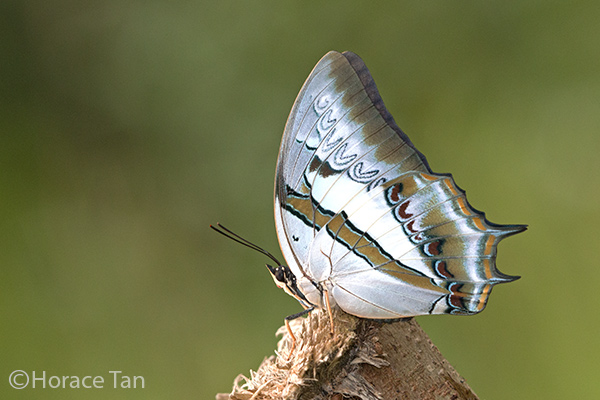
The forewing has a strongly arched costa, a pointed apex and a concave termen. The hindwing has a pair of short stubby tails, longer and more pointed in the female. On the upperside, the Blue Nawab is brownish black with a whitish median band, broadly edged in blue, stretching across both wings. The white band is broader in the female. On the underside, the Blue Nawab is silvery white and is marked with bluish and brownish bands and spots.

A male Blue Nawab giving us a view of its upperside.


Field Observations of Butterfly Behaviour:
Blue Nawab is moderately rare in Singapore. They can be found in urban parks, gardens, forested areas and mangrove wetlands. The adults are large-sized, heavy-bodies butterflies with rapid and strong flights. They have a habit of perching high at tree-top level and have also been observed to puddle on wet grounds, carrion and faeces.


Early Stages:
The early stages of the Blue Nawab have been locally observed to feed on leaves of five plants across different plant families. Of these, the Red Saga is most popularly utilized with regular sightings of caterpillars on young plants. The caterpillars feed on leaves of the host plants, and rest on the leaf upperside. The early instars rests on the midrib near the leaf tip where a silk bed has been spun. Larger caterpillars in later instars spin a silk mat across several leaves/leaflets (if the leaf or a leaflet is not large enough to accommodate the caterpillar) to create their "base camps" for rests between feeds.


Local host plant #1: Adenanthera pavonina (Red Saga).

Local host plant #2: Acacia auriculiformis.

The egg is laid singly on the upperside of a leaf/leaflet of the host plants. Each egg is yellow and spherical in shape, and its surface marked with barely distinguishable longitudinal ridges. The egg is rather large with a diameter of about 1.9mm.

Two views of an egg of the Blue Nawab.

Two views of a mature egg of the Blue Nawab. Note the head capsule being distinguishable through the egg shell.

The hatching event of a Blue Nawab caterpillar.

The egg takes about 4 days to hatch, and the newly hatched has a body length of about 5.5-6mm. The young caterpillar eats the entire egg shell as its first meal. Its body is initially golden brown but turning green a day or two later. It has a black/brownish head with 2 pairs of curved horns, the lower of which being shorter and more straight. There is also pair of pointed process at the posterior segment.

A sequence of three pics showing a newly caterpillar of the Blue Nawab eating its egg shell while its cephalic horns being unfurled concurrently.

Two views of a newly hatched Blue Nawab caterpillar, length: 5.5mm.

Two views of a 1st instar caterpillar, length: 8.5mm.

An early 1st instar caterpillar observed in the field.

After 5-7 days of feeding, the 1st instar caterpillar grows to a length of about 10mm. The caterpillar stays dormant in its base camp with the new head capsule growing progressively larger behind the current one. The caterpillar moults to the next instar about half a day later.

Two views of a late 1st instar caterpillar, dormant prior to its moult, length: 10mm.

The 2nd instar has green body. Its head capsule is now reddish brown and has proportionately longer horns than those in the 1st instar, reddish brown in colour). At the other end, the posterior segment is yellowish brown and squarish, with the two anal process proportionately shorter and positioned at the two corners of this segment. After 4.5-5 days in this instar, and having the body length increased to about 15mm, the caterpillar moults again.

Two views of a newly moulted 2nd instar caterpillar, length: 9mm.

Two views of a 2nd instar caterpillar, length: 13mm.

Two views of a late 2nd instar caterpillar, dormant prior to its moult, length: 15mm.

A 2nd instar Blue Nawab caterpillar resting on the upper surface of a Red Saga leaf in a western wasteland.

The head capsule of the 3rd instar caterpillar is pale beige brown initially; however all but the horns turn greenish (the horns) after a day or two. wide vertical streaks in dark brown. Some specimens might at this stage feature a small yellowish spot on the dorsum of the 3rd abdominal segment. This instar takes about 5 to 6 days to complete with body grown to about 23-26mm in length.

Two views of a 3rd instar caterpillar, early in this stage, length: 14mm.

Two views of a 3rd instar caterpillar, late in this stage, featuring the dorsal spot, length: 26mm.

Two views of another 3rd instar caterpillar, late in this stage, with the dorsal spot absent, length: 23mm.

A 3rd instar caterpillar found in the field, resting in its base camp on a Red Saga plant.

The head capsule of the 4th instar caterpillar is yellowish green with the horns red-tipped in most specimens. In this instar, the dorsal spot on the 3rd abdominal segment could be absent, occur as a tiny speck, a larger oval spot, and bright yellowish crescent mark (edged in black). The two anal processes are now minuscule in size and hardly distinguishable. This penultimate instar lasts a further 6-7 days with body length reaching about 34-37mm. In the last few days of the instar, pale green crescent marks start to appear on each body segment, giving us a hint of what the next instar will bring.

Two views of a newly moulted 4th instar caterpillar, length: 23mm.

Two views of a 4th instar caterpillar, with the dorsal spot in the form of a tiny speck, length: 38mm.

Two views of a 4th instar caterpillar, with the dorsal spot being a prominent crescent mark, length: 38.5mm.

A 4th instar caterpillar found in the field, with the dorsal spot being oval in shape, resting in its base camp on a Red Saga plant.

The 5th instar caterpillar closely resembles the 4th instar caterpillar. The horns on the head capsule are observed to be broader than those in the 4th instar, and the amount of red shading they carry varies from specimen to specimen. The same variation in the dorsal spot on the 3rd abdominal segment can be seen in this instar. Some caterpillars without the dorsal spot in the 4th instar have been observed to possess the spot in the final instar. Another noticeable change is in the posterior segment where the golden brown shading seen in in earlier instars is now absent.

Three 5th instar caterpillars, showing variations in the dorsal spot on the 3rd abdominal segment.

Head capsules of 6 final instar Blue Nawab caterpillars, showing variations in coloration.

Two views of a 5th instar caterpillar, with crescentic mark late in this stage, length: 60mm.

A 5th instar caterpillar found in the field, resting in its base camp on a Red Saga plant.

The 5th instar lasts for 12-13 days typically, but might reach 16 days for some specimens. The body length could reach up to 60-65mm. Toward the end of this instar, the body gradually shortens in length. The fully grown caterpillar soon abandons its "base camp" and goes in hunt for a pupation site. Eventually the caterpillar comes to rest on a spot on the under surface of a stem. There it spins a silk pad to which it attaches its claspers (anal prolegs). The pre-pupatory larva then hangs vertically, typically with its body curled up.

A pre-pupa of the Blue Nawab in its curled up posture

The pupation event of a Blue Nawab caterpillar.

Pupation takes place a day later. The pupa suspends itself from the same silk pad but now with its cremaster. The pupa has a berry like appearance with its thick and cylindrically oval shape. It is green but streaked with abundant white, especially on the leading edge of the wing pads. The tip of the pupa, where the head is sited, is colored reddish/pinky brown. Length of pupa: 24-25mm.

Three views of a berry like pupa of the Blue Nawab.

The pupal period lasts for about 10.5 to 11 days, and the pupa turns dark to reddish brown the night before eclosion. The white median band on the forewings also become visible through the pupal skin at this stage.

Three views of a mature pupa of the Blue Nawab.

Eclosion takes place the next day. The pupal case first cracks open with the adult butterfly making its way out. It quickly turns around and perches on the underside of the pupal case to "dry" and expand its wings. A few hours later, the adult butterfly makes the first flight of its life.

The eclosion event of a Blue Nawab butterfly.

A newly eclosed Blue Nawab clinging on to its pupal case.

A newly eclosed Blue Nawab.

References:
  • [C&P4] The Butterflies of The Malay Peninsula, A.S. Corbet and H.M. Pendlebury, 4th Edition, Malayan Nature Society, 1992.
  • Butterflies of Thailand, Pisuth Ek-Amnuay, 2nd Edition, 2012.
  • A Field Guide to the Butterflies of Singapore, Khew S.K., Ink On Paper Communications, 2010.
Text by Horace Tan, Photos by Lemon Tea Yi Kai, Tan Ben Jin, Simon Sng, Koh Cher Hern, Khew SK and Horace Tan

Saturday, February 7, 2015

Butterfly of the Month - February 2015

Butterfly of the Month - February 2015
The Grand Imperial (Neocheritra amrita amrita)


We're into the Lunar New Year month of 2015, where the Chinese community celebrate the incoming Year of the Goat (or sometimes referred to as the Sheep or Ram as alternative references in the animal horoscope). In the Chinese Zodiac system, the Goat is the 8th animal amongst the 12 animals in the cycle of the Great Race to meet the Jade Emperor.


The Year of the Goat in 2015 starts on 19 Feb and ends on 7 Feb 2016. According to the Chinese Calendar, the element for 2015 is wood and the lucky colour is green (good for us nature lovers and the environmentalists!). Coupled with the Goat being the 8th animal in the Zodiac, and the Chinese affinity for the number 8 being a lucky number, we start the Lunar New Year with lots of luck!


The Goat's personality, according to the mythological beliefs, tends towards those born under this sign to be disorganized, thinkers, creative, and places importance on appearances. Notwithstanding these general attributes, we hope that 2015 will be a year of global success and peace.


Speaking of peace, the last few weeks of the turbulent Year of the Horse in 2014, displayed a rather disturbing trend of extreme individuals and groups with suicidal and sadistic tendencies taking terrorism to unprecedented depths. In the past two months alone, we have had terrorist situations in Australia and France - two countries that would have seldom been associated with terrorist bombings and shootings. And then the grim ISIS madness gripped the world again, with the mindless executions of two Japanese prisoners by beheading, and the burning of a captive Jordanian pilot. A video of the execution spread through cyberspace prompting worldwide condemnation.


A Grand Imperial shot on the island of Koh Phangan, Thailand.  This is the same subspecies found in Malaysia and Singapore
© Antonio Giudici

This time, even the Islamic world was shocked at the wanton killing of totally defenceless men by the ISIS terrorists in the name of Islam. These soulless murderers are certainly not deserving of preaching any religion whatsoever, except one of absolute and darkest evil. That the execution of one of their own prompted a retaliation counterstrike by the Jordanian Air Force is not going to help peace in that part of the world, even as we wonder how this would end for ISIS?


Coming back to our more innocent butterfly world, the rains of the Northeast monsoons have pretty much dried up, and the weather is a bit more conducive for butterfly outings here in Singapore. However, butterfly activity is still generally low, particularly in the forested areas. An interesting observation (purely anecdotal though) to note is that the Hesperiidae (or Skippers) appear to be the first to make their presence felt more prominently, compared to the other butterfly families.


This month, we feature an attractive long-tailed Lycaenidae, the Grand Imperial. This pretty "Hairstreak", arguably the largest member of the family in Singapore if measured from wingtip to the ends of its long tails, is considered a rare species. Usually found in Singapore's forested nature reserves, it tends to stay in the shady forest understory, flitting amongst the thick shrubbery.


My first encounter with this species was on the military-controlled island of Pulau Tekong - an island on the northeastern coast of Singapore, measuring about 25 km2. Having had the opportunity to participate in NParks biodiversity surveys in the early 2000's on Pulau Tekong, I encountered a colony of this species quite regularly on the island. Perhaps the undisturbed forested areas was conducive for the Grand Imperial, and the highest count in terms of numbers was 8 individuals on one outing.


Over on mainland Singapore, the species is shy and remains in the sanctuary of the forested nature reserves. The caterpillar host plant is a parasitic plant, which appears to be uncommon in the forested areas. The life history is being documented, and will be featured on this blog in the near future.


A female Grand Imperial sunbathes with open wings, showing its brown upperside

The Grand Imperial has a deep bluish green upperside in the male, with broad black apical forewing tips. Females are a drab brown above and unmarked on the forewings but features large black marginal and submarginal spots on the hindwings.


A male Grand Imperial feeding on the flowers of a tree

The underside of the Grand Imperial is predominantly orange on the forewings, and the costal half of the hindwing. The rest of the hindwing is pure white. The hindwing bears a long tail at vein 2, where this long white tail is usually equal to the dimension of the fore and hindwing of the butterfly. There is an additional shorter tail at vein 3 of the hindwing.


A male Grand Imperial. Note the circular "disc" on the underside of its hindwing

Where found, the female is the commoner sex, and sometimes more than one individual can be sighted. Males tend to stay at treetop level and occasionally stop with their wings opened flat to sunbathe. Females are sometimes found in the vicinity of its caterpillar host plant closer to the ground.


A Grand Imperial takes cover under a leaf

The Grand Imperial flies with its long white tails trailing elegantly behind as it flits in the shady forested areas. Females have an interesting habit of hiding under leaves, resting upside down, probably to hide from predators. As it rests, the long tails twirl actively, as though they are alive, and this movement may fool predators to attacking the tails and tornal area of the hindwing, missing the critical parts of the butterfly when attacked, allowing it to escape. However, when alarmed, the butterfly will take to the treetops very quickly.


As we celebrate the Lunar New Year and welcome the Year of the Goat, all of us at ButterflyCircle would like to wish all our Chinese readers...

"Gong Xi Fa Cai and a Happy & Prosperous Lunar New Year!"

Text by Khew SK : Photos by Sunny Chir, Chng CK, Jerome Chua, Antonio Giudici, Khew SK, Nelson Ong and Simon Sng


Saturday, January 31, 2015

Life History of the Common Four Ring

Life History of the Common Four Ring (Ypthima huebneri )


Butterfly Biodata:
Genus: Ypthima Hübner, 1818
Species: huebneri Kerby, 1871
Wingspan of Adult Butterfly: 30-35mm
Caterpillar Local Host Plant: Ottochloa nodosa (Poaceae).


Physical Description of Adult Butterfly:
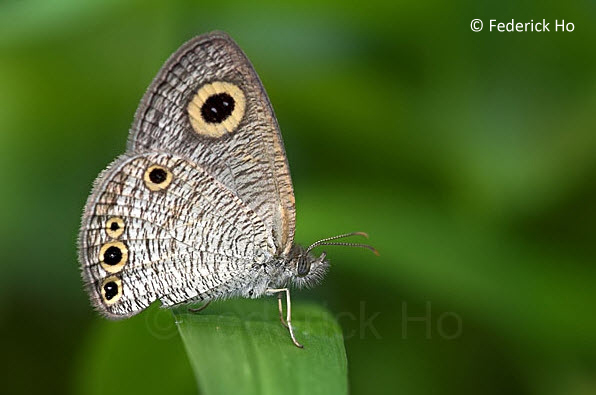
The adults are typically small as compared to other Ypthima spp. present in Singapore. On the upperside, the wings are greyish brown with a moderately large, bi-pupilled, yellow-ringed, subapical ocellus on the forewing, and two yellow-ringed ocelli in spaces 1b and 2 on the hindwing. The male has a greyish black  sex brand in the distal area of the forewing. On the underside, both wings are pale greyish to bluff brown and are traversed by numerous fine dark brown striae. The forewing has a large, bi-pupilled, yellow-ringed, subapical ocellus. The hindwing has four yellow-ringed ocelli in spaces 1b, 2, 3 and 6 with the one in space 1b bi-pupilled.

A sun-bathing male Common Four Ring showing its upperside.

A sun-bathing female Common Four Ring showing its upperside.


Field Observations of Butterfly Behaviour:
The Common Four Ring is moderately common in Singapore, and is mostly sighted in localized areas within the nature reserve. Adults are usually observed flying low among vegetation in and around grassy patches on open areas. As with other Satyrinae members, the adults have a feeble flight. They typically fly in an erratic and jerky manner as their wings are closed for a relatively long period during flights. In sunny conditions, the adults have the tendency to sun-bath with fully open wings.


Early Stages:
Only one local host plant, a common grass species, Ottochloa nodosa, has been recorded so far. It is believed that other grass spp. could also be utilized by the Common Four Ring as its larval host plant. The caterpillars feed on leaves of the host plant, and have been observed to forcefully ejecting their frass pellets, a larval habit rarely seen outside the skipper/flat families.

Host plant: Ottochloa nodosa.

A mating pair of Common Four Ring.

The eggs are laid singly on the leaf blade or the stem of its host plant, or on other plants or objects in close proximity to the host plant. Each egg is globular in shape (about 0.9mm in diameter) and bluish green in colour. The egg surface is covered with many small polygonal patches.

Two views of an egg of the Common Four Ring laid on the underside of a leaf of dicot plant.

Two views of a mature egg with the head vaguely distinguishable through the egg shell.

The egg takes about 5.5 days to mature. The young caterpillar nibbles away a portion of the egg shell to exit and proceeds to devour the rest of the egg shell. It has a pale yellowish body bearing reddish patches. The body has an initial length of about 2-2.2mm, and is covered with dorso-lateral and lateral rows of long setae. At the posterior end, there is a pair of short backward-pointing processes. Its yellowish brown head features a number of setae and has a pair of short and rounded horns and a few lateral protuberances which are smaller.

Two views of a newly hatched caterpillar, length: 2.2mm.

As a result of its leaf diet, the 1st instar caterpillar soon takes on a strong greenish undertone, and reddish patches on its body fade away in a day or two. Narrow, whitish bands appear dorsally, dorso-laterally and laterally. The first instar lasts about 6.5-7 days with the body length increases to about 5mm.

Two views of a 1st instar caterpillar, length: 2.8mm.

Two views of a 1st instar caterpillar, late in this instar, length: 4.6mm.

Two views of a late 1st instar caterpillar, dormant prior to its moult, length: 5mm.

In the 2nd instar, the head turns pale greenish in colour. The body color is pale yellowish green. There are numerous, tightly spaced, tiny, whitish protuberances on the body and the head, each with a setae emanating from it. The two anal protuberances are now proportionately longer and more pointed. The 2nd instar lasts about 7-8 days with the body length reaches about 7.5mm.

Two views of a 2nd instar caterpillar, newly moulted, length: 4.8mm.

Two views of a 2nd instar caterpillar, length: 7.5mm.

Two views of a late 2nd instar caterpillar, dormant prior to its moult, length: 7.2mm.

The 3rd instar caterpillar mostly resembles the previous instar. This stage also takes 7-8 days to complete with body length reaching about 12mm.

Two views of a newly moulted 3nd instar caterpillar, length: 7mm.

Two views of a 3nd instar caterpillar, late in this stage, length: 12mm.

Two views of a late 3nd instar caterpillar, dormant prior to its moult, length: 10mm.

The 4th instar caterpillar bears a strong resemblance to the 3rd instar caterpillar with no obvious change of any features or markings. The 4th instar lasts about 8 days with body length reaching about 15mm.

Two views of a newly moulted 4th instar caterpillar.

Two views of a 4th instar caterpillar, length: 13mm.

Two views of a late 4th instar caterpillar, dormant prior to its moult, length: 14mm.

The next moult brings the caterpillar to its 5th and final instar. There is still no prominent shift in appearance. The two anal processes are now much shorter and less prominent than in the previous instars while the blanket of setae-bearing tubercles appear to be denser in this instar. In a period of about 12 days, the body grows to a maximum length of about 21-23mm.

Two views of a newly moulted 5th instar caterpillar.

Two views of a 5th instar caterpillar, length: 21mm.

Toward the end of the 5th instar, the body gradually shrinks in length. Finally the caterpillar finds a spot on the underside of a leaf blade to spin a silk pad. It then secures itself there via its anal end, and assumes its upside-down pre-pupatory pose.

A sequence showing the development of a prep-pupa of the Common Four Ring.

After about 1 day in the pre-pupal stage, pupation takes place. The green pupa is somewhat angular and longish, with a dorsal protrusion on the thorax and ridges defining the dorsal wing margins (which are colored dark-red). Length of pupae: 8.5-9mm.

Two views of a pupa of the Common Four Ring.

After 7 days of development, the pupa becomes darkened in color, and the subapical ringed-spot on the forewings can now be seen through the pupal skin in the wing pads. The next day the eclosion event takes place with the adult butterfly emerges to start the next phase of its life cycle.

Two views of a mature pupa of the Common Four Ring.

A newly eclosed Common Four Ring clinging on to its pupal case.

References:
  • [C&P4] The Butterflies of The Malay Peninsula, A.S. Corbet and H.M. Pendlebury, 4th Edition, Malayan Nature Society, 1992.
  • Butterflies of Thailand, Pisuth Ek-Amnuay, 2nd Edition, 2012.
  • A Field Guide to the Butterflies of Singapore, Khew S.K., Ink On Paper Communications, 2010.
Text by Horace Tan, Photos by Bobby Mun, Nelson Ong, Frederick Ho and Horace Tan