Saturday, January 10, 2015

Butterfly of the Month - January 2015

Butterfly of the Month - January 2015
The Long-Banded Silverline (Spindasis lohita senama)


A new year has begun! 2015 has started cautiously for the global economy, with the falling oil prices threatening to dampen and even negatively affect many countries' economic recovery and growth. Whilst only certain countries are feeling the effect on their currencies, the world today is inextricably connected in terms of bilateral trade and economic cooperation, and when more countries are affected, it is likely that even those which appear unscathed will feel the strain. Oil is a mineral that affects practically every aspect of our daily lives and it is hard to escape any severe fluctuations in price - whether up or down.


Towards the end of an eventful 2014, a third plane disaster struck in our Southeast Asian region. Whilst we thought that two crashes affecting Malaysian Airlines Flights 370 and 17 was more than any country can take in terms of loss of innocent lives in civilian crashes, the AirAsia flight QZ8501 crash was something totally unprecedented for Malaysia in terms of a single country's flight safety record in a single year. The Airbus A320 plane carrying 162 passengers and crew from Surabaya to Singapore did not make it, and it is feared that everyone on board perished in the crash.


Murder (in whatever form you call it) in the name of religion continues to rear its ugly head even as the New Year celebrations to herald 2015 were still fresh in our minds. This time, extremists or terrorists, massacred 12 people in the unlikely city of Paris. Angered by the satirical cartoons of the the newspaper Charlie Hebdo, which purportedly pokes fun at Islam (and other religions and political leaders), two fanatical brothers stormed and shot dead a number of the cartoonists at the office of the newspaper, along with some police personnel as well.


"These madmen, fanatics, have nothing to do with the Muslim religion," France's President Francois Hollande said in a televised address. Indeed. Which religion's God teaches its subjects to murder innocent unarmed people? This form of extremism is not expected to go away in 2015. If anything, it will worsen as the world struggles with intolerance and human ego - driving fanatics to continue to eliminate people who do not subscribe to their way of thinking.


This month, January 2015, we continue with our long-standing series of featuring a butterfly species every month. Our 87th butterfly species to take the limelight on our blog is the Long Banded Silverline (Spindasis lohita senama). This small, but very attractive butterfly starts our new year with a bit of optimism and hope for the year ahead.


The Long Banded Silverline belongs to the family Lycaenidae, often known by its generic name of "Blues and Hairstreaks" - featuring many small sized butterflies with prominent tails. The tails and eyespots on the hindwings of the family Lycaenidae are often described to perform the function of a decoy which fools predators into attacking the "wrong" part of the butterfly, thereby allowing the butterfly to escape a fatal blow to its real head.


Our feature butterfly of the month is one of a few species which is attractive both on the upper and underside of the wings. There are many species showing beautiful bright colours and patterns on either the upper or underside, but not many species features such beauty on both.


The Long Banded Silverline is one of two species of the genus Spindasis found in Singapore. Both species are widely distributed, and can be found more regularly at urban parks and gardens than in the forested nature reserves of Singapore. The Silverlines are characterised by their banded appearance on the undersides of their wings, centred with silvery markings. The hindwing bears a pair of delicate filamentous white-tipped tails.


The butterfly is moderately common, and at times, several individuals are spotted together. The Long Banded Silverline is a fast-flyer, but often stops to perch at its favourite leaf or branch repeatedly. At rest, they often stop with their wings folded upright. However, when conditions are right at certain hours of the day, they can be observed to open their wings to sunbathe.


A male Long Banded Silverline showing off its upperside

The male of the Long Banded Silverline is deep blue above with broad black apical borders on the forewing. The female is a plain brownish-blue above and generally unmarked, although the underside markings can often be perceived through the wings. The underside is an yellowish-cream ground colour with red streaks infilled with silvery streaks.
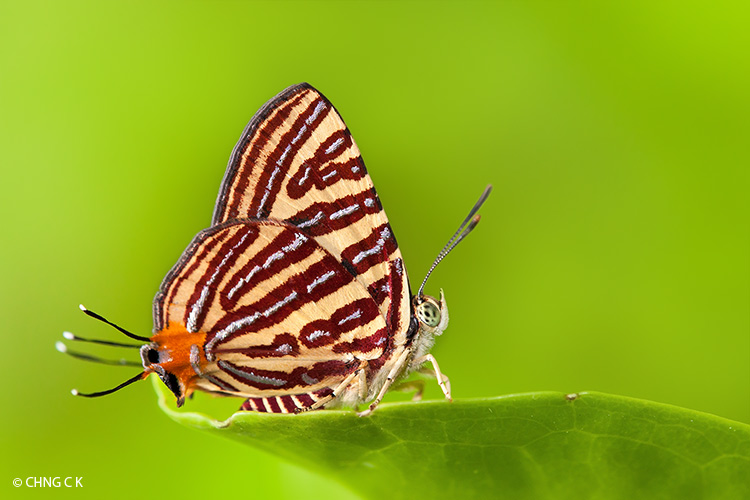


The distinguishing markings between this species and its closely-related cousin, the Club Silverline (Spindasis syama terana) can be found in the basal area on the underside of the forewing. The basal streak is L-shaped in the Long Banded Silverline, but club-shaped in the Club Silverline. The hindwing has two white-tipped tails emerging from a prominent orange tornal patch.


Long Banded Silverlines feeding on the Mile-A-Minute flowers (top) and Red Tree Bush (Leea rubra) (bottom)

The Long Banded Silverline can often be observed feeding on the flowers of the Bandicoot Berry (Leea indica) and the Red Tree Bush (Leea rubra). In other areas, we have seen a number feeding on the inflorescence of the Mile-A-Minute creeper (Mikania micrantha).


The butterfly is often observed to rest with its head facing downwards

When disturbed, the butterfly flies rapidly and hides under a leaf. At times, it also displays this habit of perching on the underside of a leaf, upside down. When at rest, individuals are also often observed to stop on a vertical perch with its head facing downwards. This may be related to a defensive behaviour of posing with its "false head and eyes" facing upwards to fool predators into attacking that part of the wings.


This species' caterpillars have been successfully bred on a number of host plants that include the guava and Singapore Rhododendron. It is also believed to be able to breed on the exotic Australian tree, Acacia auriculiformis which can be found growing wild in many parts of Singapore, where a female of the species was observe to be ovipositing on a leaf of the tree.

Text by Khew SK : Photos by Sunny Chir, Chng CK, Koh CH, Khew SK, Loke PF, Nelson Ong, Jonathan Soong, Mark Wong, Benjamin Yam and Zhuang YY

Saturday, January 3, 2015

Life History of the Three Spot Grass Yellow

Life History of the Three Spot Grass Yellow (Eurema blanda snelleni)


Butterfly Biodata:
Genus: Eurema
Hübner, 1819
Species: blanda Boisduval, 1836
Subspecies: snelleni Moore, 1907
Wingspan of Adult Butterfly: 35-45mm
Caterpillar Local Host Plant: Falcateria moluccana (Fabaceae, common name: Albizia).


A large group of puddling Three Spot Grass Yellow adults.

A Three Spot Grass Yellow with the "three spots" illustrated.

Physical Description of Adult Butterfly:
Above, the wings are deep lemon-yellow. The forewing has a black border which is regularly scalloped and deeply excavated between veins 2 and 4 (more so in the female than in the male). Underneath, the wings are yellow with freckled brown spots. There are typically three cell spots on the forewing and a black spot at the base of space 7 on the hindwing. It is not uncommon for some individuals to have a large brown apical spot/patch on the forewing. Males have a brand lying along the cubital vein on the forewing underside.


Field Observations of Butterfly Behaviour:
The Three Spot Grass Yellow is common in Singapore and can be found both inside and outside the nature reserves. The adults can be seen fluttering in their habitatss in the company of other Grass Yellow spp. leading to difficulty in identifying them correctly. They regularly visit flowers for nectar and puddle on wet grounds for minerals. There have been records of population outbreaks when hundreds of them can be seen together in various locations across Singapore.


Another Three Spot Grass Yellow with lowest of the three spots diminutive.


Early Stages:
Across the vast region where the Three Spot Grass Yellow can be found, several larval host plants in the Fabaceae family have been recorded. Locally, only one host plant, Falcateria moluccana, has been recorded so far. The caterpillars feed on the leaves of the host plant. They are gregarious throughout all five instars of their life cycle, often eating, resting, moulting and pupating together in groups.

Local host plant: Falcateria moluccana.

A mating pair of the Three Spot Grass Yellow.

The eggs of the Three Spot Grass Yellow are laid in a cluster of several tens on a young shoot of of the host plant. The spindle shaped egg is laid standing at one end with a length of about 1.3-1.4mm. It is whitish in color and has indistinct shallow vertical ridges. The micropylar sits at the tip of the standing egg.

A cluster of about 40-odd eggs of the Three Spot Grass Yellow laid on a young shoot of the local host plant.

Left: An egg of the Three Spot Grass Yellow. Right: a mature egg with the young larva caught in the act of nibbling away the egg shell.

The eggs take about 3-4 days to hatch. Each newly hatched caterpillar has a length of about 1.7mm and has a dark brown head capsule. It has a cylindrical and pale whitish body covered with dorso-lateral and lateral rows of tubercles running lengthwise. As is the case for other Eurema spp., each tubercle has a seta emerging from the middle of it with the tip of the seta bearing a droplet-like structure. These droplet-bearing setae is a feature seen in all five instars of the larval phase.

Newly hatched caterpillars of the Three Spot Grass Yellow.

Two views of a newly hatched caterpillar of the Three Spot Grass Yellow.

After hatching, the young caterpillar eats the empty egg shell for its first meal, and then moves on to eat the leaf lamina for subsequent meals. The body colour turns yellowish green as growth progresses. The body length reaches 3.8 to 4 mm in about 2 days before the moult to the 2nd instar.

Two view of a 1st instar caterpillar, length 2.5mm.

A group of 1st instar caterpillars of the Three Spot Grass Yellow.

Two view of a late 1st instar caterpillar, dormant prior to its moult, length 3.8mm.

The 2nd instar caterpillar is yellowish green in body colour. The dark brown head capsule has the same tiny setae-bearing tubercles as those on the body surface. A pale yellowish band runs laterally along each side of the body. This instar lasts about 2 days with the body length reaching 7-8mm.

Two views of a 2nd instar caterpillar, length 6.2mm.

A group of 2nd instar caterpillars of the Three Spot Grass Yellow.

Two views of a late 2nd instar caterpillar, dormant prior to its moult, length: 7.8mm

The 3rd instar caterpillar resembles the 2nd instar caterpillar closely. The head capsule is still dark brown overall but the front mod-section is now yellowish. This instar is fast-paced and takes about 1-1.5 days to complete with body length reaching about 10-11mm.

Two views of a 3rd instar caterpillar, length: 10mm.

Two views of late 3rd instar caterpillar, dormant prior to its moult, length: 10.5mm.

A group of 3rd instar caterpillars of the Three Spot Grass Yellow (with a a few 1st instar caterpillars in the mix).

The body of the 4th instar caterpillar is still yellowish green but the head capsule is now darker than in the previous instar, becoming almost all black in coloration except for the frontoclypeus (triangular area above the mouth parts) which is yellowish. This instar takes about 2-2.5 days to complete with body length reaching about 17mm.

Two views of a 4th instar caterpillar, length: 13.8mm.

Two views of a late 4th instar caterpillar, dormant prior to its moult, length: 16.8mm.

A group of 4th instar caterpillars of the Three Spot Grass Yellow.

The 5th and final instar caterpillar resembles the 4th instar caterpillar closely. Unlike some other Grass Yellow species, the yellowish lateral bands do not become broader, whitish or more prominent in the final instar. The numerous setae-bearing tubercles are more prominent as they appear in darker green in contrast to the paler body base colour. The droplets at the end of these setae turn bluish in this instar, giving the caterpillar a darker and more bluish appearance. The 5th (and final) instar lasts for 2-3 days, and the body length reaches up to 26-28mm.

Two views of a 5th instar caterpillar, early in this stage, length: 17mm.

Two views of a 5th instar caterpillar, length: 23.5mm.

A close-up view of the bluish droplets at the tip of body setae.

A group of 5th instar caterpillars of the Three Spot Grass Yellow.

On the last day of the 5th instar, the body of the caterpillar shortens and the body colour changes to either bright or dull green (with a hint of pink tone). It ceases feeding and comes to a halt on the underside of a stem/stalk on the host plant. Here the caterpillar spins a silk pad and a silk girdle. With its posterior end secured to the silk pad via claspers, and the body suspended at the mid-section with the girdle, the caterpillar soon becomes immobile in this pre-pupatory pose. It is not uncommon that a number of caterpillars choose to do so on the same stem/stalk at a short distance from each other.

A pre-pupatory larva of the Three Spot Grass Yellow.

Pupation takes place about 0.5 day later. The pupa secures itself with the same silk girdle as in the pre-pupal stage, but with the cremaster replacing claspers in attaching the posterior end to the silk pad, It has a pointed head (with a whitish cephalic horn) and a keeled wing pad, and its body is typically adorned with a number of small black spots/patches. There is a faint pale brownish dorsal band. The body colour varies from pale green to yellowish green or even pale brownish green to dark brown. Length of pupae: 18-19mm..

The pupation event of a Three Spot Grass Yellow caterpillar.

Four pupae of the Three Spot Grass Yellow, showing variations in coloration and markings.

Two views of a pupa of the Three Spot Grass Yellow.

Two views of a mature pupa of the Three Spot Grass Yellow.
The now transparent wing pad shows the yellow forewing upperside with its black border
.

After about 4 days of development, the pupal skin turns translucent as the development within the pupal case comes to an end. The yellow coloration and back borders on the forewing upperside are now discernible. The following day, the adult butterfly emerges from the pupal case.

A Three Spot Grass Yellow butterfly emerges from its pupal case.

A newly eclosed Three Spot Grass Yellow clinging onto its empty pupal case.

A sequence of pictures showing the development of three Three Spot Grass Yellow caterpillars from the pre-pupal stage to the adult stage.

References:
  • [C&P4] The Butterflies of The Malay Peninsula, A.S. Corbet and H.M. Pendlebury, 4th Edition, Malayan Nature Society, 1992.
  • Butterflies of Thailand, Pisuth Ek-Amnuay, 2nd Edition, 2012
  • A Field Guide to the Butterflies of Singapore, Khew S.K., Ink On Paper Communications, 2010.

Text by Horace Tan, Photos by Steven Wee, PF Loke, Tan Ben Jin, Khew S K and Horace Tan