Butterfly Hill @ Pulau Ubin

Aerial view of Butterfly Hill @ Pulau Ubin - © National Parks Board
Pulau Ubin, an offshore island of Singapore of about 10.2 sqkm, is often considered the "last frontier" of rural ambience and rich biodiversity in Singapore. Local Malays once called it "Pulau Batu Ubin" or Granite Stone Island. In the past this small island supplied the local construction industry with granite and sand, from which coarse aggregates and the sand were used to construct roads, manufacture concrete and other building materials. The granite was also used to make floor tiles, or Jubin as it was called in Malay.

A map of Pulau Ubin - © National Parks Board
Today, the 7km long by 2km wide island is a favourite weekend destination for adventure lovers and nature enthusiasts taking a short bumboat ride from the Changi Ferry Terminal. The island is known for its rich biodiversity and rustic environment to which many weekend visitors flock to get away from Singapore's hectic urban lifestyle.

On the bumboat back from Ubin with senior government officials and nature enthusiasts
In early 2014, the Ministry of National Development, led by Minister of State Desmond Lee, visited Pulau Ubin with a group of nature enthusiasts, heritage experts and community leaders. The visit was part of the wider plan to initiate a conversation with Singaporeans on how we can all play a part to sensitively enhance the natural environment of Pulau Ubin, which was announced by Mr Desmond Lee in Parliament in March 2014.

A group photo of Friends of Ubin Network taken at Singapore Botanic Gardens
Subsequently, the Friends of Ubin Network (FUN) was set up to continue to engage the stakeholders whilst a public feedback portal and even an Ubin Symposium was organised to openly discuss possible options for Ubin. There have been numerous media articles and blog articles discussing what different groups of people want for Ubin.

Blue Glassy Tiger (Ideopsis vulgaris macrina) - a "resident" species at Butterfly Hill
On 30 Nov 2014, a public event to celebrate Pulau Ubin, will be resurrected by Ria Tan and Grant Pereira. The event, known as Ubin Day, was previously held in 2002 and 2003, and this will be the 3rd instalment of this event, featuring different activities by various groups in many parts of the island. The event's objective is to introduce the diversity of activities that can be enjoyed by the general public on this little island, and to showcase the amazing biodiversity that we have on Ubin.

A peep at the Butterfly Hill during earthworks back in 2005
Let's come back to Pulau Ubin's Butterfly Hill. In 2005, the Jelutong Campsite was created out of a piece of wasteland reclaimed from the sea during past granite quarrying operations. Within the campsite sits Butterfly Hill – a knoll created specially to conserve and showcase butterflies. Back then, I worked with NParks' staff, Robert Teo, Choi Yook Sau, Jacky Soh and How Choon Beng to build up Butterfly Hill from scratch. I remember vividly when the hill was completely wiped clean except for a solitary tree, and the hill was just covered with red earth.

Black Veined Tiger (Danaus melanippus hegesippus) - a regular visitor at Butterfly Hill
Fast forward to 2014, it's been almost 10 years in the making, and the Butterfly Hill continues to be a good place to observe butterflies, yielding the occasional surprise in terms of rare species. Over the period since the Butterfly Hill was designed and planted with butterfly host and nectaring plants, we have recorded over 150 species (and counting!). On a typical day, one can expect to be greeted by the resident Plain Tigers, Blue Glassy Tigers, Pea Blues, Great Eggflies, Common Birdwings and others. A half day butterfly watching outing should easily yield about 20 different species.

Common Line Blue (Prosotas nora superdates) feeding on Bidens flower at Butterfly Hill
Amongst the uncommon butterflies that have been spotted and photographed at Ubin's Butterfly Hill are :
Mangrove Tree Nymph (Idea leuconoe chersonesia) - This large Danainae is very rare, previously known only from Pulau Tekong. This individual was photographed at Butterfly Hill recently.
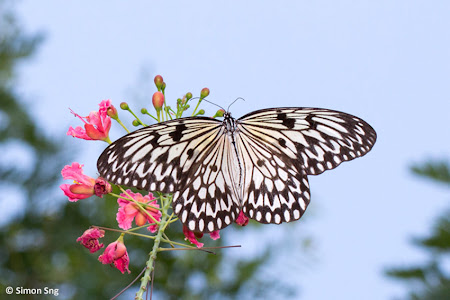
Malayan Birdwing (Troides amphrysus ruficollis) - A large and showy Birdwing, this species was first recorded in Singapore from a caterpillar discovered at Alexandra Hospital's Butterfly Trail. This species was seen on Butterfly Hill and there have been subsequent sightings in the past year.

Great Mormon (Papilio memnon agenor) - This large swallowtail frequents Butterfly Hill because its caterpillar host plant, Pomelo (Citrus grandis) is cultivated here.

Lesser Striped Black Crow (Euploea eyndhovii gardineri) - This Crow is uncommon and often encoutered singly. Butterfly Hill is one location where this species is observed quite regularly.

Dwarf Crow (Euploea tulliolus ledereri) - The Dwarf Crow is thus far known reliably only from Pulau Ubin. Whilst it was previously seen regularly at Butterfly Hill, it has become rarer and not often seen in the past two years.

Bamboo Tree Brown (Lethe europa malaya) - A shy and skittish shade lover, this species is regularly seen amongst the bamboo clumps at Butterfly Hill.

Forest Hopper (Astictopterus jama jama) - This elusive skipper has regularly been spotted at Butterfly Hill usually flying rapidly amongst the low shrubbery.

Conjoined Swift (Pelopidas conjunctus conjunctus) - This large and fast-flying skipper has been observed at Butterfly Hill on several occasions by ButterflyCircle members.

Plain Palm Dart (Cephrenes acalle niasicus) - This skipper, though not often spotted, has been seen several times at Butterfly Hill, particularly when there are flowering Syzygiums.

So when you visit Pulau Ubin's Butterfly Hill, do look out for some of these rarities, and we hope that you can also add more to the checklist of butterflies on Butterfly Hill by spotting other new species!

On 30 Nov 2014's Ubin Day, ButterflyCircle members will be on site to share tips on butterfly watching and photography. For those who are keen to join us, please sign up here. We look forward to an enjoyable morning with nature's flying jewels!
Text by Khew SK : Photos by Brian Goh, Khew SK, Simon Sng, Jonathan Soong, Anthony Wong, Yong Wei Hoong

A group photo of Friends of Ubin Network taken at Singapore Botanic Gardens
Subsequently, the Friends of Ubin Network (FUN) was set up to continue to engage the stakeholders whilst a public feedback portal and even an Ubin Symposium was organised to openly discuss possible options for Ubin. There have been numerous media articles and blog articles discussing what different groups of people want for Ubin.

Blue Glassy Tiger (Ideopsis vulgaris macrina) - a "resident" species at Butterfly Hill
On 30 Nov 2014, a public event to celebrate Pulau Ubin, will be resurrected by Ria Tan and Grant Pereira. The event, known as Ubin Day, was previously held in 2002 and 2003, and this will be the 3rd instalment of this event, featuring different activities by various groups in many parts of the island. The event's objective is to introduce the diversity of activities that can be enjoyed by the general public on this little island, and to showcase the amazing biodiversity that we have on Ubin.

A peep at the Butterfly Hill during earthworks back in 2005
Let's come back to Pulau Ubin's Butterfly Hill. In 2005, the Jelutong Campsite was created out of a piece of wasteland reclaimed from the sea during past granite quarrying operations. Within the campsite sits Butterfly Hill – a knoll created specially to conserve and showcase butterflies. Back then, I worked with NParks' staff, Robert Teo, Choi Yook Sau, Jacky Soh and How Choon Beng to build up Butterfly Hill from scratch. I remember vividly when the hill was completely wiped clean except for a solitary tree, and the hill was just covered with red earth.

Black Veined Tiger (Danaus melanippus hegesippus) - a regular visitor at Butterfly Hill
Fast forward to 2014, it's been almost 10 years in the making, and the Butterfly Hill continues to be a good place to observe butterflies, yielding the occasional surprise in terms of rare species. Over the period since the Butterfly Hill was designed and planted with butterfly host and nectaring plants, we have recorded over 150 species (and counting!). On a typical day, one can expect to be greeted by the resident Plain Tigers, Blue Glassy Tigers, Pea Blues, Great Eggflies, Common Birdwings and others. A half day butterfly watching outing should easily yield about 20 different species.

Common Line Blue (Prosotas nora superdates) feeding on Bidens flower at Butterfly Hill
Amongst the uncommon butterflies that have been spotted and photographed at Ubin's Butterfly Hill are :
Mangrove Tree Nymph (Idea leuconoe chersonesia) - This large Danainae is very rare, previously known only from Pulau Tekong. This individual was photographed at Butterfly Hill recently.

Malayan Birdwing (Troides amphrysus ruficollis) - A large and showy Birdwing, this species was first recorded in Singapore from a caterpillar discovered at Alexandra Hospital's Butterfly Trail. This species was seen on Butterfly Hill and there have been subsequent sightings in the past year.

Great Mormon (Papilio memnon agenor) - This large swallowtail frequents Butterfly Hill because its caterpillar host plant, Pomelo (Citrus grandis) is cultivated here.
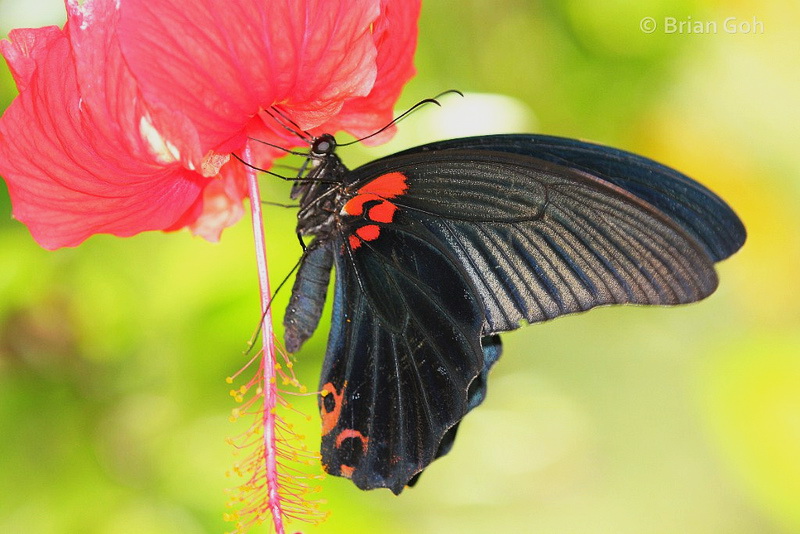
Lesser Striped Black Crow (Euploea eyndhovii gardineri) - This Crow is uncommon and often encoutered singly. Butterfly Hill is one location where this species is observed quite regularly.

Dwarf Crow (Euploea tulliolus ledereri) - The Dwarf Crow is thus far known reliably only from Pulau Ubin. Whilst it was previously seen regularly at Butterfly Hill, it has become rarer and not often seen in the past two years.

Bamboo Tree Brown (Lethe europa malaya) - A shy and skittish shade lover, this species is regularly seen amongst the bamboo clumps at Butterfly Hill.

Forest Hopper (Astictopterus jama jama) - This elusive skipper has regularly been spotted at Butterfly Hill usually flying rapidly amongst the low shrubbery.

Conjoined Swift (Pelopidas conjunctus conjunctus) - This large and fast-flying skipper has been observed at Butterfly Hill on several occasions by ButterflyCircle members.

Plain Palm Dart (Cephrenes acalle niasicus) - This skipper, though not often spotted, has been seen several times at Butterfly Hill, particularly when there are flowering Syzygiums.

So when you visit Pulau Ubin's Butterfly Hill, do look out for some of these rarities, and we hope that you can also add more to the checklist of butterflies on Butterfly Hill by spotting other new species!

On 30 Nov 2014's Ubin Day, ButterflyCircle members will be on site to share tips on butterfly watching and photography. For those who are keen to join us, please sign up here. We look forward to an enjoyable morning with nature's flying jewels!
Text by Khew SK : Photos by Brian Goh, Khew SK, Simon Sng, Jonathan Soong, Anthony Wong, Yong Wei Hoong


