Monday, March 10, 2014

Butterflies Galore! : Grand Imperial

Butterflies Galore!
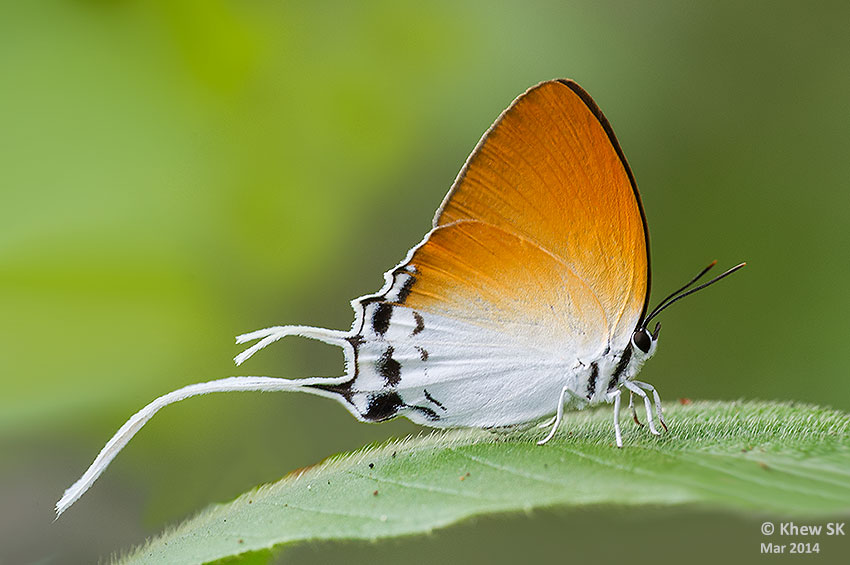
The Grand Imperial (Neocheritra amrita amrita)


This long-tailed Lycaenid is considered a rare butterfly in Singapore and is not regularly encountered. It is one of the largest Lycaenid butterflies in Singapore and sports the longest tails amongst all the "Imperials" found here. Interestingly, this species is quite common on the offshore military island of Pulau Tekong where several individuals can be observed at their favourite locations on the island. It is a forest-dependent species and is usually encountered in the shaded forests within the nature reserves.

The male Grand Imperial is a royal blue on the upperside with black apical borders. The female is dark brown above with a prominent white tornal area on the hindwing. The underside of the forewing and the costal half of the hindwing are brownish-orange and the rest of the hindwing is pure white.

Friday, March 7, 2014

Life History of the Starry Bob

Life History of the Starry Bob (Iambrix stellifer)


Butterfly Biodata:
Genus: Iambrix Watson, 1893
Species: stellifer Butler, 1879
Wingspan of Adult Butterfly: 18-22mm
Caterpillar Local Host Plants: Centotheca lappacea (Poaceae, common name: Sefa), Lophatherum gracile (Poaceae).


Physical Description of Adult Butterfly:
The adults are small and the 3rd segment of the palpi is long and thin. On the upperside, both sexes are dark brown. The male is unmarked but the female has several white post-discal spots on the forewing. On the underside, the wings are brown to dark brown overlaid with ochreous scales. The apical area of the forewing is yellowish to yellowish brown. There are variable number of silvery spots on both wings. In fully-spotted specimens, the forewing features post-discal spots in spaces 2-5 and one spot near cell-end, and the hindwing features post-discal spots in spaces 1b, 2, 5 and 7, and one spot near cell-end. Noteworthy is that the spot in space 5 on the hindwing lies further out and about half way between cell-end and the wing margin. In the look alike species Iambrix salsala (Starry Bob), this spot lies just beyond the cell.


Field Observations of Butterfly Behaviour:
Starry Bob is moderately rare in Singapore and is typically found in forested ares in the nature reserves and western wastelands. Within the nature reserve, the adults are usually sighted when they are feeding on flowers of Leea indica in the company of other skippers such as the Yellow Vein Lancer. The adults tend to perch in shady foliage and are rarely sighted puddling on wet ground or organic waste matter.


Early Stages:
Two host plants, Centotheca lappacea and Lophatherum gracile, which are bamboo-like grass species, have recently been recorded as the local larval hosts for Starry Bob. Probably due to the bamboo-like appearance of these plants, the larval host for Starry Bob was previously recorded as "bamboo spp". Both plants can be found in forested areas in Singapore, with Centotheca lappacea much more common and widespread. The caterpillars of the Starry Bob feed on leaves of the host plant, and live in shelters made by joining edges of a leaf or cut segment together with silk threads. As with other skipper species, the caterpillars have the habit of forcefully ejecting their frass pellets.

Host plant #1:Centotheca lappacea.

Host plant #2:Lophatherum gracile.

The eggs are laid singly on the upperside of a leaf of the host plant. Each dome-shaped egg is pinky red mottled with whitish patches. The base diameter is about 1mm with a height of about 0.7mm.

Two views of an egg of the Starry Bob.

Two views of a maturing egg of the Starry Bob.

Two views of a mature egg with the caterpillar in the midst of nibbling away the egg shell to emerge.

It takes about 4-4.5 days for the egg to hatch. The young caterpillar eats just enough of the shell to emerge, and will devour the rest of the egg shell after emergence. The newly hatched has a length of about 2.3mm. Its yellowish golden body bears rows of very short dorso-lateral and sub-spiracular setae. A tuff of long setae can be found at the posterior end. The head capsule is entirely black and there is a black collar just behind the head on the dorsum of the prothorax.

A newly hatched caterpillar of the Starry Bob, almost done with the egg shell.

Two views of a newly hatched 1st instar caterpillar, after completely devoured its egg shell, length: 2.3mm.

The newly hatched constructs its leaf shelter at the leaf tip or along the leaf edge soon after it is done with the egg shell. The body color changes to pale yellowish green after a few feeding sessions on the leaf. The 1st instar takes about 3 days to complete with body length increases to 4.2-4.5mm.

Two views of a 1st instar caterpillar, length: 3.3mm.

Two views of a late 1st instar caterpillar, dormant prior to its moult, length: 4.5mm.

A leaf of Lophatherum gracile bearing a leaf shelter of a first instar caterpillar. Upperside view. The shelter is created by cutting and folding down the leaf fragment near the tip. The egg shell remnant can be seen next to the leaf shelter.

The 2nd instar caterpillar is yellowish with a green undertone. At the posterior end, the tuff of long setae is replaced with a few relatively long setae. The black prothoracic collar is now absent. This instar lasts about 4 days with the body length reaching about 6.5-6.8mm.

Two views of a 2nd instar caterpillar, early in this stage, length: 4mm.

Two views of a 2nd instar caterpillar, length: 5.3mm.

Two views of a late 2nd instar caterpillar, dormant prior to its moult, length: 6.8mm.

The 3nd instar caterpillar resembles the 2nd instar caterpillar but its body more whitish than yellowish. This instar lasts about 4 days with the body length reaching about 10-11mm.

Two views of 3rd instar caterpillar, newly moulted, eating its exuvia, length: 7mm.

Two views of a 3rd instar caterpillar, length: 10.8mm.

Two views of a late 3nd instar caterpillar, dormant prior to its moult, length: 10.2mm.

The leaf shelter of a 2nd/3rd instar caterpillar at the leaf tip of a leaf of Lophatherum gracile.

The 4th instar caterpillar is strongly whitish translucent in its body colour. The head capsule is still black. This penultimate instar lasts about 4 days with the body length reaching up to 14.5-15.5mm.

Two views of a 4th instar caterpillar, length: 14.5mm.

Two views of a 4th instar caterpillar, late in this stage, dormant prior to its moult, length: 14.5mm.

The leaf shelter of a 3rd/4th instar caterpillar on a leaf of Lophatherum gracile, underside view showing the fold.

The 5th instar ushers in a drastic change in the appearance of the head capsule. The base colour of the head is pale purplish brown with dark brown shading along frontal cleavage lines and the periphery. The lower "cheek" area, on both sides of the mouth part, is yellow. The body is strongly whitish with a green undertone. This final instar takes about 5-6 days to complete with the body length reaching up to about 19-20mm.

Two views of a 5th instar caterpillar, early in this stage, length: 16mm.

Two views of another 5th instar caterpillar, late in this stage, length: 20mm.

Towards the end of the 5th instar, the body of the caterpillar shortens and its coloration changes uniformly to beige brown. Typically it picks the underside of a leaf glade to construct its pupation shelter. Typically the basal part of the leaf is devoured bare of any lamina and the shelter is constructed by folding and sealing the remaining part of the leaf blade. Within the shelter, it spins a silk pad and a girdle to secure itself. Whitish waxy substance is deposited on the inner wall of the shelter in moderately large quantity. It then becomes dormant for the prepupatory phase which lasts for about 1-1.5 day.

Two views of a pre-pupa of the Starry Bob.

Two pupation shelters of the Starry Bob.

Within the tight shelter, the pupa secures itself to the substrate with a silk girdle and via a cremastral attachment to the silk pad. It is pale beige brown mostly with its body surface covered in short pale setae. There are two rather large "eye" markings at the anterior end. Length of pupae: 12-14mm.

Two views of a pupa of the Starry Bob.

On the last day of the pupal period, the pupa becomes mostly dark brown to black. The next day, after about 8 days of the pupal phase, eclosion takes place with the adult emerging from the pupal case.

Two views of a mature pupa of the Starry Bob.

A newly eclosed Starry Bob.

References:
  • [C&P4] The Butterflies of The Malay Peninsula, A.S. Corbet and H.M. Pendlebury, 4th Edition, Malayan Nature Society, 1992.
  • Butterflies of Thailand, Pisuth Ek-Amnuay, 2nd Edition, 2012.
  • A Field Guide to the Butterflies of Singapore, Khew S.K., Ink On Paper Communications, 2010.
Text by Horace Tan, Photos by Benjamin Yam, Nelson Ong, Anthony Wong, Khew SK  and Horace Tan

Wednesday, March 5, 2014

Butterflies Galore! : Blue Jay

Butterflies Galore! 
The Blue Jay (Graphium evemon eventus)


This fast-flying Papilionidae butterfly is common in Singapore. However, it is a forest-dependent species and rarely found in urban parks and gardens. It often puddles in the company of other species in the family, like the Common Bluebottle, Five Bar Swordtail and Tailed Jay. It is fast flying, skittish but males can often be found puddling at damp streambanks or forest paths. This puddling Blue Jay was shot by ButterflyCircle member Huang CJ in the nature reserves.

The upperside features a blue macular band with broad black borders on both wings. There is a series of blue submarginal spots on both wings. The underside is silvery blue and there is a series of red tornal spots on the hindwing. The black costal bar on the underside of the hindwing, is conjoined with the black basal bar, and this distinguishes the Blue Jay from the several other lookalikes in the genus.

Tuesday, March 4, 2014

Butterflies Galore! : Formosan Swift

Butterflies Galore!
The Formosan Swift (Borbo cinnara)


This predominantly brown and rather drab skipper is one of many lookalikes amongst the Hesperiidae family that is frustrating to identify in the field. Skippers are often mistaken to be moths by the general public, and understandably so, due to these butterflies' large eyes, fat bodies and usually unattractive colours. In Singapore, there are likely to be more species that will be added to the checklist as research continues into their early stages and other aspects of distinguishing the many similar-looking butterflies.

This Formosan Swift was shot in the early morning hours whilst it was busy feeding on the flowers of Bidens pilosa, a wild-growing weed in wastelands. The typical colouration of this skipper, light brown with a slight greenish scaling, and the absence of a cell spot on the hindwing below, sets it apart from its close cousins in the Pelopidas and Polytremis genera. The butterfly is relatively common in urban areas, but can also be found in the forested fringes of our nature reserves.

Monday, March 3, 2014

Butterflies Galore! : Great Helen

Butterflies Galore!
The Great Helen (Papilio iswara iswara)


The Great Helen has a wingspan of 130-140mm that matches and often exceeds that of the Great Mormon and Common Birdwing - two of the other large Papilionidae that occur in Singapore. A forest-dependent butterfly, the Great Helen is often seen flying erratically at tree top level in the nature reserves of Singapore. Its caterpillar host plant, Maclurodendron porteri, is probably a forest plant that is not found outside the nature reserves. The full life history of the Great Helen is recorded here.

After a period of active flying, the Great Helen is often observed to rest with its wings opened flat as is shown in the photo above. This species exhibits an example of "startle display" strategy. At rest with its wings opened flat, the butterfly's forewings conceal the white patches on the hindwings, making it appear totally black. But when startled, it flashes the white patch to 'dazzle' a would-be predator momentarily, giving it a precious moment to make good its escape.

Saturday, March 1, 2014

Book Review - Butterflies Up Close

Book Review - Butterflies Up Close
A Guide to Butterfly Photography
by Roger Rittmaster, M.D.


With the rapid evolution and development of digital technology in photography in the early 2000's, digital cameras have become more and more accessible to the masses. Digital photography, once scoffed by conservative film buffs to be 'never able to duplicate the quality of silver bromide prints', has taken the world by storm. With the introduction of smart phones, practically everyone now has a camera in his pocket or handbag.

The availability of competitively-priced digital cameras has also changed the landscape in nature photography. Today, there are probably hundreds of millions of nature photographs being featured on the internet, social media and all other forms of digital and print technology. Even within nature photography, there are numerous genres, focusing on a whole spectrum of subjects from landscape and animal to bird and macro photography. Each specialised genre requires dedicated equipment like the camera body, lenses, flash and all sorts of ancillary accessories that come with the nature subject of choice.


Besides the ever-popular bird photography, macro and insect photography has a steadily increasing following all over the world. Butterfly photography has also caught on, and there are many groups of photographers who dedicate their free time and weekends to shooting just butterflies as their primary nature subject of choice.

Shooting butterflies can be an extremely challenging but rewarding past time for photographers. Some basic understanding of photographic equipment and about butterflies would be needed as a primer to starting butterfly photography. Other than learning from scratch and bringing your camera out in the field, one can also turn to books to teach them some basic skills and techniques in butterfly photography.

A good example of such a book is the recently launched "Butterflies Up Close : A Guide to Butterfly Photography" by Dr Roger Rittmaster. I had the good fortune of meeting Roger when he was in Singapore some years back, and we went on a butterfly photography outing in Singapore. It was a great day out together, as we compared notes and shared techniques on butterfly photography.

Now in 2014, Roger has launched his book on butterfly photography. Featuring butterflies from North America, his book is a breeze to read, and is organised into three very clear sections that provide a concise and easy-to-understand writing style for all budding butterfly photographers.


The first section deals with butterflies as subjects and Roger shares his knowledge and resources about butterflies in general, habitats where they can be found (again, mainly for the US context), identification, natural history, how to attract them to your own backyard and so on. I particularly liked Roger's advice on butterfly photography etiquette! Butterflies, being rather small and skittish subjects, require a lot of patience and stalking before one can get a good opportunity to photograph them. Often when in a group, overzealous newbies may get in the way of others and frustrating the efforts of their friends who are trying to stalk a skittish subject. So it is a timely reminder to exercise restraint, respect and due consideration for others when out photographing butterflies in a group.


This entire section discusses how, through butterfly photography, one will begin to appreciate butterflies, their amazing diversity of colours, shapes, behaviour, life history, survival in the wild and so on, and in the process, learn a lot more about butterflies than merely reading a science book about them. Roger also shares some web resources in the US where readers can look to, for butterfly identification and specialist groups where interested readers can go to learn more about butterflies.


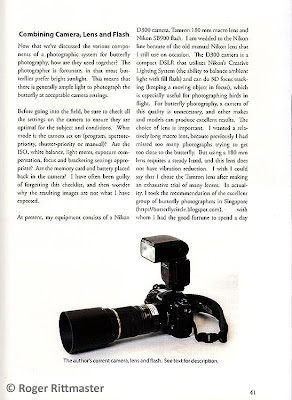
In Section 2, Roger shares his experience on the photographic equipment that he has personally used in his years of photographing butterflies, and the pros and cons of various systems (like how deep your pockets should be, when picking up this hobby!). There are advantages of using a simple Point-and-Shoot (P&S) camera system, from the swivel LCD screen that can be used for shooting butterflies perched in awkward positions, to the large depth of field of the smaller sensors that will almost ensure tack sharp shots of the butterflies and everything else in the frame!


The rest of the section deals with camera systems, lenses, flashes, focusing, image stabilisation and other basic information that a newcomer to butterfly photography may want to consider, before investing his hard-earned salary on his preferred photographic equipment.

The final section of the book deals with going out in the field and taking the photo. In Section 3, aptly sub-titled "Taking the Photograph", Roger summarises the information in the two preceding sections and takes the reader right out into the field and to start practising the techniques of photographing butterflies. I'm glad that Roger shares the opinion that the majority of ButterflyCircle members also agree with - that the Tamron 180mm f/3.5 SP macro lens is one of the best butterfly-shooting lenses there is out there today. Despite the lens' shortcomings of having a slow AF and no image stabilisation, some of ButterflyCircle's best works (and from the book, I can also see that Roger's own best works too) are taken with this lens.


The discussion on the technical aspects of camera settings - like AF, Rear Synch Flash, Metering and so on, are useful tips that Roger shares in this section. As would most regular butterfly photographers would already be aware of, Roger also shares the opinion that carrying a tripod for butterfly photography is more of a hindrance than an advantage. It would be more effective to select an appropriate ISO for the lighting conditions and then practising one's handholding and breathing techniques to minimise motion blur when shooting at low shutter speeds.


The basic rules of composition are also discussed, and the fundamental guide of using the classic "rule of thirds" makes composing the subject much easier to understand. Roger also shares his tips on stalking a butterfly subject, understanding how the butterfly behaves in various situations, before approaching stealthily for a shot without spooking the butterfly off.


This section also deals with how the background of a shot can be managed using the correct aperture so that the subject stands out without a messy background. Some basic post-processing techniques, which are almost as important as taking the photograph itself, are elaborated. In digital photography, a photographer will also very quickly learn that spending time in front of a computer will pay good dividends in getting a perfect photograph at times. Manipulating a shot on the computer can sometimes save an underexposed or overexposed shot which may yield an acceptable output that would have otherwise been destined for the trash folder.


All in all, Roger did a great piece of work in this book, and it would be a great help to those who are just starting out to appreciate butterflies and venturing into the realm of butterfly photography. I would also like to thank Roger for acknowledging ButterflyCircle in his book and for generously sending a copy of his book to me when it was launched.

For readers who would like to get a copy of this book, you may order online from the following two sources :


Text by Khew SK : Scans of "Butterflies Up Close", courtesy of Dr Roger Rittmaster.