Wednesday, February 26, 2014

Butterflies Galore! : Spotted Judy

Butterflies Galore!
The Spotted Judy (Abisara geza niya)


We feature another shot of the Spotted Judy, this time shot by ButterflyCircle member Huang CJ, at a forested patch in the western part of Singapore. Such remnant forested patches of high biodiversity are always threatened by development, and indeed, this location appears to be slated for development in the not-too-distant future. Last weekend, as the ButterflyCircle team made its way to an area where the Spotted and Malay Tailed Judys are regularly encountered, we met a group of men who were carrying land survey equipment.

Sadly, it will only be a matter of time when the area will be cleared and residential and other developments spring up in its place. For some of our forest-dependent species, once their habitats are destroyed, it is virtually impossible to re-create the same habitat artificially. This is one of the reasons why it is important to preserve our nature reserves, such as the MacRitchie Forest, as permanent sanctuaries for our biodiversity - for once these areas are gone, our rich biodiversity will be permanently lost.

Tuesday, February 25, 2014

Yellow Glassy Tiger Spotted at GB

Yellow Glassy Tiger (Parantica aspasia aspasia)
Spotted at Gardens by the Bay


The biodiversity at Gardens by the Bay is increasing by the day! Some time in late November last year, Sebastian Ho, a staff of Gardens by the Bay, spotted a Yellow Glassy Tiger feeding on the flower of Bidens pilosa growing at the gardens. This shot was taken with Sebastian's iPhone 5s. Although this "tiger" is a common species in Malaysia, it is seldom seen in Singapore, except for the occasional migrant. Though recorded in the early checklists, this species has been seen only a handful of times in Singapore in recent years.

The Yellow Glassy Tiger resembles its close cousins, the Blue and Dark Glassy Tigers. However each wing has a yellow basal patch with the yellow more extensive on the hindwing. It has been recorded mainly in urban parks and gardens like Alexandra Hospital Butterfly Trail and Hort Park. With this sighting, we add an additional species to Gardens by the Bay's butterfly checklist.

Monday, February 24, 2014

Butterflies Galore! : Starry Bob

Butterflies Galore!
The Starry Bob (Iambrix stellifer)


The Starry Bob (Iambrix stellifer) is a forest butterfly and is rarely seen in urban areas, unlike its close cousin and lookalike, the Chestnut Bob (Iambrix salsala salsala), which is more common and widely distributed. It can be distinguished from its more common relative by the spot on space 5 of the hindwing, which is placed midway between the cell end and the termen of the hindwing. The underside of the forewing apical area is also distinctly orange tinged in most individuals of the Starry Bob.

This shot of a newly eclosed Starry Bob taking a drink at a pool of water and its reflection makes an interesting composition. The orange background adds to the shot that ButterflyCircle member Nona Ooi managed to take on an outing in the nature reserves of Singapore.

Saturday, February 22, 2014

Life History of the Common Five Ring

Life History of Common Five Ring (Ypthima baldus newboldi)


Butterfly Biodata:
Genus: Ypthima Hübner, 1818
Species: baldus Fabricius, 1775
Subspecies: newboldi Distant, 1882
Wingspan of Adult Butterfly: 30-40mm
Caterpillar Local Host Plant: Axonopus compressus (Poaceae, common names: Wide-leaved Carpet Grass, Cow Grass).


The upperside view of a female Common Five Ring.

The upperside view of a male Common Five Ring.

Physical Description of Adult Butterfly:
On the upperside, the wings are dull brown with the female being paler in the ground colour in the distal halves of both wings. Both sexes have a large yellow-ringed ocellus in space 2 of the forewing, and two smaller and adjoined yellow-ringed ocelli in spaces 2 and 3 of the hindwing (with another ocellus in space 5 in some specimens). The male has a broad strip of greyish black brand in the forewing. On the underside, both wings are pale greyish to bluff brown against a whitish background, and are traversed by numerous fine dark brown striae. The forewing has a large, bi-pupilled, yellow-ringed subapical ocellus. The hindwing has five yellow-ringed ocelli in spaces 1b, 2, 3, 5 and 6. Some specimens might bear another small ocellus in space 4. The pair of ocelli in spaces 2 and 3 are large and adjoined, and the one in space 1b consists of two conjoined spots. The pair of ocelli in spaces 5 and 6 are typically adjoined, with the one in space 6 larger than the one in space 5.


Field Observations of Butterfly Behaviour:
The Common Five Ring is moderately common in Singapore,and are more commonly observed in the Southern Ridges. Adults are typically sighted flying low among vegetation in and around grassy patches. As with other Satyrinae members, the adults fly in an erratic and jerky manner. The adults visits flowers for nectar and sun-bathe with fully opened wings in sunny conditions.


Early Stages:
Thus far, only one grass species has been recorded as the larval host for the Common Five Ring. The caterpillars feed on leaves of the host plant, and have been observed to forcefully ejecting their frass pellets, a larval habit rarely seen outside the skipper/flat families. They tend to rest lengthwise on the underside of a leaf during pauses between feeds.

Host plant:Axonopus compressus.

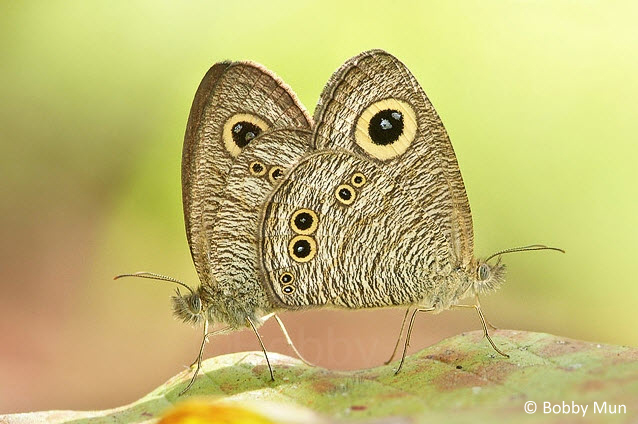
A mating pair of the Common Five Ring.

The eggs are laid singly on the underside of a grass blade of the host plant or on other small plants or objects in the vicinity of the host plants. Each egg is nearly globular (about 0.85mm in height, 0.8mm in diameter) and pale translucent with a light bluish tinge. The surface is tessellated with moderately large polygonal faces.

A mother Common Five Ring laying an egg on another plant in the vicinity of its host plant.

Two views of an egg of the Common Five Ring.

Two views of a mature egg with the head visible through the egg shell.

The egg takes about 4.5-5 days to mature. The young caterpillar nibbles away a portion of the egg shell to exit and then proceeds to devour the rest of the egg shell. It has a whitish, cylindrical body with small pink patches occurring dorsally and laterally. The initial body length is about 2mm. The body is covered with dorso-lateral and lateral rows of long setae. At the posterior end, there is a short pair of backward-pointing processes. Its pale brownish head features a few setae, a pair of short and rounded "horns" and a few lateral small protuberances.

Two views of a newly hatched caterpillar, length: 2.mm

As a result of its leaf diet, the 1st instar caterpillar soon takes on a strong greenish undertone. The first instar lasts about 3.5-4 days with the body length increases to about 4-4.5mm.

Two views of a 1st instar caterpillar, length: 2.5mm.

Two views of a late 1st instar caterpillar, dormant prior to its moult, length: 4.5mm.

In the 2nd instar, the cephalic "horns" are smaller, pointed and less distinct whilst the two anal processes become proportionately longer and pointed. The head is now pale translucent yellow to green and featuring a number of small, whitish tubercles. The body color is pale yellowish green and adorned with rows of numerous, whitish, minute tubercles, each with a single seta emanating from it. The 2nd instar lasts about 3 days with the body length reaches about 6-6.5mm.

Two views of a 2nd instar caterpillar, early in this stage, 4.8mm.

Two views of a 2nd instar caterpillar, length: 6mm.

Two views of a late 2nd instar caterpillar, dormant prior to its moult, length: 6.3mm.

The 3rd instar caterpillar mostly resembles its former self in the 2nd instar. The alignment of the numerous, small, whitish/yellowish tubercles in rows gives the caterpillar a banded appearance. This stage takes 3.5-4 days to complete with body length reaching about 9-9.5mm.

Two views of a newly moulted 3nd instar caterpillar.

Two views of a 3nd instar caterpillar, length: 9mm.

Two views of a late 3nd instar caterpillar, dormant prior to its moult, length: 9.5mm.

The 4th instar caterpillar bears a close resemblance to the 3rd instar caterpillar with no obvious change of any features or markings. The 4th instar lasts about 4.5-5 days with body length reaching 15mm.

Two views of a newly moulted 4th instar caterpillar, length: 9.3mm.

Two views of a 4th instar caterpillar, length: 13mm.

Two views of a late 4th instar caterpillar, dormant prior to its moult, length: 15mm.

Common Five Ring caterpillars in the act of catapulting frass pellets.

The 5th instar caterpillar could appear in two colour forms: green form and brown form. It has a strongly banded appearance with a number of narrow bands, colours alternating between pale and darker green or pale brown and darker brown, running lengthwise. The dorsal band and spiracular bands are typically darker than the rest. Pairs of small black patches appear on the dorsum of several mid-body segments. The head capsule has additional small brown to black patches occurring on the front and laterally. As growth progresses, some green-form specimens could develop pinky patches. In a period of 5-6 days, the body grows to a maximum length of about 24-26mm.

Two views of a newly moulted 5th instar caterpillar, length: 14.5mm.

Two views of a 5th instar caterpillar, brown form, length: 23mm.

Two views of a 5th instar caterpillar, green form, length: 26mm.

Two views of a 5th instar caterpillar, late in this stage, intermediate form, length: 24mm.

Toward the end of the 5th instar, the body gradually shrinks in length. Finally the caterpillar finds a spot on the underside of a leaf blade or a stem to spin a silk pad. It then secures itself there via its anal end, and assumes its upside-down pre-pupatory pose.

A prep-pupa of Common Five Ring. Left: early stage; Right: late stage.

After one day as a pre-pupa, pupation takes place. The slender pupa has a beige brown ground colour with numerous small brown/black patches. There are two low transverse dorsal ridge on abdominal segments 3 and 4, and a longitudinal dorsal ridge on the thorax. Length of pupae: 10.5-11mm.

A Common Five Ring caterpillar moults to its pupal stage.

Three views of a pupa of Common Five Ring.

After 7.5-8 days of development, the pupa becomes darkened in color, and the ringed-spot on the forewings can now be seen through the pupal skin in the wing pads. The next day the eclosion event takes place with the adult butterfly emerges to start the next phase of its life cycle.

Three views of a mature pupa of Common Five Ring.

A Common Five Ring butterfly emerges from its pupal case.

A newly eclosed Common Five Ring.

References:
  • [C&P4] The Butterflies of The Malay Peninsula, A.S. Corbet and H.M. Pendlebury, 4th Edition, Malayan Nature Society, 1992.
  • Butterflies of Thailand, Pisuth Ek-Amnuay, 2nd Edition, 2012.
  • A Field Guide to the Butterflies of Singapore, Khew S.K., Ink On Paper Communications, 2010.
Text by Horace Tan, Photos by Bobby Mun, Anthony Wong and Horace Tan

Wednesday, February 19, 2014

Butterflies Galore! : Ancyra Blue

Butterflies Galore!
The Ancyra Blue (Catopyrops ancyra)


The Ancyra Blue was a new discovery for Singapore when it was first encountered on Pulau Ubin some time ago in June 2005. Since then, this species has been quite widespread in Singapore, from urban parks to the nature reserves. Like many of the Lycaenidae, it is a rapid flyer, often flying erratically amongst shrubbery, and resting with its wings folded upright on the tops of leaves.

The shot was taken by ButterflyCircle member Nelson Ong at a wasteland site in the western part of Singapore. The species has characteristic thick striations on the undersides of the wings and if observed at rest, is quite easily to distinguish from the similar-looking species in the family. Its caterpillars feed on two local host plants and the life history has been recorded here.

Tuesday, February 18, 2014

Butterflies Galore! : Yellow Chequered Lancer

Butterflies Galore!
The Yellow Chequered Lancer (Plastingia pellonia)


At a glance, this skipper looks very much like its more frequently-encountered cousin, the Chequered Lancer (Plastingia naga). However, a closer look at the colour of the spots will separate it easily. All the markings on the underside of the wings and its body are yellow instead of white.

The Yellow Chequered Lancer prefers shady forested areas in the nature reserves of Singapore. It is usually found perched on the top surface of a leaf, as was photographed here by ButterflyCircle member Loke PF. However, it can be skittish if disturbed and flies off rapidly. It tends to be affected by the camera's flash at times, jumping and flapping its wings whenever the flash goes off.

Monday, February 17, 2014

Butterflies Galore! : Spotted Judy

Butterflies Galore! 
The Spotted Judy (Abisara geza niya)


The Riodinids, collectively called "Metalmarks" for the metallic spots of some of the species in the family, are quite unique in the way the butterflies fly around and twist and turn with half opened wings. A few of the members of this family have deep red wings with black spots and white streaks. They prefer dark shady habitats under the forest canopy.

The Spotted Judy is only moderately rare, and is quite local in its distribution, often occurring in certain preferred localities with regularity. Where found, several individuals can often be observed together. This Spotted Judy was photographed by ButterflyCircle member Sunny Chir.