Saturday, February 18, 2012

Life History of the Hoary Palmer

Life History of the Hoary Palmer (Unkana ambasa batara)


Butterfly Biodata:
Genus: Unkana Distant, 1886
Species: ambasa
Moore, 1858
Sub-species: batara Distant, 1886
Wingspan of Adult Butterfly: 50-65mm
Caterpillar Local Host Plants: Pandanus amarylifolius (Pandanaceae, common name: Pandan), Pandanus tectoris (Pandanaceae, common name: Seashore Pandan, Screw Pipe)


A female Hoary Palmer.

A male sighted in early morning in a western wasteland.

 
The upperside of a newly eclosed male, showing the yellowish spots on the forewing.

Physical Description of Adult Butterfly:

Adults are rather large in size. The females are typically larger than the males. Above, both sexes are dark brown with hyaline spots on the forewing: a large spot in the cell, four post-discal spots in spaces 2-5 in decreasing  size and three small sub-apical spots in spaces 6-8. These spots are white in the female but pale yellow in the male. The female has a large white patch covering the basal two-thirds of the hindwing. Underneath, the wings are dark brown with a slight purple wash in  the female but a much stronger wash in the male (for pristine specimens).  The whole hindwing is  strongly whitened between the veins except for the tornal area. In contrast, the forewing is only partially whitened. The adult has a  rather long  proboscis which is red in colour.

The upperside of a newly eclosed female, revealing  the whitish spots on the forewing.

A female on a leaf perch in the late afternoon sun in a wetland reserve. Note the predominantly white hindwing.

A female taking nectar from Ixora flowers. Note the particularly long reddish proboscis.

Field Observations of Butterfly Behaviour:
This species is moderately rare in Singapore. The adults are seldom seen, due likely to its crepuscular habit. The adults are typically observed on flowering trees or shrubs at forest edge or near mangrove habitats, taking in nectar with their long proboscises. 

A male  Hoary Palmer taking nectar from Syzygium flowers.

Another female enjoying nectar of Ixora flowers at a forest edge.

A  male visiting Syzygium flowers.

Early Stages:
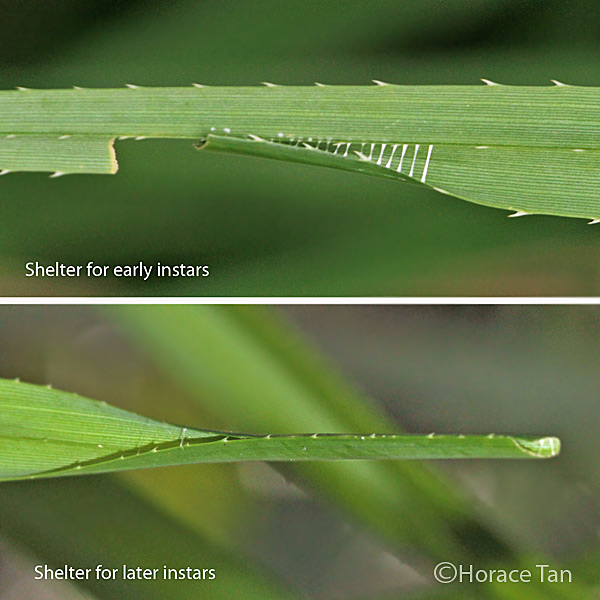
The local host plants are members of the genus Pandanus of the Pandanaceae family. One recorded plant is the Pandan (Pandanus amarylifolius), a widely cultivated plant which has its aromatic leaves commonly used in Southeastern Asian cooking. The other plant, Seashore Pandan (Pandanus tectoris) is found in coastal and mangrove areas. Its leaves have been used in making mats, baskets and even grass skirts. Besides these two   plants, Hoary Palmer has also been observed to utilize at least two other Pandanus spp. in the Central Catchment reserve.  The caterpillars of the Hoary Palmer feed on leaves of the host plant, and live in shelters made either by joining two opposite edges of a  blade together with silk threads or by joining one edge of a cut segment to the blade.

Local Host plant #1: Pandanus amarylifolius (Pandan)

Local Host plant #2: Pandanus tectoris.

Leaf shelters of Hoary Palmer caterpillars found in the field.

The eggs are laid singly on either side of a leaf of the host plant.   The  hemispherical egg is in a medium brownish shade of red (when fresh). The micropylar sits atop in a darker patch. The egg is rather large with  a base diameter of about 2.1mm, and a height of about 1.5mm.

An egg of the Hoary Palmer.

A mature egg with the young caterpillar already nibbled away the polar part of the egg shell.

It takes about 7 days for the egg to fully mature. The egg is in light salmon colour at this stage.  The young caterpillar eats just enough of the shell to emerge, and will devour the rest of the egg shell after emergence. The newly hatched has a length of about 6mm. Its has a cylindrical body shape, very short dorso-lateral and sub-spiracular setae and a tuff of long setae at the posterior end. The body is creamy yellow with a prominent black collar on the dorsum of the prothorax. The head capsule is entirely black.

A newly hatched 1st instar caterpillar in the process of nibbling away its egg shell.

An early 1st instar caterpillar resting part way through the construction of its first leaf shelter.

The body color changes to pale yellowish green after a few feeding sessions on the leaf. The newly hatched constructs its leaf shelter soon after it is done with the egg shell. Between feedings on the nearby leaf lamina, the caterpillar retreats to its shelter for rest and security. 

Two views of a 1st instar caterpillar, late in this stage,length: 10mm.

One noteworthy  observation is that the caterpillars of Hoary Palmer, unlike most other skipper species which eject their frass pellets far away from their shelter,  have rather poor "toilet" discipline and do not seem to mind having frass pellets piling up in their shelter. By the time the caterpillar lies dormant in its shelter for the moult to the 2nd instar, its length has reached about 11mm. The 1st instar takes about 3.5 days to complete.

A 1st instar caterpillar resting it its leaf shelter between feeds. Note the collection of frass pellets in its shelter.

A 1st instar caterpillar in a dormant state prior to its moult, length: 10.5mm.

The 2nd instar caterpillar is pale yellow with a strong green undertone. A large black patch fully cover the anal plate.  The head capsule varies from  black to a dark shade of reddish brown.  The black collar is no longer present on the prothorax.  This instar lasts about 5-6 days with the body length reaching about  16-17mm.
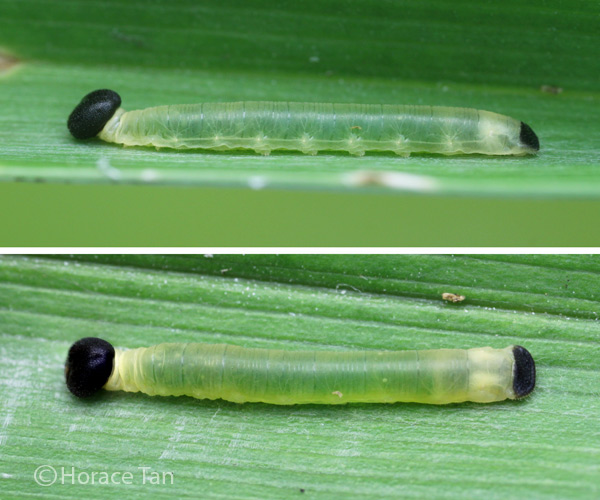
Two views of a 2nd instar caterpillar, length: 11.5mm.

A 2nd instar caterpillar in a dormant state prior to its moult, length: 15.5mm.

The 3nd instar caterpillar resembles the 2nd instar caterpillar closely. One slight difference is on the anal plate where the black patch is somewhat smaller.  This instar lasts about 5-6 days with the body length reaching  23-24mm.

Two views of a 3rd instar caterpillar, length: 18mm.

A 3nd instar caterpillar in a dormant state prior to its moult, length: 23mm.

The 4th instar caterpillar again resembles the 3rd instar caterpillar closely. The black patch on the anal plate is slightly more constricted on its two sides. The head capsule is very dark reddish brown to black.   This penultimate instar lasts 6-7 days with the body length reaching up to 37-38mm.

Two views of a 4th instar caterpillar, length: 27mm.

A 4th instar caterpillar in a dormant state prior to the moult, length: 37mm.

The 5th (and final) instar caterpillar has one distinct difference from the earlier instars in the black patch on the anal plate: The patch is now much smaller within the plate and has a bi-lobed shape.  This instar takes about 10-12 days to complete with the body length reaching up to  55-60mm.

Two views of a 5th instar caterpillar, early in this stage, length: 39mm.

Two views of a 5th instar caterpillar, late in this instar, length: 55mm.

The head (left) and anal plate (right) of a 5th instar caterpillar.

Towards the end of the 5th instar, the body of the caterpillar shortens and its color  changes to yellow with a slight green wash. As it enters the pre-pupal phase within the leaf shelter, the caterpillar excretes  copious amount of white substance which can be found coating its body and lining  the inner wall of the shelter. It laboriously seals both ends of the shelter  with silk bands and layers of silk shields. The floor of the shelter  is also covered with a mat of silk threads. Finally the pre-pupa secures itself by a silk girdle around mid-body. As the pre-pupa purges its "stomach" content before it enters this dormant state, an egg-shaped fluid sac formed from the expelled fluid  can be found lying next to the pre-pupa. The sac is eventually broken by further purging action of other solid substance from the "stomach".

Two views of a pre-pupa of the Hoary Palmer.

An egg-shaped fluid sac in the pupation shelter.

The maize yellow  pupa  secures itself to the substrate with a cremastral attachment to the silk pad and the previously constructed silk girdle. It has a long abdomen  and two small reddish lateral markings on the prothorax. The sheath containing the developing proboscis is rather long and extends well beyond the posterior end of the abdomen.  Length of pupae: 30-34mm.

Two views of a pupa of the Hoary Palmer.

On the last day of the pupal period, the pupa becomes mostly   black. Yellowish/whitish  spots against a black background are now visible in the wing cases. The sheath holding the proboscis is now reddish, reflecting the colour of its content.  Finally, after about 12-13 days of pupal phase, eclosion takes place with the adult emerging from the pupal case.

Two views of a mature pupa of the Hoary Palmer.

A newly eclosed female Hoary Palmer.

References:
  • [C&P4] The Butterflies of The Malay Peninsula, A.S. Corbet and H.M. Pendlebury, 4th Edition, Malayan Nature Society.
  • Butterflies of Thailand, Pisuth Ek-Amnuay, 1st Edition, 2006
Text by Horace Tan, Photos by Henry Koh, Loke PF, Anthony Wong, Federick Ho, Khew SK  and Horace Tan

Friday, February 10, 2012

Rhopalocera Singaporeana

Rhopalocera Singaporeana
A Tribute to 3 "Singapura" Butterflies


Singapore, an island at the southernmost tip of the Malay Peninsula, is a city-state comprising a total of 63 islands and islets with a combined land mass of 712.4 sq km. Singapore is highly urbanised city, but more than half the island is covered by greenery. Because of this, Singapore is often referred to as the "Garden City".


With a population of about 5.2 million people, it is considered a very densely populated country, in terms of persons per sq km. Despite being a land-scarce island city-state, about 23% of its land area is set aside for forests, parks & gardens and nature reserves. The National Parks Board, a statutory board that oversees the management of the Garden City, manages a total of 300 parks and 4 nature reserves and a total of 180 km of parks connectors which links the nature reserves, parks and urban gardens in a network of greenery covering the island.


A night shot of the Singapore City Skyline

It is always amazing to relate the story of how this "little red dot", as Singapore is fondly referred to, is home to a rich biodiversity of flora and fauna. Its butterfly biodiversity has crossed the 300 mark and is likely to increase as more species are discovered and re-discovered. This little piece of trivia is in itself remarkable, for example, when compared to Great Britain, where Singapore has more than five times the number of butterfly species compared to a country that is over 340 times the size of Singapore!


Hence, despite the highly urbanised built environment, Singapore's incredible and diverse range of flora and fauna stand testimony to the nature conservation efforts of governmental and non-governmental organisations.


The English name of Singapore is derived from the Malay word Singapura (Sanskrit: सिंहपुर, lit. Lion City), hence the customary reference to the nation as the Lion City. This week's article features butterflies in Singapore with their scientific names containing the word "singapura" in them.


The Blue Spotted Crow (Euploea midamus singapura)


The subspecies singapura of the Blue Spotted Crow is found in Singapore, as well as on the islands of Pulau Aur and Tioman in Malaysia. This subspecies lacks the blue sheen on the upperside forewings of the Malaysian subspecies chloe. It is a moderately common species that is often observed singly at both urban parks and gardens as well as in the nature reserves.


Males of the Blue Spotted Crow are often seen puddling at damp sandy spots near streams, and also observed at flowering trees in parks and gardens. When puddling it often returns repeatedly to the same spot even when disturbed, but can be skittish and not easily approached.


The butterfly is predominantly black with white spots typical of the Danainaes. It resembles the Spotted Black Crow very closely, with the difference in that there are four elongated white apical spots in the Blue Spotted Crow, compared to its lookalike's five spots.


The Singapore Fourline Blue (Nacaduba pavana singapura)


The Singapore Fourline Blue is the 2nd butterfly to carry the subspecies name singapura. The early authors commented that "it is seldom seen, except in Singapore, where it is sometimes quite common on the landward edge of mangrove swamps". This description is still accurate to this day, as the species continues to thrive at the Sungei Buloh Wetland Reserve, a protected mangrove nature reserve in Singapore.


The species' life history has been recorded on this blog here, with its host plants, Derris trifoliata (Leguminosae), Andira inermis (Leguminosae), Allophylus cobbe (Sapindaceae), all found at the landward edge of the mangrove swamps.


The Singapore Fourline Blue is a pale greyish blue with very thin borders on the upperside of the male, whilst the female is brown on the upperside with a blue wedge-shaped discal patch on the forewing and basal blue dusting on the hindwing.


The Shining Plushblue (Flos fulgida singhapura)


The last of the three butterfly species to bear Singapore in its name is the Shining Plushblue. The subspecies carries the name singhapura with the additional "h" in the name, but for all intents and purposes, it qualifies as a species that has the Singapore "brand".


It is a rather rare species that is most often encountered in Singapore's forested nature reserves, usually skulking amongst the shaded understorey along the forest edge and along paths. It is a fast flyer and is skittish. Usually, individuals are encountered, often in the company of species of the Arhopala genus.


The Shining Plushblue has a short stumpy tail at vein 2 of the hindwing and the dark brown bands across both wings on the underside. The males are dark blue above with almost indiscernible borders whilst females are a shining purple-blue with broad black borders. The partial life history of this species has also been recorded.


And so we celebrate three butterflies with their subspecies names carrying the name Singapore, or the Malay version "singapura" and "singhapura", giving these three butterflies a special pedigree that is closely associated with our beloved island in the sun!


Text by Khew SK : Photos by Sunny Chir, Chng CK, Henry Koh, Koh CH, Khew SK, Horace Tan, Mark Wong & Wong CM

References :

Saturday, February 4, 2012

Life History of the Blue Glassy Tiger

Life History of the Blue Glassy Tiger (Ideopsis vulgaris macrina)


Butterfly Biodata:
Genus: Ideopsis Horsfield, 1857
Species: vulgaris Butler, 1874
Subspecies: macrina
Fruhstorfer, 1904
Wingspan of Adult Butterfly: 65mm
Caterpillar Local Host Plant: Tylophora flexuosa 
(Apocynaceae, synonym: T.  tenuissima)

Physical Description of Adult Butterfly:
Above, the wings are mostly bluish grey with veins and all margins blackened. On the hindiwng, the bluish grey streaks in the cell form a  narrow V with its apex pointing to the wing base. On the forewing, there is a transverse black bar towards the distal cell-end.  Underneath, the markings resemble those on the upperside but in lighter colour.The male has a distinct brand near the sub-tornal area of the hindwing.


Field Observations of Butterfly Behaviour: 
This species is locally common in Singapore and is most   likely encountered in coastal mangrove habitats such as the Sungei Buloh Wetland Reserve and Pasir Ris Park. Occasionally the adults can also be spotted in some urban parks and gardens. Blue Glassy Tiger shares the same habitats with the similar-looking Dark Glassy Tiger (Parantica agleoides agleoides) and the two are difficult to tell apart when they are in flight. Once settled on a perch, Blue Glassy Tiger can be identified by the presence of the transverse bar in the forewing cell, a feature not present in the Dark Glassy Tiger. The sun-loving adults are slow and undulating in flight, and prefers open but sheltered environments.


Early Stages:
The local host plant  is Tylophora flexuosa,  a climber typically found in back mangrove habitats.  The caterpillars of Blue Glassy Tiger feed on the young and  tender leaves in its early instars but move on to the more mature and larger leaves in  later instars.

Local host plant: Tylophora reflexuosa.

A mating pair of the Blue Glassy Tiger.

The eggs of the Blue Glassy Tiger are laid singly on young leaves or  a slender stem of the host plant. The white egg resembles a rugby ball standing on one end  (about 1.75mm in height). The egg surface is transverse ribbed and is adorned with  shallow vertical ridges.

Left: fresh egg; Right: mature egg. Note the black head is visible in the mature egg.

The egg takes about 3 days to hatch. The young caterpillar emerges by eating away part of the egg shell. The rest of the egg shell becomes the first meal for the newly hatched  which has a length of about 2.6-2.7mm. Its cylindrical body is whitish and has a fair number of short setae. The large head capsule is black in color. A pair of very short and pale  brown protuberances can be found on the dorsum of the 2nd thoracic and the 8th abdominal segment. Another pair of small black dash-shaped patches are visible on the dorsum of the prothorax. All eight pairs  of legs are black in colour and there is a large black patch at the posterior end.


Two views of a newly hatched caterpillar, length: 2.3mm.

Once the newly hatched moves on to feed on the young leaves over the next few hours, its body starts to take on a wine red coloration, and numerous white oval-shaped markings appear. The two pairs of protuberances becomes wine-red in colour and are longer and projected outwards.   The growth is rather rapid with the body length about doubling in about 1-1.5 days, and after just 1.5 to 2 days from hatching, it moults to the 2nd instar.


Two views of a 1st instar, late in this instar, length: 5.1mm.

Two views of a 1st instar caterpillar, dormant before its moult, length: 4.5mm.

The body of the 2nd instar caterpillar is dark wine red to dark purplish brown in base colour, and is ornamented with numerous small white dots. The short protuberances on the 2nd thoracic and 8th abdominal segments in the 1st instar have become longer and fleshy processes with the pair on the mesothorax much longer.  This instar lasts about 2  days with the body length reaching 7.5-8mm before the moult to the 3rd instar.

Two views of a 2nd instar caterpillar, early in this stage, length: 5.8mm


Two views of a 2nd instar caterpillar, length: 7.5mm

The 3rd instar caterpillar is similar in appearance to the 2nd instar caterpillar with the only change being the proportionally longer processes. This instar takes about 2 days to complete with body length reaching about 13-14mm.


A newly moulted 3rd instar caterpillar next to its exuvia, it head capsule yet to fully turn black.


Two views of 3rd instar caterpillar,  length: 11.5mm


Two views of a 3rd instar caterpillar, late in this stage, dormant before its moult,  length: 13.5mm

Retaining very much the same body features from the earlier two instars, the 4th instar caterpillar distinguishes itself in having proportionally longer processes, the meso-thoracic pair of  which have the tendency to flex forward. The lower one-quarter of each of the four processes is coloured in dark red. This instar lasts about 2 days with the body length reaching about 21-24mm.


Two views of a 4th instar caterpillar, newly moulted, length: 13.5mm.


Two views of a 4th instar caterpillar,   length: 24mm.


Two views of a 4th instar caterpillar, late in this stage, dormant before its moult, length: 21mm.

The 5th and final instar resembles the 4th instar closely albeit with a noticeable increase in the size of the white spots which are thus packed closer to each other.


A freshly moulted 5th instar caterpillar, with its exuvia trailing behind.


Two views of a newly moulted 5h instar caterpillar, length: 21mm.


Two views of a 5th instar caterpillar,  length: 31mm.

The 5th instar lasts for about 3.5-4 days, and the body length reaches up to 34mm. On the last day, the caterpillar ceases feeding. Its body becomes shortened and the dark purplish brown base colour decolorises to a dark shade of grey, and the wine red colour in the basal part of the processess turns white. The fully grown caterpillar  wanders around in search of a pupation site. Typically it comes to a halt on a branch/stem or a leaf underside, where the caterpillar spins a silk pad from which it  next hangs vertically to take on the pre-pupatory pose. The body gradually takes on a yellowish tone during the pre-pupal stage.  Within the few hours prior to pupation, the caterpillar gradually relaxes and lengthens to a straight posture. Waves of contraction soon travel from the the rear end to the head until the pupation event kicks in.


Pre-pupatory larva. Left: early stage; Right: late stage with the onset of pupation only minutes away.


The pupation event of a Blue Glassy Tiger caterpillar.

Pupation takes place about 0.5 days after the caterpillar assumes the hanging posture. Typical of the pupae within the Nymphalidae family, the pupa of the Blue Glassy Tiger suspends itself from the silk pad with no supporting silk girdle. The pupa is bright yellowish green and is somewhat barrel-shaped. It has a median transverse whitish line marked with a series of black spots. Several scattered silvery spots adorns the dorsum of the thorax and the wing pads. Two thick black streaks lie close to the black cremaster on the dorsal side.  Length of pupae: 18-20mm.


Three views of a pupa of the Blue Glassy Tiger.


Three views of a mature pupa of the Blue Glassy Tiger.
The pale streaks and some of the spots  can be seen in the wing pad area.


After about 7 days of development, the pupal skin turns translucent as the development within the pupal case comes to an end. The spots/streaks on the forewing upperside also become discernible. The following day, the adult butterfly emerges from the pupal case. It then perches nearby to expand and dry its wings before taking its first flight.


A newly eclosed Blue Glassy Tiger drying its wings while clinging onto its pupal case.

References:
  • [C&P4] The Butterflies of The Malay Peninsula, A.S. Corbet and H.M. Pendlebury, 4th Edition, The Malayan Nature Society.
  • Butterflies of Thailand, Pisuth Ek-Amnuay, 1st Edition, 2006
Text by Horace Tan, Photos by Simon Sng, Sum CM, Nelson Ong,  Loke PF,  Federick Ho,  and Horace Tan