Saturday, October 1, 2011

Lords of the Rings? - Singapore's Ypthima species

Lords of the Rings? - Singapore's Ypthima species


A casual reader of the Field Guide to the Butterflies of Singapore (2010) recently asked me, after looking through the pages of the Common ??? Rings. "They all look so similar and it's difficult to tell them apart. The number of rings on the wings also doesn't seem to match the English names! Why is that so?"

The Rings species, as we commonly refer to them, are relatively small and unattractive butterflies and tend to fly weakly amongst low shrubbery and grasses.  Two earlier articles in this Blog featured species from this genus, Ypthima- The Cinderella of Butterflies and Variability of the Common Four Ring.


This article sums up the five extant Ypthima species in Singapore, and provides an understanding of the subtle differences amongst the five, as well as shed some light on the naming convention used for their common English names.


The caterpillars of all the species of this genus comprise species of Graminae or generally, grasses.  The adults are greyish or pale buff brown, with striate undersides. All have a large subapical ocellus on the underside of the forewing, with a series of yellow-ringed black submarginal ocelli on the underside of the hindwing.

A Common Five Ring perches on a blade of grass

The basic ID Key to separate and distinguish the five extant species in Singapore is as follows :

Common Three Ring (Ypthima pandocus corticaria)
Underside hindwing with ocelli in spaces 1b, 2 and 6 only.

Common Four Ring (Ypthima huebneri)
Underside hindwing with ocelli in spaces 1b, 2, 3 and 6 ; but never an ocellus in space 5

Common Five Ring (Ypthima baldus newboldi)
Underside hindwing with ocelli in spaces 1b, 2, 3, 5 and 6.  The ocelli in space 5 is much larger than in space 6.  The ocellus in space 6 is sometimes missing, although there is not infrequently an additional small ocellus in space 4.

Malayan Five Ring (Ypthima horsfieldii humei)
Underside hindwing with ocelli in spaces 1b, 2, 3, 5 and 6.  The ocelli in space 5 and 6 are subequal, that in 5 sometimes smaller. Underside ground colour whiter.

Malayan Six Ring (Ypthima fasciata torone)
Underside hindwing with ocelli in spaces 1b, 2, 3, 4, 5 and 6.  All ocelli rather small and in an almost straight line. Underside of both wings are crossed by two dark and distinct fasciae.

English Naming convention

The curious naming convention in this genus is based on the number of rings (or ocelli) found only on the hindwing of the species.  In addition to that, the pair of rings, or what appears to be two rings encircled by a yellow outer ring at the tornal area of the hindwing in space 1b is counted as one ring instead of two. Hence in a species like Ypthima pandocus corticaria or what is commonly called the Common Three Ring, we can clearly see the number of rings on the hindwing of the species as shown in the photo below.

A Common Three Ring, showing the 3 ocelli on the hindwing

The members of the genus are highly variable, and aberrations are frequently observed. The two species with five rings - Common Five Ring and Malayan Five Ring, are particularly controversial, where their variability may be the subject of debate as to what constitutes one species or the other!

A Common Four Ring perches on a dead fern

In the earlier blog article on the Common Four Ring, this phenomenon is also exhibited, where the range of contiguity and size of the ocelli in spaces 2, 3 and 6 is also the subject of debate as to whether there are two distinct species, or just merely a variability in the arrangement and size of the hindwing ocelli.

The Common Three Ring (Ypthima pandocus corticaria)


This species is the largest in the genus found in Singapore. It is locally common in locations where its preferred host plant (a type of grass) is found.  It is more often found on the fringes of the nature reserves, but can occur in urban parks and gardens as well. 


The upperside is grayish brown with a large subapical ocelli on the forewing above.  The underside is heavily striated with three large ocelli on the hindwing, which gives it its English Common name based on the naming convention described above.


There are occasional individuals which display an additional small ocellus - sometimes contiguous, sometimes separated, from the large ocellus in space 6. Sightings of such individuals are rare, but the photos shown above and below (a mating pair of Common Three Rings) show two examples of such variations in the Common Three Ring.


The Common Four Ring (Ypthima huebneri)


The Common Four Ring is the smallest member of the genus, with four ocelli on the underside of the hindwing. Whilst the tornal ocellus is described as in line with those in spaces 2 and 3, these three ocelli are often very variable in contiguity and size as explained in the earlier blog article.


The species is relatively common, and can be found most frequently in urban parks and gardens, although their presence at the fringes of the nature reserves is also quite evident.

The Common Five Ring (Ypthima baldus newboldi)


Always smaller in size than the Common Three Ring, the Common Five Ring features ocelli in spaces 1b, 2, 3, 5 and 6 of the hindwing beneath.  Again, the variability of these physical characteristics bring about much debate about the species.  Whilst the hindwing ocelli in space 2 and 3 are "large and almost always contiguous", this characteristic appear to be not always reliable to identify this species. 

As if to confuse the matter even further, C&P4 records that "there is not infrequently an additional small ocellus in space 4!" This would effectively give the particular variant six rings instead of five!  An example of the Common Five Ring with six ocelli is shown below. 


In the mating pair shot below, it shows a clear difference in this characteristic between the male and female of the species in terms of the size and contiguity of the ocelli in spaces 5 and 6.  The mating pair also suggests that the two individuals are the same species, although displaying quite different ocelli characteristics.


The more often ID key that is used to identify this species, is the relative sizes of the two ocelli in spaces 5 and 6, in that the ocellus in space 5 is always larger than that in space 6, irrespective of whether they are contiguous or separated.
 
The Malayan Five Ring (Ypthima horsfieldii humei)


Appearing very similar to the Common Five Ring, the Malayan Five Ring's identification has frequently been the subject of debate. Sporting an arrangement of ocelli that is similar to its lookalike, this species also features ocelli in space 1b, 2, 3, 5 and 6 on the underside of the hindwing.


It has been described that the underside of the hindwing is whiter in appearance rather than the usual grayish buff, but in the field and with photos, the level of "whiteness" can often be misread due to lighting conditions.  However, in many individuals of this species, particularly males, the slightly darker postdiscal and submarginal fasciae are more distinct.


The most reliable ID characteristic thus far, would be to look at the ocelli in spaces 5 and 6. In the Malayan Five Ring, these two ocelli are usually similar in size, and more often, the ocelli in space 5 is smaller than the one in space 6.

The Malayan Six Ring (Ypthima fasciata torone)


This is the rarest member of the genus in Singapore.  It has been rarely seen, with the last few sightings around the northernmost extent of the nature reserves in Singapore.
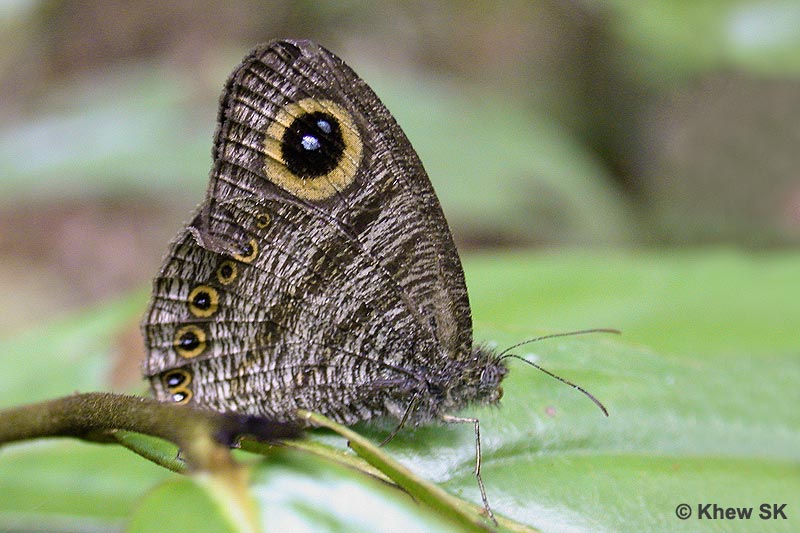


Besides having a full complement of ocelli across the underside of the hindwing, stretching from space 1b to 6, forming a total of six rings, a distinctive feature of this species is the pair of dark straight fasciae crossing both wings.  The ocelli sizes can be variable, but are usually small and separated from each other, except for the pair at the tornal area.


This article compares the five species of the Ypthima in Singapore, and we hope that it has been helpful in aiding observers of the species of this genus to separate and identify them.

Text by Khew SK : Photos by Sunny Chir, Goh LC, Khew SK, Loke PF, Bobby Mun & Wong CM

References : [C&P4] The Butterflies of The Malay Peninsula, A.S. Corbet and H.M. Pendlebury, 4th Edition, The Malayan Nature Society.

Saturday, September 24, 2011

Life History of the Brown Awl

Life History of the Brown Awl (Badamia exclamationis)
(This is the 100th article in this life history series at BC Blog)


Butterfly Biodata:
Genus: Badamia Moore, 1881
Species: exclamationis Fabricius, 1775
Wingspan of Adult Butterfly: 45-55mm
Caterpillar Local Host Plants: Combretum sundaicum (Combretaceae), Terminalia calamansanai (Combretaceae).


A Brown Awl perching on a flower bud in a forest clearing.


A Brown Awl taking in the afternoon sun on a fallen branch.

Physical Description of Adult Butterfly:
Adults have elongated wings and the hindwing is caudate at vein 1b and excavate along the termen between ends of veins 1b and 2. Above, the wings are dark brown with greyish green scalings at the wing bases. The female has prominent and elongated hyaline streaks in spaces 1b, 2 and 3, and the cell in the forewing. In contrast, these streaks in the male are rather small and subdued. Below, both sexes are pale greyish brown and largely unmarked. There is a small yellowish sub-tornal spot in space 1b of the hindwing, which usually goes unnoticed as the hindwings typically fold up in the dorsal area.


A partial view of the upperside of a female Brown Awl, note the prominent streaks/spots.


A view of the partially open wings of a male Brown Awl, note the inconspicuous streaks/spots.

Field Observations of Butterfly Behaviour:

This species is moderately rare in Singapore. Adults have been sighted in multiple locations across Singapore, including the Sungei Buloh Wetland Reserve, Mandai Orchid Gardens, Central Catchment Nature Reserve and also rarely in urban parks and residential areas. The fast flying adults have a habit of resting on the underside of a leaf or other plant parts when they rest among the foliage of a tree.


A Brown Awl perching on the underside of a leaf.


A Brown Awl enjoys the sun while perching on a brick in MOG.

Early Stages:
Across its vast area of distribution stretching from South Asia to East Asia, and to South-East Asia and southward to Australia, Brown Awl utilizes host plants in several families. Both recorded local host plants, Terminalia calamansanai and Combretum sundaicum, are in the Combretaceae family. It is thus very likely that more host plants, either in the same family or others, are yet to be discovered locally for the Brown Awl. Caterpillars of the Brown Awl feed on the very young to the moderately young (before hardening) leaves of the host plants.


Local host plant: Combretum sundaicum.

The eggs are laid singly on very young shoots of the host plants. Each egg is shaped like a bun with a flattened base (diameter: 0.6-0.7mm). Prominent ridges run from the pole to the base. The micropylar sits atop at the pole. Initially greyish white in coloration, the entire egg turns wine red as it develops, and then decolorizes again to yellowish red when the caterpillar is ready to emerge.


A close-up view of a young shoot of Combretum Sundaicum, showing two eggs of the Brown Awl.


Two views of a 1-day old egg of the Brown Awl.


Two views of a mature egg of the Brown Awl, note the black larval head visible through the egg shell.

It takes 2 days for the collected egg to hatch. The young caterpillar eats just enough of the shell to emerge, and has a length of about 1.5mm. It does not make an attempt to devour the egg shell after its emergence. The golden and cylindrical body has a number of very short white setae. The large head is black, slightly bi-lobed and lightly hairy. The body turns pale yellowish green as it feeds on the leaf lamina and grows in this initial instar.


Two views of a 1st instar caterpillar, early in this stage, length: 1.7mm.


Two views of a 1st instar caterpillar, length: 1.9mm.

The young caterpillar constructs its first shelter by spinning a silk web over a void of space on the young shoot. It rests within the shelter and ventures out to eat on nearby leaf surface. In later instars, the Brown Awl caterpillars also construct leaf shelters but do so by joining leaf blades together. The larval growth of the Brown Awl is rapid in pace for all instars, with all but the final instar lasting only 1.5-2.5 days.


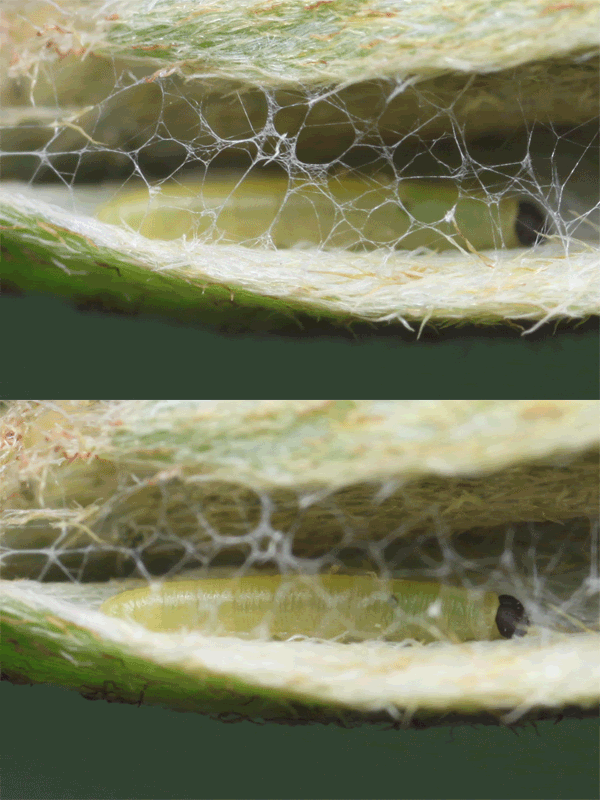
A late first instar caterpillar in its shelter. The focus was varied to show details in the net of silk threads securing the shelter.

After reaching a length of about 3.4-3.8mm in the 1st instar, the caterpillar moults to the next instar after a short dormant period. The 2nd instar caterpillar is pale yellowish green with a faint brown rings on its body segments, from the pro-thorax to the 8th abdominal segment. The yellowish head has an upper transverse brown stripe and two lower short stripes on each side of the adfrontal area. The body and the black head capsule are covered in numerous tiny setae.


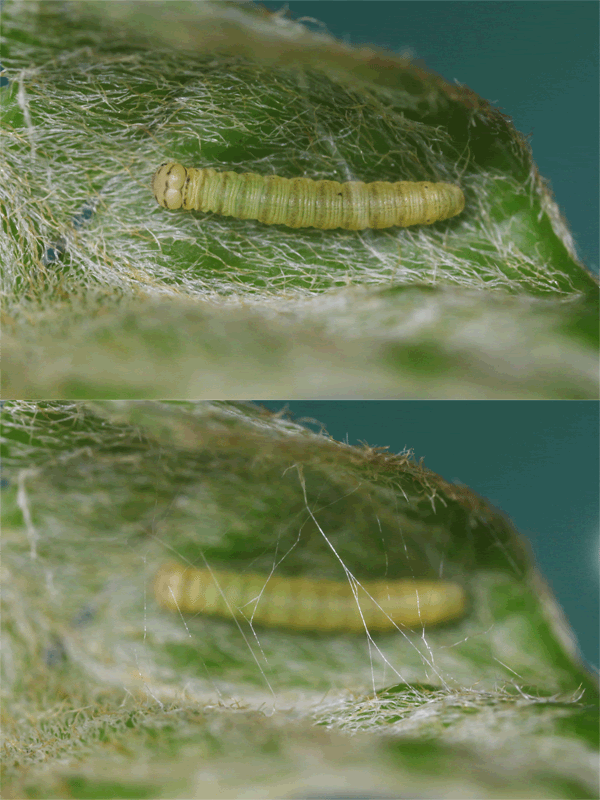
Two views of a 2nd instar caterpillar, length: 5mm.


A second instar caterpillar in its shelter.

The 2nd instar caterpillar reaches a length of about 6.5-7.5mm, and after 1.5-2 days in this stage, it moults again. The 3rd instar caterpillar has 14 dark brown to black black rings, bold and prominent against the pale yellowish green of the body ground color. There is one ring to each of the 13 body segments and one on the posterior body edge. On the yellow head, the stripes have also become darker and more prominent. This instar lasts another 1.5-2 days with the length reaching 12mm.


Two views of a 3rd instar caterpillar, length: 9.5mm.

The 4th instar caterpillar resembles the 3rd instar caterpillar mostly but has additional intra-segmental dark rings, typically 3 to each segment. These rings are much thinner in width compared to the inter-segmental rings. This penultimate instar takes about 1.5-2 days to complete with the body length reaching up to 21mm.


Two views of a 4th instar caterpillar, length: 15.5mm.

The final and 5th instar caterpillar has similar body markings as the 4th instar caterpillar. Noteworthy is that dark inter-segmental rings are particularly broader in the 2nd, 4th, 6th and 8th abdominal segments. On the head capsule, the transverse black stripes seen in the earlier instars are now broken into short and bold dash-like stripes. This stage takes about 3-4 days to complete with body length reaching up to 46mm.


Two views of a 5th instar caterpillar, early in this stage, length: 30mm.


Two views of a 5th instar caterpillar, later in this stage, length: 43mm.

Towards the end of 5th instar, the body of the caterpillar gradually shrinks in length. The fully grown caterpillar ceases feeding and stations itself in a leaf shelter. During the early part of this pre-pupal stage, the caterpillar constructs a silk girdle across the dorsum of its anterior abdominal segments, and a short transverse silk band on the substrate near its posterior end. Both the dorsal point of the girdle and the transverse band are also secured by vertical/oblique threads to the inner wall of the shelter.


Two views of a pre-pupa of the Brown Awl.

After about 1 day of the pre-pupal phase, pupation takes place within the pupation shelter. The pupa secures itself with its cremaster attached to the transverse band. The pupa has a short thorax, a rather long abdomen and a short and pointed golden brown rostrum. Fresh after the pupation event, the body is pale golden brown to dark brown, but after 0.5 to 1 day, the body surface becomes mostly covered in a white substance. Length of pupae: 24-26mm.


A Brown Awl caterpillar turning into a pupa.


Two views of a pupa of the Brown Awl at any early stage with white substance just appearing on the surface.


Two views of a pupa of the Brown Awl, after the white substance has fully formed on the surface.

After 7-8 days, the pupa becomes darkened in color signaling the imminent emergence of the adult. The next day the adult butterfly emerges from the mature pupa.


Two views of a mature pupa of the Brown Awl


A newly eclosed male Brown Awl.

References:

  • [C&P4] The Butterflies of The Malay Peninsula, A.S. Corbet and H.M. Pendlebury, 4th Edition, The Malayan Nature Society.
  • Butterflies of Thailand, Pisuth Ek-Amnuay, 1st Edition, 2006
  • A Photographic Monograph on Hong Kong Butterflies, Vol. 4, Hong Kong Lepidopterists Society, 2011.
Text by Horace Tan, Photos by Sunny Chir, Khew SK, and Horace Tan

Saturday, September 17, 2011

Butterfly of the Month - September 2011

Butterfly of the Month - September 2011
The Peacock Royal (Tajuria cippus maxentius)


September is the 9th month of the Julian and Gregorian calendars, and one of only four months of the year that has 30 days - the others being April, June and November.  In the northern hemisphere, September heralds the season Autumn - a time of falling leaves and rich reds, oranges and browns in the landscape.  The weather cools as Mother Nature prepares for the colder weather ahead. 


On the Singapore front, in the aftermath of the Presidential Elections where the top two candidates were separated by a whisker of a margin of 0.35%!  Singapore's 7th President, Dr Tony Tan was sworn in on 1 Sep 2011. 


Elsewhere in the world, America remembers 9 Sep (the infamous '911'), ten years after the Al-Qaeda terrorist attacks on the Twin Towers of the World Trade Centre in New York City in which thousands lost their lives. 


The birthstone for September is the sapphire [Greek: σάπφειρος; sappheiros, "blue stone"] which is a gemstone of the mineral corundrum, an Aluminium oxide.  The most well known colour of this gemstone is blue, and sapphire is usually synonymous with blue or purple in the nature world. 


A maiden born when September leaves
Are rustling in September's breeze,
A sapphire on her brow should bind
`Twill cure diseases of the mind.
- Gregorian Birthstone Poems


The butterfly of the month for September is the Peacock Royal, a pretty four-tailed Lycaenid of which the upperside of the males of the species is a brilliant sapphire blue.  The Peacock Royal frequents urban parks and gardens but can also be found in the nature reserves.  It is a fast flying butterfly, but can often be observed close up when it stops to feed at flowering plants. 


Both males and females are encountered at flowers, although females are usually more often observed, particularly when its caterpillar host plant, the parasitic Dendrophthoe pentandra can be found growing on other trees. 


The upperside of the male Peacock Royal is a deep sapphire blue with broad black apical border on the forewing.  The female is a light pale blue with a series of black post-discal striae on the upperside of the hindwing.


The underside is grayish white with post-discal striae and a series of diffuse black spots. The large black tornal spots are broadly orange-crowned.  The hindwing feature a pair of white-tipped tails at veins 1a and 2.


The adult butterflies love the red flowers of Ixora javanica and where there are healthy bushes of this plant at parks and gardens, where an observer may be able to find the Peacock Royal feeding.  


The species is considered moderately common, as it has been seen in parks in urban Singapore and is quite widespread in distribution.  But the Peacock Royal cannot be said to be abundant.  More often than not, only individuals are sighted.  


At certain times of the day, both the males and females have been observed to open their wings to sunbathe, displaying their more colourful upperside. 


Most times of the day, however, they stop with their wings folded upright, especially when resting on their favourite perches.  When disturbed, they take off rapidly, moving very quickly out of harm's way.


The Peacock Royal is one of three species of the genus Tajuria found in Singapore.  The other two, T. mantra and T. dominus are much rarer and not as often seen.  All appear superficially similar on the underside.


Text by Khew SK ; Photos by Sunny Chir, Federick Ho, Khew SK, Simon Sng, Tan BJ, Anthony Wong & Liyana Zolpakar

This blog article is dedicated to Federick Ho, a veteran butterfly watcher and photographer, and a long-time friend and active supporter of ButterflyCircle. Federick's avatar and nick in the ButterflyCircle community is the Peacock Royal.