
Butterfly Biodata:
Genus: Hypolycaena C & R Felder, 1862
Species: erylus Godart, 1824
Subspecies: teatus Fruhstorfer, 1912
Wingspan of Adult Butterfly: 27-32mm
Caterpillar Local Host Plants: Clerodendrum inerme (Lamiaceae, common name: Wild Jasmine, Sorcerers Bush), Saraca thaipingensis (Fabaceae, common name: Yellow Saraca); Talipariti tiliaceum (Malvaceae, common name: Sea Hibiscus); Ixora javanica (Rubiaceae); Guioa pleuropteris (Sapindaceae).

A male Common Tit, note the forewings which are more pointed.

A male Common Tit sunbathing on a leaf perch, showing off its upperside.
Physical Description of Adult Butterfly:
Above, the male is deep purple with a circular black brand on the forewing centering roughly at cell-end; the female is dull brown with a dark brown post-discal line on both fore- and hindwings, and has two large, marginal, black, white-crowned spots at spaces 1b and 2. Underneath, both sexes are pale grey, darker in the male than in the female, and have a cell-end bar and a narrow orange post-discal line on both fore- and hindwings. The forewing termen is shaded in orange and this orange shading is more extensive and extend up to the post-discal area. The hindwing has a prominent, orange-crowned tornal black in space 2 and a smaller one on the lobe. There are two white-tipped tails at ends of veins 1b and 2, with the longer one at vein 1b. The upperside of the abdomen is colored as per wing upperside, but the underside is mostly white and black banded. The legs are also white and black-banded.

A female Common Tit sunbathing on a leaf perch.

A female Common Tit .
Field Observations of Butterfly Behaviour:
This species is not uncommon in Singapore and can be found in multiple habitats, ranging from the mangrove habitats in Sungei Buloh Wetland Reserve, Pasir Ris Park to Central Catchment Reserve, the Southern Ridges, and various urban gardens. Adults have been observed to visit flowers, puddling on roadside seepage and sunbathing with open-wings.

Another Common Tit perching on a leaf.

Another male Common Tit.
Early Stages:
The Common Tit is polyphagous as its early stages feed on a number of host plants from different families. At Sungei Buloh Wetland Reserve, caterpillars of Common Tit have been found on leaves of Sea Hibiscus and Cleorodendrum inerme which are both common there. In the wild, the caterpillars are typically found in the company of the 'Weaver Ant' or Kerengga (Oecophylla smaragdina). Young to middle-aged leaves of various hosts are utilized by the caterpillars.

Local host plant #1: Cleorodendrum inerme.

Local host plant #2: Yellow Saraca. The caterpillars feed on the young leaves shown in the right panel.
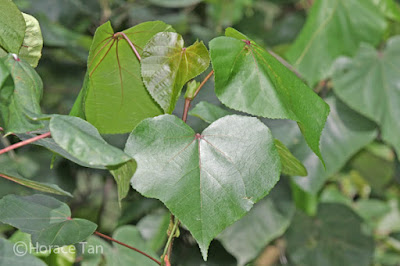
Local host plant #3: Sea Hibiscus.

Local host plant #4: Guioa pleuropteris.
The eggs are laid singly on leaves, stems or young shoots of the host plants. Each egg is about 0.8mm in diameter, white in color with a greenish tinge when freshly laid. It is dome-shaped with a depressed micropylar at the pole, sporting a reticulated pattern of intersecting ridges with large indentations on the surface.

Two views of an egg of the Common Tit

Left: a mature egg with the young making its first nibbles at the shell.
Right: empty egg shell.
It takes about 3 days for the egg to hatch. The pale yellowish brown newly hatched has a length of about 1.4mm and has an obscure dark lateral band on each side of the body. It has a woodlouse appearance with a large pro-thoracic shield in the same coloration as the body ground colour. The body also features rather long, black, dorso-lateral and whitish, lateral setae (hair). The head is yellowish brown. The newly hatched shows no interest in devouring the remnant of the egg shell after its emergence, and moves straight away to nibble on the leaf lamina in its vicinity. As it grows, the body color becomes more yellowish and the dorso-lateral bands become reddish brown. These bands appear to join at the posterior and anterior end. A thin, reddish, dorsal line also appears at this stage.
1st instar caterpillar, newly hatched, length: 1.5mm

1st instar caterpillars. Top: length: 2mm; Bottom: 2.5mm, in dormant mode prior to its moult.
After about 2 days of growth in the first instar, and reaching a length of about 2.6-2.7mm, the caterpillar moults to the next instar. Unlike many other butterfly species, the newly moulted does not eat the exuvia. The 2nd instar caterpillar has short fine lateral setae and numerous very short and fine hairs all over the body surface. It is mostly yellowish green with the same reddish lateral and dorsal bands seen in the L1 stage. Even at this early stage, the dorsal nectary organ is discernible on the dorsum of the 7th abdominal segment.
Two views of a 2nd instar caterpillar, early in this stage, length: 2.4mm..
Two views of a 2nd instar caterpillar, length: 3.3mm.

Two early instar caterpillars of the Common Tit attended by Weaver Ants on the back of leaf of the Sea Hibiscus.The 2nd instar caterpillar reaches a length of about 4.5-4.7mm, and after about 2 days in this stage, it moults again. The yellowish green 3rd instar caterpillar has a more striking appearance with the dorso-lateral red bands now outlined in white and there is now a reddish brown, white-crowned anal patch, extending from the dorsal nectary organ to the anterior end. The peripheral edge of the body becomes more prominently whitish as growth progresses in this isntar. The 3rd instar takes about 2 days to complete with the body length reaching about 8.7mm.
Two views of a 3rd instar caterpillar, early in this stage, length: 4.3mm

Two views of a 3rd instar caterpillar, late in this stage, length: 8.3mm.
The 4th instar resembles the late 3rd instar caterpillar closely with the body ground color in pale to lime green. The broad dorsal band, flanked by the dorso-lateral white-red bands, is edged with reddish brown strips, and has a thin, central intermittent red line. In some specimens, the reddish dorso-lateral band becomes less well defined by infusing white patches. The 4th instar takes about 2 days to complete with the body length reaching 13.5-14mm.

Top: Late 3rd instar caterpillar, dormant prior to its moult.
Bottom: A newly moulted 4th instar caterpillar.
Two views of a 4th instar caterpillar, late in this stage, length: 14mm

Another newly moulted 4th instar caterpillar next to its exuvia.
The 5th instar caterpillar has similar but more striking markings especially in the reddish brown to orangy brown dorso-lateral bands. These bands, unlike in the earlier instars, do not extend into the prothoracic segment. In some specimens, there are noticeably much greater infusion of white in the dorso-lateral bands.
Two views of a 5th instar caterpillar, late in this stage, length:: 21mm

Two views of anoter 5th instar caterpillar, late in this stage, length:: 21mm. Note the greater extent of change to white in the dorso-lateral bands.
After about 4 days of feeding and reaching a length of about 22mm, the caterpillar actually stops food intake for about 1 day. During this time, its body gradually shortened and decolorised to shades of green. At the end of this period, typically the caterpillar chooses a spot on the leaf underside as its pupation site.

Weaver ants attending to a 5th instar caterpillar on a leaf of Cleorodendrum inerme.
The pre-pupa caterpillar prepares for pupation by spinning a silk girdle and a silk pad to which it attaches itself via its anal claspers. After 1 day as a pre-pupa, pupation takes place. The pupa is predominantly pale green and has numerous small dark green speckles. Pupal length: 13-14.5mm. The pupa has a typical but stout Lycaenid shape.
Two views of a pre-pupa of the Common Tit lying (immobile).

Two views of a pupa of the Common Tit.Even at the pupal stage, at least for the initial few days of this stage, a little slit on the dorsum of the 7th abdominal segment has been found to exude fluid droplets. This is likely the remnant or continuation of the dorsal nectary organ of the larval stage.

Close-up views of the posterior end of a pupa, showing the remnant (inset) of the dorsal nectary organ still exuding fluid.
Five days later, the pupa turns rather dark, first in the wing pad and thorax, then progressively in the abdomen. The extent of the blue patches in the wing pads gives an early indication of the gender of the soon-to-emerge adult. The next day, the pupal stage comes to an end with the emergence of the adult butterfly.

Two views of a mature pupa of the Common Tit.

A newly eclosed Common Tit, still in the midst of wing expansion.
Genus: Hypolycaena C & R Felder, 1862
Species: erylus Godart, 1824
Subspecies: teatus Fruhstorfer, 1912
Wingspan of Adult Butterfly: 27-32mm
Caterpillar Local Host Plants: Clerodendrum inerme (Lamiaceae, common name: Wild Jasmine, Sorcerers Bush), Saraca thaipingensis (Fabaceae, common name: Yellow Saraca); Talipariti tiliaceum (Malvaceae, common name: Sea Hibiscus); Ixora javanica (Rubiaceae); Guioa pleuropteris (Sapindaceae).

A male Common Tit, note the forewings which are more pointed.

A male Common Tit sunbathing on a leaf perch, showing off its upperside.
Physical Description of Adult Butterfly:
Above, the male is deep purple with a circular black brand on the forewing centering roughly at cell-end; the female is dull brown with a dark brown post-discal line on both fore- and hindwings, and has two large, marginal, black, white-crowned spots at spaces 1b and 2. Underneath, both sexes are pale grey, darker in the male than in the female, and have a cell-end bar and a narrow orange post-discal line on both fore- and hindwings. The forewing termen is shaded in orange and this orange shading is more extensive and extend up to the post-discal area. The hindwing has a prominent, orange-crowned tornal black in space 2 and a smaller one on the lobe. There are two white-tipped tails at ends of veins 1b and 2, with the longer one at vein 1b. The upperside of the abdomen is colored as per wing upperside, but the underside is mostly white and black banded. The legs are also white and black-banded.

A female Common Tit sunbathing on a leaf perch.

A female Common Tit .
Field Observations of Butterfly Behaviour:
This species is not uncommon in Singapore and can be found in multiple habitats, ranging from the mangrove habitats in Sungei Buloh Wetland Reserve, Pasir Ris Park to Central Catchment Reserve, the Southern Ridges, and various urban gardens. Adults have been observed to visit flowers, puddling on roadside seepage and sunbathing with open-wings.

Another Common Tit perching on a leaf.

Another male Common Tit.
Early Stages:
The Common Tit is polyphagous as its early stages feed on a number of host plants from different families. At Sungei Buloh Wetland Reserve, caterpillars of Common Tit have been found on leaves of Sea Hibiscus and Cleorodendrum inerme which are both common there. In the wild, the caterpillars are typically found in the company of the 'Weaver Ant' or Kerengga (Oecophylla smaragdina). Young to middle-aged leaves of various hosts are utilized by the caterpillars.

Local host plant #1: Cleorodendrum inerme.

Local host plant #2: Yellow Saraca. The caterpillars feed on the young leaves shown in the right panel.

Local host plant #3: Sea Hibiscus.

Local host plant #4: Guioa pleuropteris.
The eggs are laid singly on leaves, stems or young shoots of the host plants. Each egg is about 0.8mm in diameter, white in color with a greenish tinge when freshly laid. It is dome-shaped with a depressed micropylar at the pole, sporting a reticulated pattern of intersecting ridges with large indentations on the surface.

Two views of an egg of the Common Tit

Left: a mature egg with the young making its first nibbles at the shell.
Right: empty egg shell.
It takes about 3 days for the egg to hatch. The pale yellowish brown newly hatched has a length of about 1.4mm and has an obscure dark lateral band on each side of the body. It has a woodlouse appearance with a large pro-thoracic shield in the same coloration as the body ground colour. The body also features rather long, black, dorso-lateral and whitish, lateral setae (hair). The head is yellowish brown. The newly hatched shows no interest in devouring the remnant of the egg shell after its emergence, and moves straight away to nibble on the leaf lamina in its vicinity. As it grows, the body color becomes more yellowish and the dorso-lateral bands become reddish brown. These bands appear to join at the posterior and anterior end. A thin, reddish, dorsal line also appears at this stage.

1st instar caterpillar, newly hatched, length: 1.5mm

1st instar caterpillars. Top: length: 2mm; Bottom: 2.5mm, in dormant mode prior to its moult.
After about 2 days of growth in the first instar, and reaching a length of about 2.6-2.7mm, the caterpillar moults to the next instar. Unlike many other butterfly species, the newly moulted does not eat the exuvia. The 2nd instar caterpillar has short fine lateral setae and numerous very short and fine hairs all over the body surface. It is mostly yellowish green with the same reddish lateral and dorsal bands seen in the L1 stage. Even at this early stage, the dorsal nectary organ is discernible on the dorsum of the 7th abdominal segment.

Two views of a 2nd instar caterpillar, early in this stage, length: 2.4mm..

Two views of a 2nd instar caterpillar, length: 3.3mm.

Two early instar caterpillars of the Common Tit attended by Weaver Ants on the back of leaf of the Sea Hibiscus.The 2nd instar caterpillar reaches a length of about 4.5-4.7mm, and after about 2 days in this stage, it moults again. The yellowish green 3rd instar caterpillar has a more striking appearance with the dorso-lateral red bands now outlined in white and there is now a reddish brown, white-crowned anal patch, extending from the dorsal nectary organ to the anterior end. The peripheral edge of the body becomes more prominently whitish as growth progresses in this isntar. The 3rd instar takes about 2 days to complete with the body length reaching about 8.7mm.

Two views of a 3rd instar caterpillar, early in this stage, length: 4.3mm

Two views of a 3rd instar caterpillar, late in this stage, length: 8.3mm.
The 4th instar resembles the late 3rd instar caterpillar closely with the body ground color in pale to lime green. The broad dorsal band, flanked by the dorso-lateral white-red bands, is edged with reddish brown strips, and has a thin, central intermittent red line. In some specimens, the reddish dorso-lateral band becomes less well defined by infusing white patches. The 4th instar takes about 2 days to complete with the body length reaching 13.5-14mm.

Top: Late 3rd instar caterpillar, dormant prior to its moult.
Bottom: A newly moulted 4th instar caterpillar.

Two views of a 4th instar caterpillar, late in this stage, length: 14mm
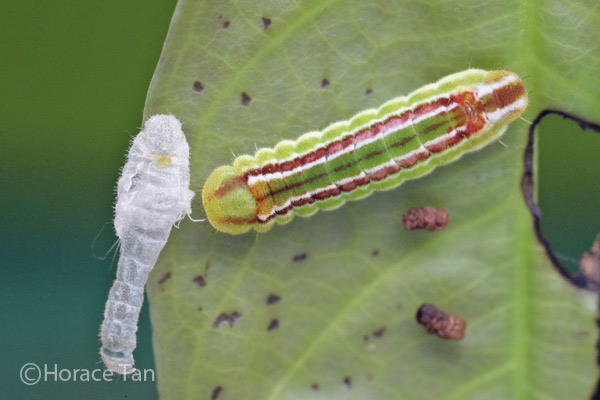
Another newly moulted 4th instar caterpillar next to its exuvia.
The 5th instar caterpillar has similar but more striking markings especially in the reddish brown to orangy brown dorso-lateral bands. These bands, unlike in the earlier instars, do not extend into the prothoracic segment. In some specimens, there are noticeably much greater infusion of white in the dorso-lateral bands.

Two views of a 5th instar caterpillar, late in this stage, length:: 21mm

Two views of anoter 5th instar caterpillar, late in this stage, length:: 21mm. Note the greater extent of change to white in the dorso-lateral bands.
After about 4 days of feeding and reaching a length of about 22mm, the caterpillar actually stops food intake for about 1 day. During this time, its body gradually shortened and decolorised to shades of green. At the end of this period, typically the caterpillar chooses a spot on the leaf underside as its pupation site.

Weaver ants attending to a 5th instar caterpillar on a leaf of Cleorodendrum inerme.
The pre-pupa caterpillar prepares for pupation by spinning a silk girdle and a silk pad to which it attaches itself via its anal claspers. After 1 day as a pre-pupa, pupation takes place. The pupa is predominantly pale green and has numerous small dark green speckles. Pupal length: 13-14.5mm. The pupa has a typical but stout Lycaenid shape.

Two views of a pre-pupa of the Common Tit lying (immobile).

Two views of a pupa of the Common Tit.Even at the pupal stage, at least for the initial few days of this stage, a little slit on the dorsum of the 7th abdominal segment has been found to exude fluid droplets. This is likely the remnant or continuation of the dorsal nectary organ of the larval stage.

Close-up views of the posterior end of a pupa, showing the remnant (inset) of the dorsal nectary organ still exuding fluid.
Five days later, the pupa turns rather dark, first in the wing pad and thorax, then progressively in the abdomen. The extent of the blue patches in the wing pads gives an early indication of the gender of the soon-to-emerge adult. The next day, the pupal stage comes to an end with the emergence of the adult butterfly.
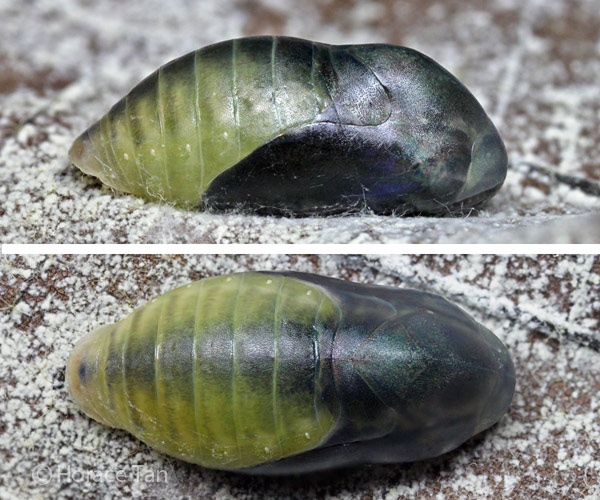
Two views of a mature pupa of the Common Tit.

A newly eclosed Common Tit, still in the midst of wing expansion.

A newly eclosed female Common Tit.
References:
- [C&P4] The Butterflies of The Malay Peninsula, A.S. Corbet and H.M. Pendlebury, 4th Edition, The Malayan Nature Society.
- Butterflies of Thailand, Pisuth Ek-Amnuay, 1st Edition, 2006
Text by Horace Tan, Photos by James Chia, Sunny Chir and Horace Tan


