Friday, December 17, 2010

Butterfly of the Month - December 2010

Butterfly of the Month - December 2010
Painted Jezebel (Delias hyparete metarete)


Almost in the blink of an eye, the year 2010 is nearly over. It has been an eventful year for ButterflyCircle, as our online group grows from strength to strength with more new members joining and the standard of butterfly photography reaching new heights. The year saw some new additions to the Singapore checklist, as well as many valuable discoveries on the early stages of various species recorded meticulously by our ever-diligent cat farmer, Horace Tan.


The crowning achievement of the year was the launch of the Field Guide to the Butterflies of Singapore, which saw the combined photographic efforts of nearly 40 members of ButterflyCircle come to fruition in a single book.


As we are only a week before Christmas 2010, we in ButterflyCircle would like to take this opportunity to thank our members and readers for being with us all these years. In these turbulent times of global financial crises and terrorists in all shapes and sizes, it is a time to reflect and be thankful for what we've got and to be with our loved ones.


Our butterfly of the month for December 2010 is the intrepid Painted Jezebel. A common urban butterfly, the species appears all over the island, often seen flying restlessly at treetop levels, coming down only to feed on flowering plants or to rest after a long day of flying.


The species displays aposematic colouration i.e. warning colouration that advertises the butterfly's distastefulness to would-be predators. The species belongs to the genus Delias of the Pieridae family, which features some of the most colourful and attractive butterflies in the world. For more information on the genus Delias, do visit the website of one of ButterflyCircle's members, Leslie Day, at the Delias of the World.


It is interesting that the English common name of the butterfly takes reference from biblical origins. Historically, Queen Jezebel was the wife of King Ahab of Israel in the mid-ninth century BCE. A Phoenician by birth, Queen Jezebel claimed her place on the throne of Israel and solidified a prosperous trade alliance between Israel and Tyre.


Queen Jezebel's story was tragic, however, as it ended with her murder where she was thrown out of her palace window and her corpse eaten by dogs.


In modern times, the name Jezebel has rather uncomplimentary connotations. It has come to be associated with women who are sexually agressive, promiscuous, wicked, manipulative and controlling. Such phrases as "painted Jezebel" refer to the scene in 2 Kings 9, in which the vain, elderly queen paints her eyes and does her hair just before being thrown to her death. In some contemporary views, her dressing in finery and putting on makeup before her execution led to the association of the use of cosmetics with "painted women" or prostitutes.


With that little bit of history, we now come back to focus on our little butterfly, which probably does not know (nor care!) much about its rather dubious pedigree. The Painted Jezebel flutters nonchalantly amongst the treetops, never making any attempts to conceal itself as its predominantly white wings can be seen clearly from afar.


The Painted Jezebel occurs commonly throughout Singapore and is seen in urban areas as well as within forested reserves. It usually flies at treetop level, frolicking amongst the canopies of tall trees. Its restless flight is interrupted only when it descends to feed at flowering shrubs or to rest in the shaded understorey of the forests towards the later part of the day.


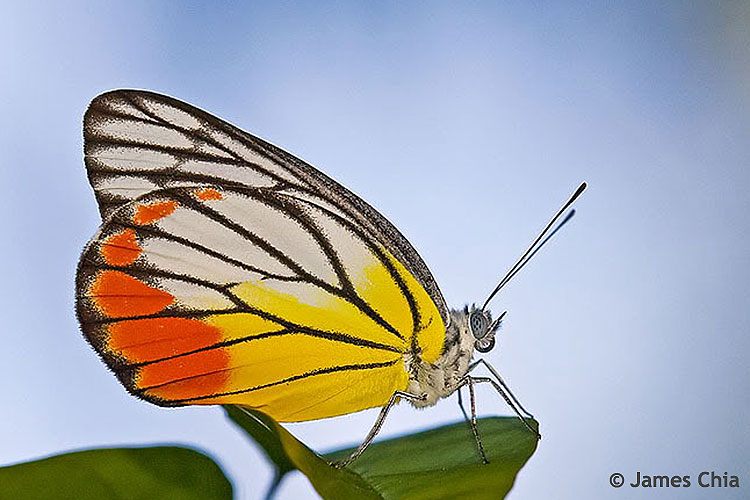
The wings of the Painted Jezebel are white above, with the veins prominently black-dusted in the outer areas. The female is more heavily dusted with black, more so on the upperside than the underside, than the male - appearing almost dark grey when in flight. The basal half of the underside of the hindwing is bright yellow with a bright red marginal border and crossed with the contrasting black veins, giving it an attractive and colourful appearance.

Two male Painted Jezebels competing for a single female

One can often observe the courtship dance between males and females of the species. Often, more than one male (I have see up to four!) can be seen in pursuit of a female Painted Jezebel.

Painted Jezebel caterpillar trio... singing Silent Night this Christmas?

The caterpillars of the Painted Jezebel feed on the plant Dendrophthoe pentandra, a parasite that grows on the branches of other trees and plants. The caterpillars are equally colourful and prominent, and feed gregariously amongst the leaves of its host plant. As the seeds of this plant are usually spread by birds, the plant itself can often be seen growing amongst the treetops 3-4 storeys above ground amongst the lofty canopies of large trees.


It has been a good year for butterflies, and we look forward to 2011 with great anticipation for more discoveries and new knowledge to share with the nature community in Singapore and the rest of the world.


As the countdown to Christmas 2010 and the new year 2011 approaches, on behalf of ButterflyCircle, we would like to wish everyone.....


* * * A Happy and Peaceful Christmas !!! * * *

Text by Khew SK : Photos by James Chia, Sunny Chir, Federick Ho, Khew SK, Henry Koh, Bobby Mun, Benedict Tay, Tan Ben Jin, Tan Tze Siong & Anthony Wong

Saturday, December 11, 2010

Life History of the Dark Caerulean

Life History of the Dark Caerulean (Jamides bochus nabonassar)


Butterfly Biodata:
Genus: Jamides Hübner , 1819
Species: bochus Stoll, 1782
Sub-species: nabonassar, Fruhstorfer, 1916
Wingspan of Adult Butterfly: 30mm
Caterpillar Local Host Plants:
Pueraria phaseoloides (Leguminosae); Derris trifoliata (Leguminosae); Crotalaria mucronata (Leguminosae); Pongamia pinnata (Leguminosae).


A female Dark Caerulean "tip-toeing" on a leaf tip in a wasteland.


A male Dark Caerulean perching on a leaf.

Physical Description of Adult Butterfly:
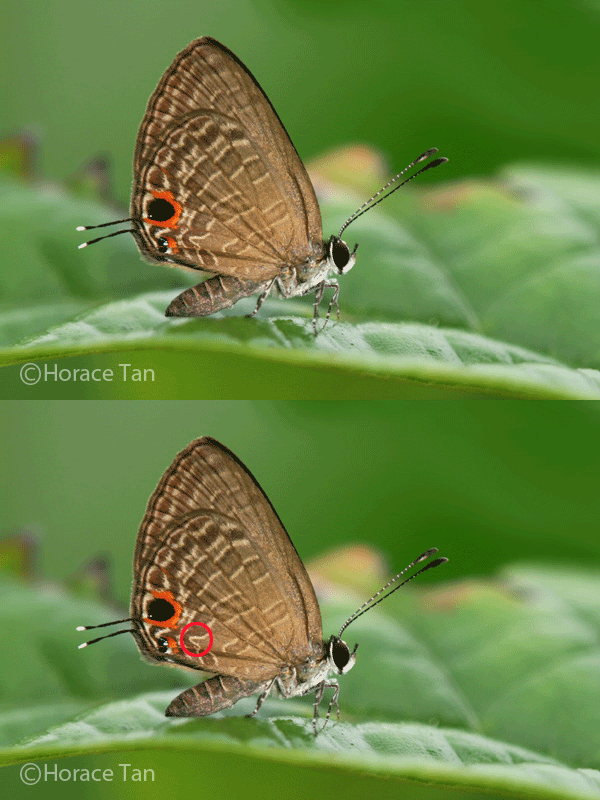
Above, the male is dark metallic blue above on both wings, and the female is paler blue with prominent marginal spots on the hindwings. Both sexes have broad black borders on both wings (narrower in the hindwings) reaching into the upper portion of the cell. Underneath, the wings are ochreous-brown and marked with buff striae. The comma-like marking in space 1b on the hindwing is narrow and rather indistinct (marked with a flashing red circle in the picture above this section). Each hindwing features a black-centred orange-crowned tornal spot and a white-tipped filamentous tail at the end of vein 2.


A male Dark Caerulean giving us a partial view of its metallic blue patch on the upperside.


A male Dark Caerulean caught perching on a twig.

Field Observations of Butterfly Behaviour:
This species is not uncommon in Singapore but its distribution is rather localized and restricted to places where its host plants are growing. At times, a fair number of the adults can occur together at certain locations. They are relatively small for a Jamides species, and have a rapid and active flight, unlike most of the other species of the genus. The males give an attention-grabbing metallic blue flash when fly past an observer. The adults can be found in open wastelands, mangrove areas and the fringes of various nature reserves.


A Dark Caerulean visiting flowers of Pueraria phaseoloides.


Another Dark Caerulean on a leaf perch.

Early Stages:
All four recorded local host plants are from the Leguminosae family and feature relating large inflorescences which serve as food sources for the early stages of the Dark Caerulean. A newly hatched caterpillar will bore into a flower bud and proceed to eat the flower parts lying within. Subsequent instars continue to do so until they are too large to feed within the bud. Moulting also takes place within the confine of the flower buds/flowers. For this reason, only the larger final instar caterpillars are readily observed on inflorescences of the host plants.


Host plant : Pueraria phaseoloides. Inflorescences are shown.


Host plant : Pongamia pinnata. Relatively young leaves are shown.


Host plant : Crotalaria mucronata. A close-up view of the flowers is given in the right panel.


A mating pair of the Dark Caerulean.

Eggs of the Dark Caerulean are laid in a rather unique manner with the females seeking out tightly spaced flower buds and then laying eggs in the space between the buds. If such tight spaces are not available, the eggs are laid in the space between the pedicel (flower stalk) and the peduncle (main supporting stalk of the inflorescence). The eggs are laid in a small group enclosed in a gelatinous substance.


A female Dark Caerulean laying eggs on flower buds of Pueraria phaseoloides.


A female Dark Caerulean laying eggs on flower buds of Pongamia pinnata .


Dark Caerulean mothers laying eggs on flower buds of Derris trifoliata (left) and Crotalaria mucronata (right)

The small pale green egg is discoid in shape and about 0.4-0.5mm in diameter. The surface is covered with a reticulated pattern of intersecting ridges.


Eggs of the Dark laid between buds on an inflorescence of Pueraria phaseoloides.


An egg of the Dark Caerulean laid between a pedicel and the peduncle of an inflorescence of Pongamia pinnata.

The egg takes 2 days to hatch. The young caterpillar emerges after nibbling away sufficiently large portion of the egg shell and eating its way out of the dried gelatinous substance. Measured at a length of about 0.8-0.9mm, its pale yellow body is cylindrical in shape, sporting long fine setae (hairs) dorso-laterally and laterally. It has a black head capsule, a broad and a greyish to black prothoracic shield and a greyish anal plate.


Two views of a newly hatched caterpillar, length: 0.8mm.

The newly hatched moves to a nearby flower bud and begins the laborious task of boring into it. It then stays within the flower bud for the goodies within. After about 1.5 days of growth and reaching a length of about 1.8-2mm, the caterpillar moults to the next instar, typically within the same first flower bud it bored into earlier.


A 1st instar caterpillar, later in this stage, length: 1.5mm.

The 2nd instar caterpillar has numerous short setae, each with a black base. The body ground color is yellow, but the body surface is predominantly red on the lateral fringe, and to a lesser extent on the dorsum. The diamond-shaped prothoracic shield has become pitch-black in color and the head capsule yellowish brown. This instar lasts about 2 days with the body length reaches up to 3.5mm.


Two views of a 2nd instar caterpillar, early in this stage, length: 1.7mm.


A far view of the previous picture showing the 2nd instar caterpillar boring into a flower bud of Pongamia pinnata.


Two views of a 2nd instar caterpillar, late in this stage, length: 2.8mm.

The 3rd instar caterpillar resembles the 2nd instar caterpillar closely in having numerous short and fine setae all over the body, and the same reddish brown body coloration. Both the dorsal nectary organ (on the 7th abdominal segment) and tentacular organs (on the 8th abdominal segment) are barely discernible.
The 3rd instar takes 2-3 days to complete with the body length reaching about 6.5mm.


Two views of a 3rd instar caterpillars, newly moulted, length: .3mm.


Two views of a 3rd instar caterpillar, length: 4.5mm.


A 3rd instar caterpillar boring into a flower bud of Pongamia pinnata.

Still covered with numerous fine setae on the body surface, the 4th (and final) instar caterpillar has taken on a darker shade of yellowish to reddish brown. The dorsal nectary organ is now more easily observed as a paler elliptical patch on the 7th abdominal segment. The whitish tentacular organs are short but everted rather frequently . Another noticeable change is in the diamond shaped prothoracic shield becoming less prominent with its color changed to yellowish brown.


Two views of a 4th instar caterpillar, length: 6mm.


A 4th instar caterpillar feeding on a flower bud of Derris trifoliata.


Two views of a 4th instar caterpillar, length: 10mm.

After about 4 days of growth and reaching a maximum length of around 11mm in the final instar, the body of the caterpillar gradually shrinks, and finally takes on a dark pinkish to reddish brown coloration. Most bred specimens chose to enter their pre-pupatory phase in tight pockets of space within leaf litter, sometimes in groups of 2 to 3. A handful chose to do so within flower buds which are sufficiently large to house the matuer caterpillar. At the chosen spot, the caterpillar readies itself for pupation by spinning a silk girdle and a silk pad. The caterpillar secures itself to the silk pad via claspers on its posterior end.


Two views of a pre-pupa of the Dark Caerulean.

Pupation takes place after one day of the pre-pupal stage. The pupa has the typical lycaenid shape. It is pale pinkish to beige in base color with a number brown and black specks. of various sizes. The pupa has a length of about 8.5-9.5mm.


Two views of a pupa of the Dark Caerulean, length: 9mm

Eclosion takes place after 6 days in the pupal stage. The mature pupa gradually darkens in colour the day before. Bluish patches on forewing uppersides become clearly visible in the wing pads of the mature pupa.


Two views of a mature pupa of a male Dark Caerulean.


A newly eclosed male Dark Caerulean

References:
  • The Butterflies of The Malay Peninsula, A.S. Corbet and H.M. Pendlebury, 4th Edition, The Malayan Nature Society.
  • A Photographic Monograph on Hong Kong Butterflies, Volume 2, Hong Kong Lepidopterists' Society.
  • Butterflies of Thailand, Pisuth Ek-Amnuay, 1st Edition, 2006
Text by Horace Tan; Photos by Sunny Chir, Khew SK and Horace Tan

Friday, December 3, 2010

ButterflyCircle makes it to AsiaMag

ButterflyCircle Makes it to AsiaMag
Winged Rajahs, Colonels and Dukes


A feature article earlier posted on this blog made it to the online magazine, AsiaMag recently. AsiaMag (theasiamag.com, or asia!), is an online and mobile platform for Asian bloggers and other writers. asia! is published by Tusitala Pte Ltd, which is part of the Potato Productions group based in Singapore.


AsiaMag's aim is for asia! to be a place where people can get a feel for what ordinary Asians are thinking, saying and doing; a glimpse of the Asia that lies beyond the news headlines. The editors scour the web for fresh thinking and good writing about what’s going on in Asia. They look for interesting or entertaining perspectives on issues both big and small, and ask bloggers and writers to contribute their posts or to collaborate with AsiaMag in one or another way.

The article, which was originally titled "Origins of Some Common Names of Butterflies", caught the eye of one of the editors, Ms Clarissa Tan, and she approached me to feature the article in AsiaMag.


The article is by no means exhaustive nor authoritative, but my own theory of how the common English names of butterflies could have possibly originated. It was an article that was meant to prompt some thought and discussion on how common names of butterflies came to be and my postulations of how some of these names could have originated in this part of the world.


The article can be found under the "Patterns" tab in the online magazine and is titled "Winged Rajahs, Colonels and Dukes".

A reader also made an observation on the post, saying "Actually, what is really curious about this (re: colonial science) is the way recent historiography has pointed out the imperialist motivations underlying such scientific endeavours-- in the early days of the raj it was as the writer points out, alot of individuals who for their own interest pursued these hobbies -- 'gentlemanly science' as it is called; but as you go further on into the 1800s, science in general was seen as way of rationalising india and the rest of the empire into governable spheres of knowledge, and in so doing create what Foucault later called 'governmentality'. see David Arnold and Gyan Prakash. Fascinating."

Many thanks to Ms Clarissa Tan for giving ButterflyCircle the honour of featuring an article on AsiaMag!

Text by Khew SK ; Screen captures from AsiaMag online