Saturday, October 16, 2010

Life History of the Common Banded Awl

Life History of the Common Banded Awl (Hasora chromus chromus)


Butterfly Biodata:
Genus: Hasora Moore, 1881
Species: chromus Cramer, 1780
Subspecies: chromus Cramer, 1780
Wingspan of Adult Butterfly: 45mm
Caterpillar Host Plants: Pongamia pinnata (Leguminosae).


A male Common Banded Awl perching on a leaf.


A male Common Banded Awl perching on the underside of a branch.

Physical Description of Adult Butterfly:
Adults are rather large in size with pointed forewing apex and markedly lobate hindwings. Above, the wings are dark brown. In the male, the wings are unmarked while the female has two pale yellowish crescentic spots in spaces 2 and 3 on the forewing. The male has a discal stigma on the forewing. Below, both sexes are pale purplish brown. On the hindwing, there is a prominent and narrow white to bluish white discal band partitioning the wing into an inner and an outer half. The inner edge of the band is more sharply defined compared to the outer edge. In contrast, the discal band on the forewing is faint and extends only over the upper portion of the wing. The female has two apical spots in spaces 6 and 7 of the forewing with the one in space 7 absent from some specimens.


Close-up views of the light brown and purplish scales of a female Common Banded Awl.


A male Common Banded Awl perching on the underside of a leaf.


A male Common Banded Awl perching on the underside of a grass blade.

Field Observations of Butterfly Behaviour:
This species is uncommon in Singapore. There is a better chance of finding larval stages of this species on its host plant, Pongamia pinnata, than seeing the adults up close. The fast flying adults have been observed to visit flowers for nectar. When resting, the adults typically do so on the underside of a leaf or other plant parts.


A female Common Banded Awl visiting flowers.


A female Common Banded Awl perching on a stem.

Early Stages:
The local host plant, Pongamia pinnata, is a tree which can grow up to 6-15m tall. Its compound leaf has 5-7 leaflets in a pinna. Each leaflet is thin leathery, shiny reddish brown when young, and turn darker green when matured. It is listed as "Endangered" in the latest Singapore Red Data book, and at present can be found locally in small numbers in parks and along side walks in certain built-up areas. The caterpillars of the Common Banded Awl feed on young to middle-aged leaves of this plant.


Host plant : Pongamia pinnata. Relatively young leaves are shown.

The eggs are laid singly or in small groups of 2-3 on young shoots of the host plants. Each egg is initially white and shaped like a bun with a flattened base (diameter: 0.4-0.5mm). Prominent ridges running from the pole to the base. The micropylar sits atop at the pole. The entire egg turns pinky red as it develops, and then decolorizes again when the caterpillar is ready to emerge.


Two views of a `fresh' egg of the Common Banded Awl.


Two views of a maturing egg of the Common Banded Awl.


Two views of a mature egg of the Common Banded Awl with the larval head vaguely visible.


Two views of empty egg shells of the Common Banded Awl.

It takes 2-3 days for the collected egg to hatch. The young caterpillar eats just enough of the shell to emerge, and has a length of about 2mm. It has the typical cylindrical shape for skipper caterpillars, and the yellowish brown body has a number of short setae. The large head is black, slightly bi-lobed and lightly hairy. The dorsum of the prothorax carries a dark-colored patch/shield.


Two views of a 1st instar caterpillar, early in this stage, length: 1.8mm.


Two views of a 1st instar caterpillar, late in this stage, length: 2.6mm.

The young caterpillar constructs its first leaf shelter by bringing two halves of a small young leaf together with silk threads. It rests within the flap and ventures out to eat on nearby leaf surface. In later instars, the Common Banded Awl caterpillars also construct leaf shelters in a similar fashion but do so with larger and older leaves. The larval growth of the Common Banded Awl is rapid in pace for all five of its instars, with all but the final instar lasting only 1-1.5 days.


1st instar caterpillar, late in this stage, dormant before its moult, length: 3.2mm.

After reaching a length of about 3.2mm in the 1st instar, the caterpillar moults to the next instar after a short dormant period. The 2nd instar caterpillar has four faint whitish narrow dorsal bands and one lateral band which are barely visible against the pale yellowish body ground color. These bands become more prominent as the body ground colour turn pale brownish towards the end of this instar. The body and the head capsule are also covered in short fine setae.


Two views of a 2nd instar caterpillar, early in this stage, length: 3.3mm.


2nd instar caterpillar, late in this stage, length: 5mm.


2nd instar caterpillar, late L2, dormant before its moult, length:5.5mm.

The 2nd instar caterpillar reaches a length of about 5.5mm, and after 2 days in this stage, it moults again. The 3rd instar caterpillar resembles the 2nd instar caterpillar but with more prominent dorsal and lateral whitish bands due to the much darker brown in its ground colour. Overall the body takes on a freckled appearance with numerous tiny lighter patches dotting the dark brown surface. A narrow anal plate dark brown to black in color, can now be seen on the posterior end. This instar lasts another 1-1.5 days with the length reaching 9mm.


Two views of a 3rd instar caterpillar, early in this stage, length: 6.5mm.


Two views of a 3rd instar caterpillar, prior to its moult, length: 9mm.


The 4th instar caterpillar resembles the 3rd instar caterpillar closely, but with its body ground colour in darker brown. The whitish setae on the head capsule are proportionately much longer than in earlier instars. This stage takes about 1-1.5 days to complete with the body length reaching 19mm.


Two views of a 4th instar caterpillar, early in this stage, length: 12.3mm.


Two views of a 4th instar caterpillar, late in this stage, length: 19mm.

The final and 5th instar caterpillar has similar body markings as the 4th instar caterpillar, though the ground colour has changed to a dark shade of purplish brown or even pinky brown above the lateral band. Several large dorso-lateral spots are also present here. Below the narrow lateral band, the body is in a contrasting yellowish brown. One unmistaken change is in the head capsule which has now become pale orangy brown. Moderately long white setae are found over the whole body and the head capsule. This stage takes about 3 days to complete with body length reaching up to 36mm.


A newly moulted 5th instar caterpillar eating its `old' larval skin.
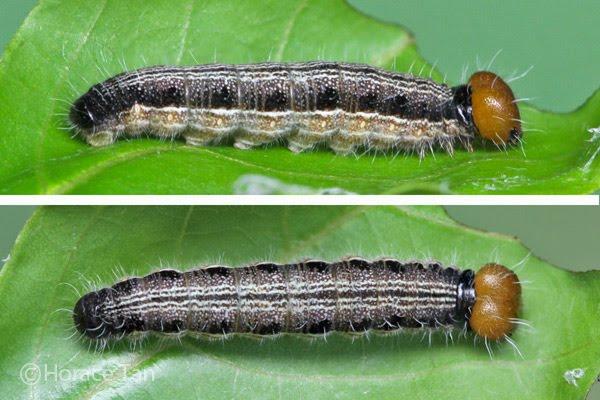

Two views of a 5th instar caterpillar, early in this stage, length: 19mm.


Two views of a 5th instar caterpillar, length: 26mm.

Towards the end of 5th instar, the body of the caterpillar gradually shrinks in length and decolorises. Some caterpillars would turn completely pale greenish whilst others retains several lateral dark spots. The fully grown caterpillar ceases feeding and stations itself in its leaf shelter and enters the preparatory pupa phase. During the early part of this stage, the caterpillar spins large quantity of silk threads to seal the pupation shelter, and in particular, constructs a silk girdle at its 2nd/3rd abdominal segment and a short transverse silk band near its posterior end. Both the dorsal point of the girdle and the transverse band are also secured by vertical/oblique threads to the inner wall of the shelter.


Two views of a 5th instar caterpillar, late in this stage, length:36mm.


Two views of a pre-pupa of the Common Banded Awl secured via silk girdle and anchor in its shelter.

After about 0.5-1 day of the pre-pupal phase, pupation takes place within the pupation shelter. The pupa secures itself with its cremaster attached to the transverse band. The pupa has a short thorax, a rather long abdomen and a short and pointed rostrum. Fresh after the pupation event, the body is greenish, but after 0.5 to 1 day, the body surface becomes mostly covered in a white substance. Length of pupae: 23-24mm.


Two views of a pupa of the Common Banded Awl with a coating of whitish powdery substance.

After 5-5.5 days, the pupa becomes darkened in color signaling the imminent emergence of the adult. The next day the adult butterfly emerges from the mature pupa.


Two views of a mature pupa of the Common Banded Awl


A newly eclosed male Common Banded Awl.

References:

  • The Butterflies of The Malay Peninsula, A.S. Corbet and H.M. Pendlebury, 4th Edition, The Malayan Nature Society.
  • Butterflies of Thailand, Pisuth Ek-Amnuay, 1st Edition, 2006
  • The Butterflies of Hong Kong, M. Bascombe, G. Johnston, F. Bascombe, Princeton University Pres 1999
Text by Horace Tan, Photos by Khew S K and Horace Tan

Sunday, October 3, 2010

Metamorphosis - the Birth of a New (Butterfly) Book

Metamorphosis - The Birth of a New Butterfly (Book)
10/10/10 : Launch of A Field Guide to the Butterflies of Singapore


The idea of coming out with a book on Singapore's butterflies stretched as far back as 2003. Then, the only book dedicated to Singapore's Flying Jewels was the Science Centre/BP Book that was authored by Steven Neo and published in 1996.


Back then, I was hoping that I could get one of the prominent publishing companies to financially back the book. That would leave me to concentrate on the task of writing and collecting photos for the book. Not surprisingly, the response that I got was rather lukewarm, to say the least, as no one thought that a book about Singapore's butterflies would have any commercial value nor interest.


So the idea for the book went on the backburner.


I made another attempt after that, even consulting the ever-energetic Ria Tan, a long-time friend who runs WildSingapore and the author of the Chek Jawa Guidebook, for advice. I also consulted Morten Strange of Nature's Niche, who authored and published a number of excellent bird books. But again, the initial effort fizzled out due to my own lack of time to focus on the book.


About three years ago, in 2007, after a few months of setting up this blog and penning many articles, I managed to gain the interest, and the offer of a personal sponsorship from a generous individual in Singapore.


This important catalyst sparked off renewed effort on the book again, and it has been three long years. I had to balance my work which required a lot of my energy and time to deal issues attributed to another untimely global recession, with working on the book. That left me with little spare time to conceptualise the book, its design, do literature research, write and collect the photos for as many species as possible.


Hence, many of my weekends were spent out in the field, taking photos of species that were still unavailable, and also writing and researching for the book.


I am very thankful that many ButterflyCircle members came forward readily to offer their excellent photographs to add more quality and completeness to the book. Particularly for the photos of species that I did not have a good shot of.


Special mention has to be made of BC members like Sunny Chir, who probably contributed the most photographs amongst the BC members, and also friends like Horace Tan, Leslie Day, Steven Neo, Marcus Ng, Ellen Tan, Teo Kiam Pheng and my wife, Shirley, who helped and meticulously vetted the drafts for the write ups for grammatical correctness and technical accuracy. (And I must say that there were plenty of mistakes in the early drafts!).


The full list of ButterflyCircle members is featured in the acknowledgement pages of the book. And I must sincerely thank each and every individual who contributed their work, that your photos have added so much quality and colour to the book. You have every reason to be proud of what you and ButterflyCircle have achieved over the years.


So the work continued over the period of three years, as BC members also raised their quality of butterfly photography, and the pages began to fill up with photos that will eventually grace the final book.


Researching and deciding what to put in the book took some effort, as the intention was to feature the book to as wide an audience as possible without too much scientific jargon. But at the same time, make the book as accurate as possible to the expert community.


A shot of the photoplate machine, which generates the master plate used in the printing process

There were many changes and amendments, and this is where I have to thank the publisher, Ink On Paper Communications Pte Ltd, a small Singaporean boutique set-up, for their help and patience with this first-time author! The design and layout was conceptualised by the young and very capable layout artist, Cressindie Tan, and ably advised by Kalyn Choi and Alicia Tan (the lady boss!). They even went on an outing with BC members to get the feel of what we do out in the field, shooting butts!


A peek at a stack of the finished 16-page sheet after which the pages are machine-cut and bound

It was almost a year ago that I'd set the goal of launching the book on 10 Oct 2010, that is, 10/10/10, an interesting date. It is also apt that this book is launched in the United Nations' International Year of Biodiversity 2010, as a contribution to biodiversity education and conservation, and in particular, to Singapore.


A view of the CMYB 4-colour printer used in the production of the book

It has been a tiring, but rewarding experience, putting this book together. The past few weeks have been a flurry of vetting, amending, inserting new photos, more vetting and proof-reading and changes! The final finishing touches to the digital files, and then more colour-proofing at the printers. It was also amazing to see the printing technology that we have today, as the lithographic and book-binding processes are now so technologically advanced and fast!


Colour-proofing process of the printed sheets and tweaking the colours digitally

My publisher even went the extra mile to ensure that a dummy copy of a fully-bound book sample was made to check the binding strength of the spine and to ensure that the pages do not fall out easily through frequent use of the book.


A "blind" copy of the bound book to check the robustness of the binding and spine sewing. The Trees of Our Garden City book, which is the same size and thickness, is shown for comparison

All that remains now, is to wait for the "butterfly" to eclose. The pupa shell is now transparent, and we can see the colours of the "wings" of this new butterfly, all set for its maiden flight. For the privileged few who have been invited to the launch this coming Sunday, let's celebrate the eclosion process together!


The Field Guide will be 370-page soft-cover A5 sized book featuring a total of 904 photographs.


Text by Khew SK : Photos (all of which will be featured in the forthcoming book) by James Chia, Sunny Chir, Chng CK, Khew SK, Nelson Ong, Jonathan Soong, Horace Tan & Zhuang Yaoyang

Friday, October 1, 2010

Origin of Some Common Names of Butterflies

Origin of Common Names of Butterflies
Nymphalidae : Some English Common Names

A Commander having a meal at the Officers' Mess!

The study and the naming convention of butterflies date back several centuries, to the 18th century naturalist Carolus Linnaeus (Carl von Linne). Linnaeus pioneered the binominal and trinominal taxonomic naming convention in classic work Systema Naturae - a catalog of all the names of known animals and plants.

A Cruiser anchored in harbour

In 1758 came the 10th edition of Systema Naturae, which is usually regarded as the starting point for the biological classification of animals by family, genus and species. As more and more amateur hobbyists picked up collecting butterflies, and the general layman began to appreciate nature's flying jewels around them, the widespread use of English common names became more prevalent.

An Archduke surveys over his domain

The English common name given to butterflies, however, is always a subject for debate, as these names are coined by amateurs and layman enthusiasts. The well-meaning intention is to give an easier and less daunting name for the general public which they can appreciate and endear themselves to. The downside of this is that we often end up with different common names for the same species across different countries, causing confusion. Hence although English Common Names are ideal for the general enthusiasts, scientific names should always remain at the core of butterfly identification.

A Dot-Dash Sergeant alert!

How then, did these English Common Names start? In the Asian region, where amateur collectors spent their time amassing large collections of insects, amongst which butterflies were undoubtedly a favourite, many of these collectors were British, and particularly from the military. Renown collectors who described new species and wrote articles and books on butterflies in the Indian subcontinent and Malaysia & Singapore were either from the military or were civilians working in the region who were interned during the Japanese occupation during World War II.

Amongst some of these collectors who were military men were :
  • Brigadier William Harry Evans - a British officer who spent most of his commission in India
  • Lt Col John Eliot - the 'guru' who revised the 4th edition of the definitive book about butterflies of the Malay Peninsula by Corbet & Pendlebury
  • Captain M K Godfrey
  • Captain Stackhouse Pinwill
  • Major J M Kerr
  • Lieutenant A M Goodrich
  • Lieutenant H Roberts
Others, who were in the service of British companies in East India and the far east, were :

  • Alexander Steven Corbet, a soil chemist and bacteriologist with the Rubber Research Institute of Malaya
  • H Maurice Pendlebury, Director of Museums, Federated Malay States, and who was interned at Changi Prison during the war
  • W A Fleming, a Scotsman who worked for a London-based rubber company and who was also interned during the war.
  • R Morrell, who was also interned at Changi during the war
A Colonel with two Sergeants in attendance. Left : Colour Sergeant, Right : Malay Staff Sergeant

It is therefore understandable that many of the English common names of butterflies were coined after British origins. In the first category, we have, obviously, the military titles and ranks - old world and new! For the butterflies in Singapore we have the Commander, the various Sergeants, Knight, Colonel, Lascars and Sailors.

A platoon of Lascars - clockwise from top left : Malayan, Perak, Burmese and Common Lascars

Whilst some of these ranks are clearly recognised, I had to do a bit of research into the origins of some others. The Lascar, for example is an Indian sailor, army servant, or artilleryman. Interesting, because some of the British collectors were indeed militarymen stationed in India, where they would have come across such titles.


Ahoy! the Navy - Sailors and a Yeoman. Top to Bottom : Chocolate Sailor, Banded Yeoman & Short Banded Sailor

Amongst the definitions of the Yeoman, was this : a naval petty officer who performs clerical duties. The Sailors, too, generated some debate, as there are some quarters who believe that the common name should be "Sailers" - which originate from the way the Neptis species "sails" in flight. Of course, given the family of names of the armed forces, it could well be possible that there was every intention to call these species "Sailors" instead, so that the officers of the British Navy could also be recognised, and the butterflies named for posterity. And finally of course, we have to salute the Indian Red Admiral. as the highest ranking officer in the navy.


An Admiral and his Cruiser?

Another possible military association for a butterfly name is the Cruiser. Amongst the definition is : a large fast moderately armored and gunned warship.

Said the Viscount to the Duke "Where are the ladies?" Top : Malay Viscount Bottom : Purple Duke

In another category of common names, would be titles from Peerage - a system of titles in the UK, representing the upper ranks of British nobility and aristocracy. Peers are of five ranks in descending order of heirarchy :
  • Duke
  • Marquess (or Marquis)
  • Earl
  • Viscount
  • Baron


Aristrocratic gentry : Clockwise from top left : Baron, Green Baron, Horsfield's Baron, Malay Baron and White-Tipped Baron

The title Archduke may be the odd one out, as it is an aristocratic title that originates from the European countries. And for the Nawab (or Nabob) the definition would be : a provincial governor of the Mogul empire in India. Another from Indian origin, would be the Rajah : the bearer of a title of nobility among the Hindus


In the world of Archdukes and Nawabs : Top : Yellow Archduke, Blue Nawab, Archduke, Black-Tipped Archduke and Plain Nawab.

So now we postulate some of the possible origins behind some of the English common names behind these butterflies, and why these early collectors may have coined these names for our beloved winged beauties!

Text by Khew SK : Photos by Sunny Chir, Khew SK, Koh Cher Hern, Neo Chee Beng, Horace Tan, Tan Ben Jin, Anthony Wong & Mark Wong